John Wesley — "The best of all is, God is with us."
The best of all is, God is with us.
The best of all is, God is with us.
Click any product to generate a realistic preview. Up to 3 at a time.
* Initial load can take up to 90 seconds — revising the preview in another color is nearly instant.
"I desire no other epitaph, than 'Here lies the friend of all, and the enemy of none.'"
"We have nothing to do but to save souls."
"Preach not doctrines, but Christ."
"I should be glad if I could spend my whole life in reading and writing."
"I have not time to be busy."
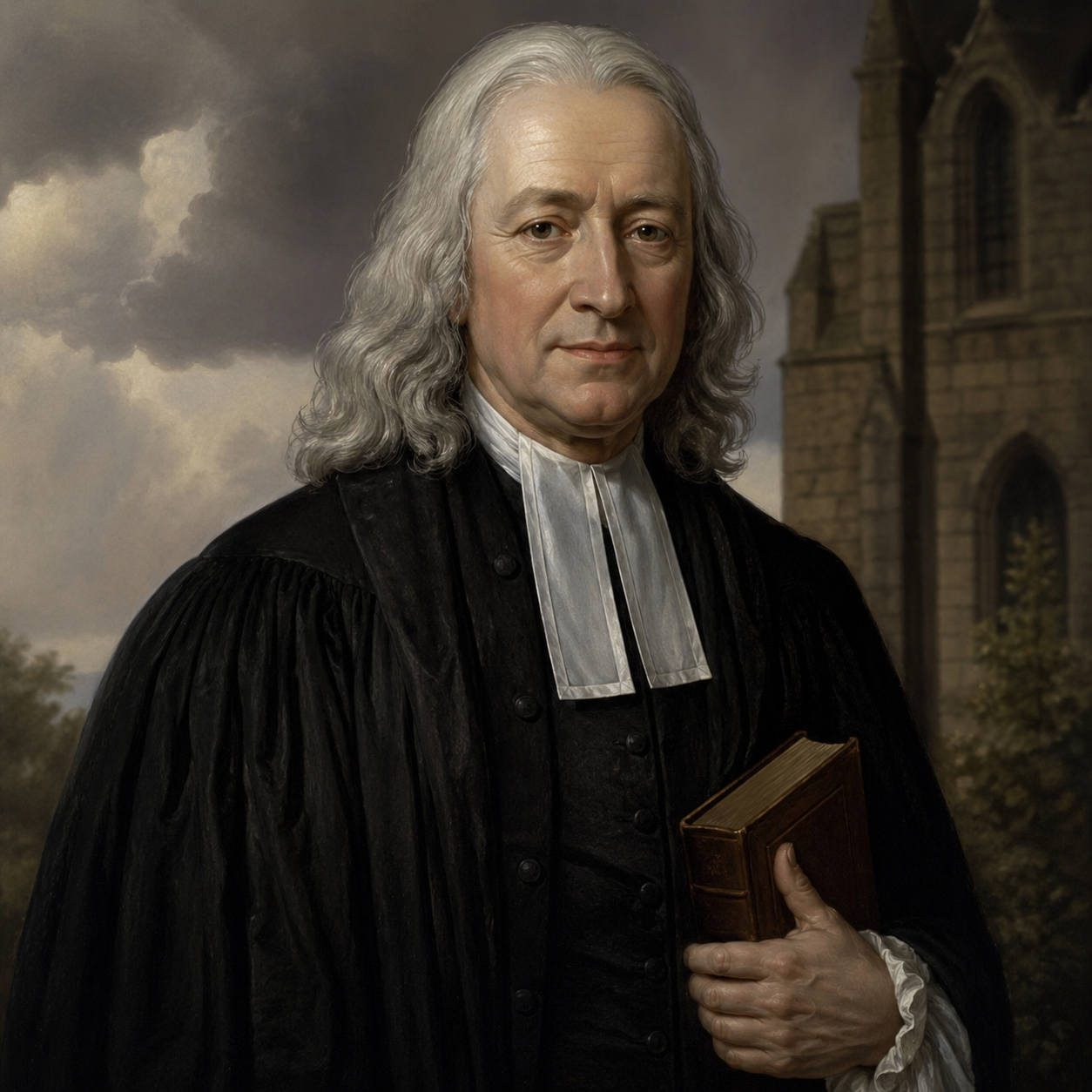
English Anglican cleric and founder of Methodism, whose open-air preaching and class-meeting structure created the largest 18th-century evangelical revival. Closely associated with Charles Wesley (his hymn-writing brother) and George Whitefield (early co-revivalist, later doctrinal opponent). For an intellectual contrast, see George Whitefield, Calvinist evangelical revivalist — Whitefield's predestinarian Calvinism vs Wesley's free-grace Arminian theology split the early Methodist movement permanently in the 1739-41 break. The founding evangelical Calvinist-Arminian schism — the two parallel evangelical traditions American Christianity descends from.
Found in 1 providers: grok
1 source checked
This quote declares that divine presence—God being 'with us'—supersedes every hardship, uncertainty, or loss. No external condition, however dire, can strip away what matters most: the companionship of the divine. In modern language, it means the one irreplaceable thing that can never be taken from you is ultimately the most valuable possession you have. Everything temporal and material is secondary to that foundational truth.
Wesley reportedly spoke these words on his deathbed in March 1791, making them his literal final testament. They crystallize a life of radical trust: he rode over 250,000 miles preaching to the poor and outcast, endured mob violence, failed relationships, and rejection by the Church of England—yet never wavered. His entire Methodist movement was built on this conviction: direct, personal, felt access to God, not mediated through institution or hierarchy.
The 18th century saw the Enlightenment erode traditional religious certainty, replacing faith with reason and empiricism. Simultaneously, early industrialization uprooted rural communities and created mass urban poverty. Wesley preached directly to England's dispossessed miners and factory workers, for whom the institutional Church of England was inaccessible and indifferent. His assurance that God was personally present—not distant or clergy-filtered—was revolutionary and emotionally electrifying against this backdrop of displacement, doubt, and social upheaval.
AI-generated insights based on extensive research and information for context. Factual errors? Email [email protected].
Your cart is empty