Alexander Fleming — "I was just a dirty old man who left his dishes unwashed."
I was just a dirty old man who left his dishes unwashed.
I was just a dirty old man who left his dishes unwashed.
Click any product to generate a realistic preview. Up to 3 at a time.
* Initial load can take up to 90 seconds — revising the preview in another color is nearly instant.
"I never thought of myself as a great man, just a man who made a great discovery."
"It is not often that one finds a substance that is both highly bactericidal and non-toxic to animal tissues."
"My work was not a flash of genius, but a gradual unfolding of facts."
"The greatest danger in the world is ignorance, and the greatest weapon is knowledge."
"I hope that my work will inspire others to pursue scientific discovery."
Found in 1 providers: deepseek
1 source checked
Fleming is downplaying his role in one of medicine's greatest discoveries by joking that he was simply messy. He's saying the breakthrough came not from genius or careful planning, but from leaving lab dishes dirty long enough for mold to grow. It's a humble admission that accident and untidiness, not heroic effort, produced penicillin, and that he was lucky enough to notice what the contamination revealed.
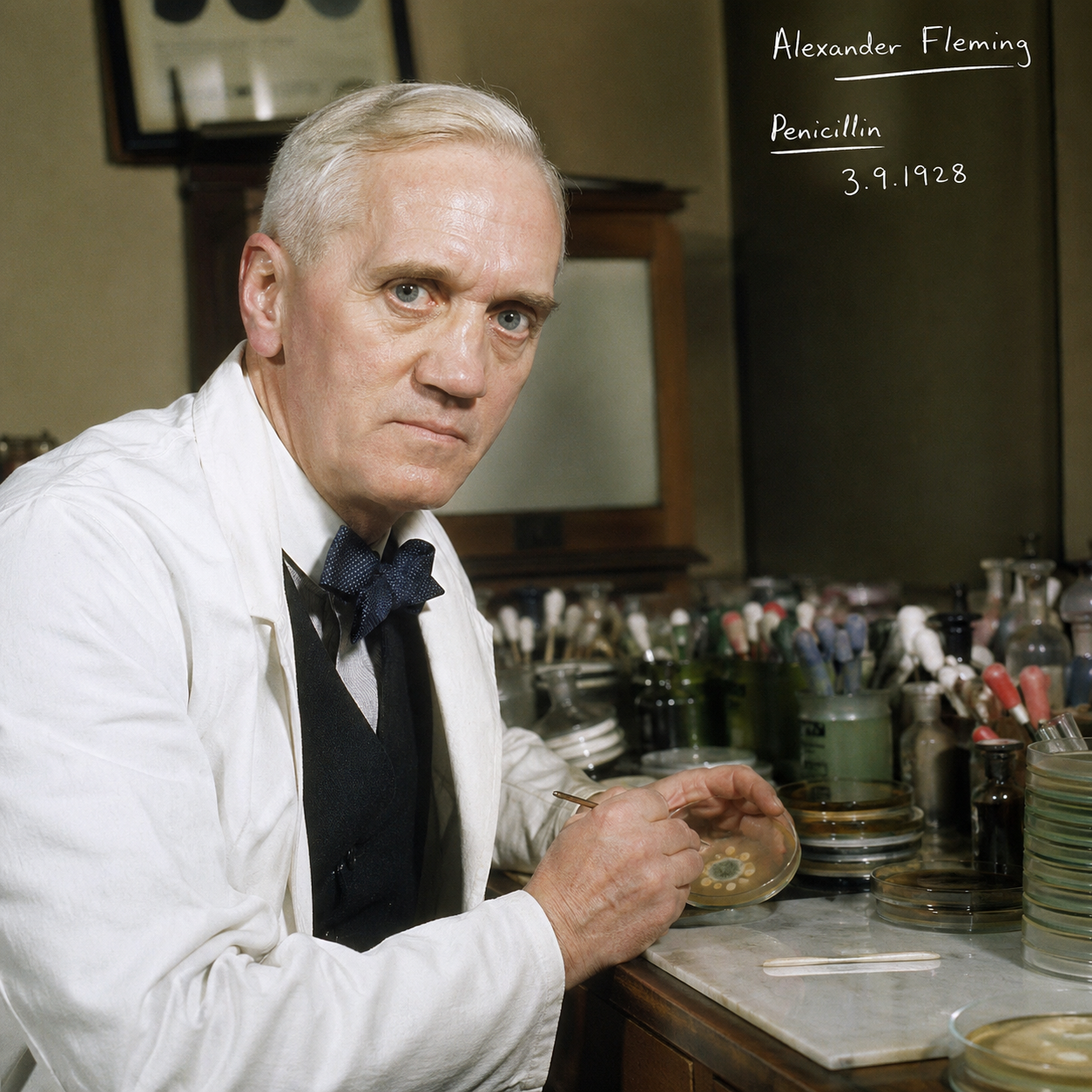
Fleming literally returned from a 1928 holiday to find a Petri dish of Staphylococcus contaminated by Penicillium mold, with bacteria dissolved around it. His cluttered St. Mary's lab bench was famously chaotic, and colleagues teased him about it. The self-deprecating quote fits his quiet, modest personality: he shared the 1945 Nobel Prize with Florey and Chain and consistently credited chance and observation rather than presenting himself as a singular genius.
In the 1920s, bacterial infections like pneumonia, sepsis, and wound infection routinely killed people; World War I had just shown how soldiers died more often from infected injuries than bullets. Antiseptics existed but no true antibiotics. Labs were modest, hand-run operations without sterile automation. Fleming's accidental 1928 discovery, scaled up by Florey and Chain in the 1940s, arrived in time to save countless World War II soldiers and launched the antibiotic era that reshaped modern medicine.
AI-generated insights based on extensive research and information for context. Factual errors? Email [email protected].
Your cart is empty