Euclid — "If equals be subtracted from equals, the remainders are equal."
If equals be subtracted from equals, the remainders are equal.
If equals be subtracted from equals, the remainders are equal.
Click any product to generate a realistic preview. Up to 3 at a time.
* Initial load can take up to 90 seconds — revising the preview in another color is nearly instant.
"An acute angle is an angle less than a right angle."
"A line is breadthless length."
"No trace of Euclid's personality has survived."
"The greatest of the parts is called the antecedent, and the less the consequent."
"A diameter of the circle is any straight line drawn through the center and terminated in both directions by the circumference of the circle, and such a straight line also bisects the circle."
Found in 3 providers: grok,deepseek,gemini
3 sources checked
Take two equal quantities and subtract the same value from each — the results will be equal. This axiom sounds obvious, but its power lies in making that obviousness explicit and usable in proof. It underpins how we balance equations, divide fairly, and reason about symmetry. Modern algebra treats this as elementary, but Euclid formalized it so every step in a geometric proof could be traced back to something undeniable.
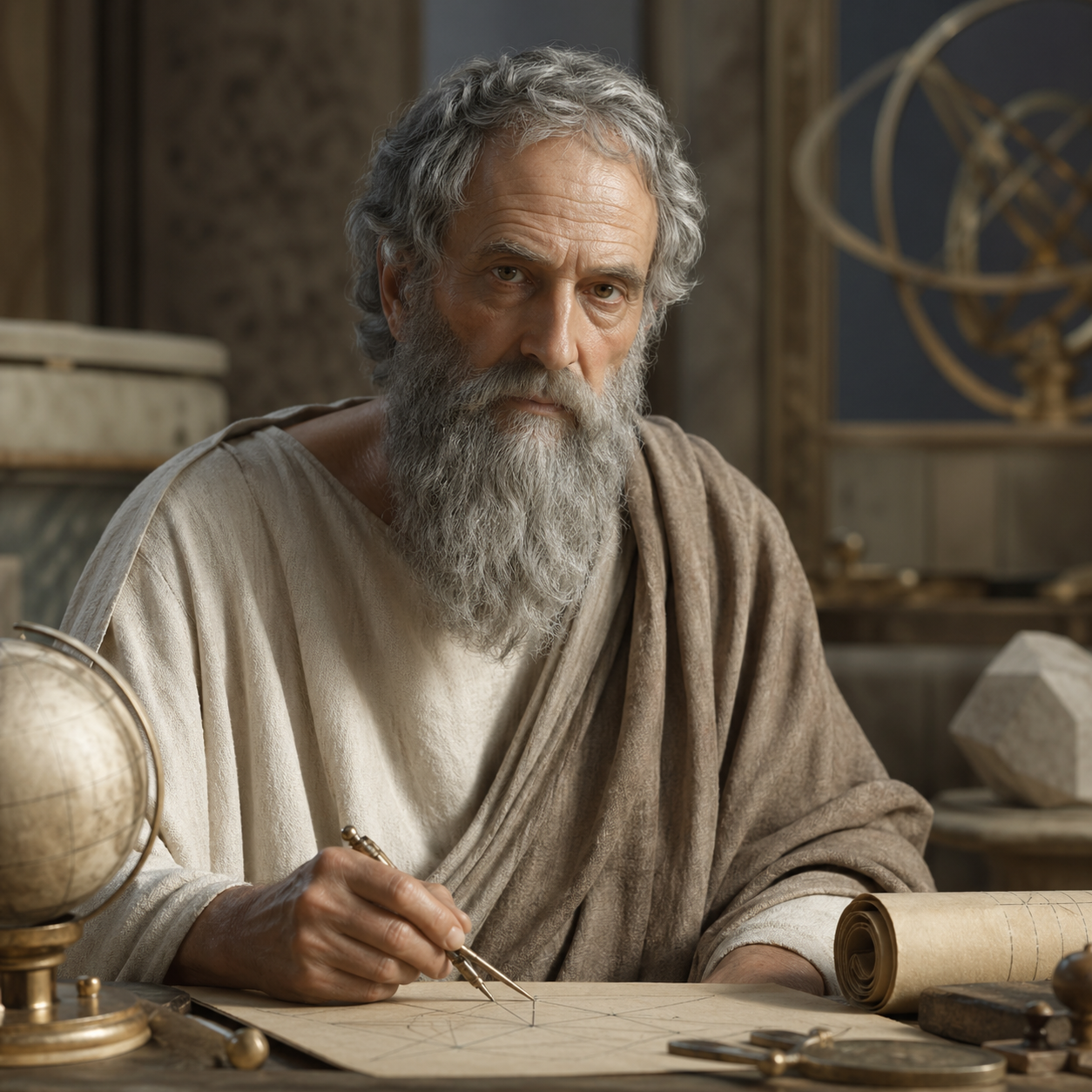
Euclid's Elements opens with definitions, postulates, and five common notions — this being the third. He believed mathematics had to be built from the ground up, with no step assumed without justification. This reflects his character as a rigorous systematizer rather than an inventor of flashy theorems. Ancient sources say he told Ptolemy I there was no royal road to geometry — the same insistence that even kings must earn truth through proof.
Around 300 BCE, Alexandria was the intellectual center of the Hellenistic world, its famous Library attracting scholars from across the Mediterranean. Greek thinkers were codifying knowledge systematically for the first time. Euclid's axioms responded to a real need: competing philosophical schools disputed nearly everything, so mathematics needed an agreed-upon foundation immune to argument. Establishing self-evident starting points meant geometry could transcend personal opinion and become universal, permanent knowledge.
AI-generated insights based on extensive research and information for context. Factual errors? Email [email protected].
Your cart is empty