Alexander Fleming — "It is not wise to be too dogmatic in science. One must always be prepared to cha…"
It is not wise to be too dogmatic in science. One must always be prepared to change one's mind.
It is not wise to be too dogmatic in science. One must always be prepared to change one's mind.
Click any product to generate a realistic preview. Up to 3 at a time.
* Initial load can take up to 90 seconds — revising the preview in another color is nearly instant.
"I am not a hero. I just happened to be in the right place at the right time."
"The unprepared mind cannot see the outstretched hand of opportunity."
"I am not an orator, but a simple bacteriologist."
"It is not an exaggeration to say that the discovery of penicillin has saved millions of lives."
"The public will not understand the dangers of using penicillin indiscriminately."
Found in 1 providers: grok
1 source checked
Rigid adherence to existing theories is an obstacle to discovery. Science demands staying open to evidence that contradicts current assumptions, revising conclusions when new data demands it. Intellectual flexibility is not weakness—it is the engine of progress. Certainty closes doors; curiosity keeps them open. Genuine scientific thinking requires the humility to admit error and update understanding, rather than defending a position simply because it was held first.
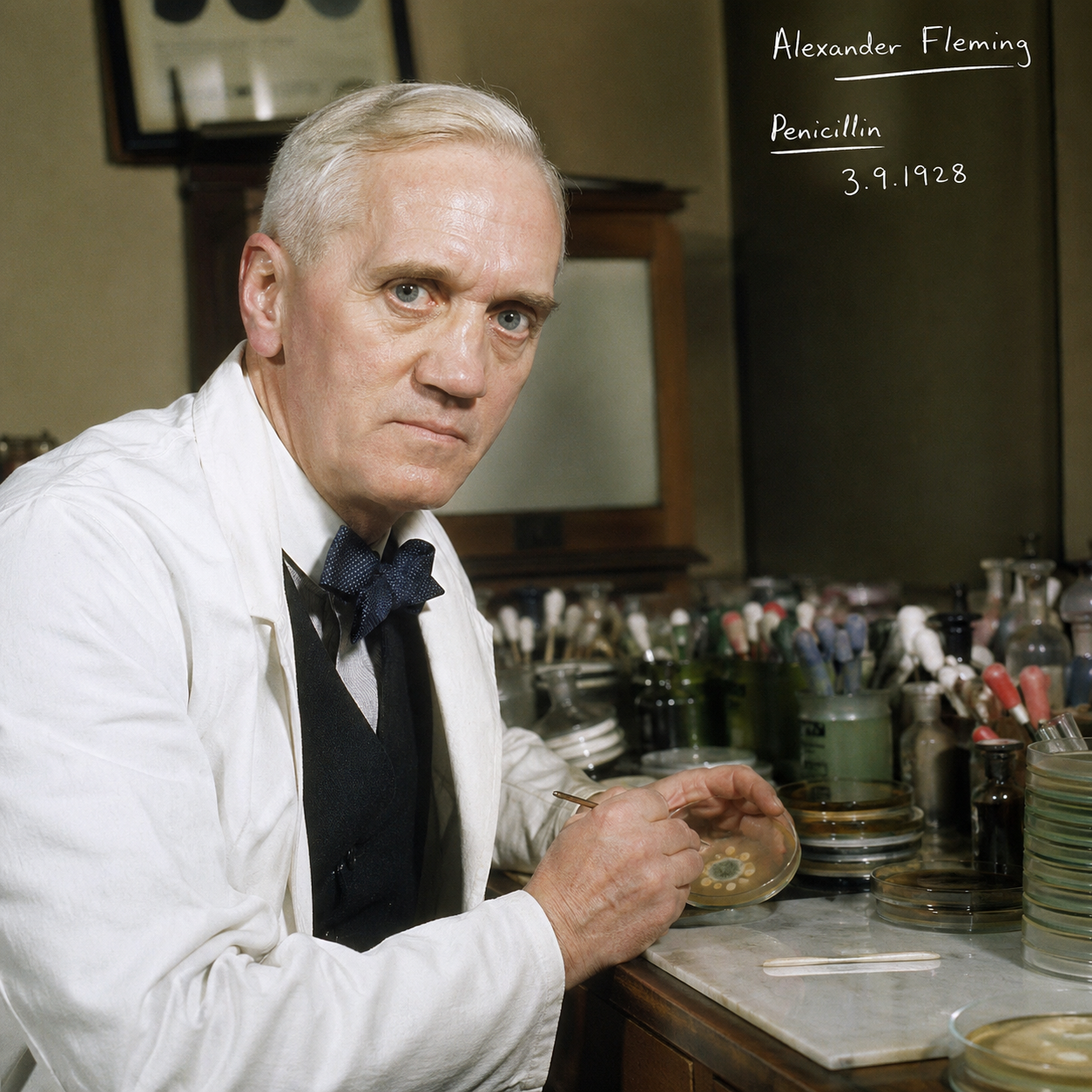
Fleming discovered penicillin in 1928 largely because he noticed something unexpected—a mold contaminating a petri dish had killed surrounding bacteria. A dogmatic scientist would have discarded the contaminated plate as ruined. Instead, Fleming paused, questioned what he saw, and followed the anomaly. His openness to unplanned observation changed medicine forever. His entire career demonstrated that rigid hypothesis-chasing would have caused him to miss one of the most consequential accidental discoveries in history.
In the early-to-mid 20th century, science was rapidly overturning Victorian certainties. Quantum mechanics dismantled Newtonian physics, Einstein rewrote gravity, and germ theory was still reshaping medicine. Yet institutional science remained deeply conservative, with established figures resisting new paradigms. Penicillin itself was initially dismissed and shelved for over a decade after Fleming's 1928 paper. Openness to revision was not assumed—it was a genuine intellectual virtue worth stating explicitly.
AI-generated insights based on extensive research and information for context. Factual errors? Email [email protected].
Your cart is empty