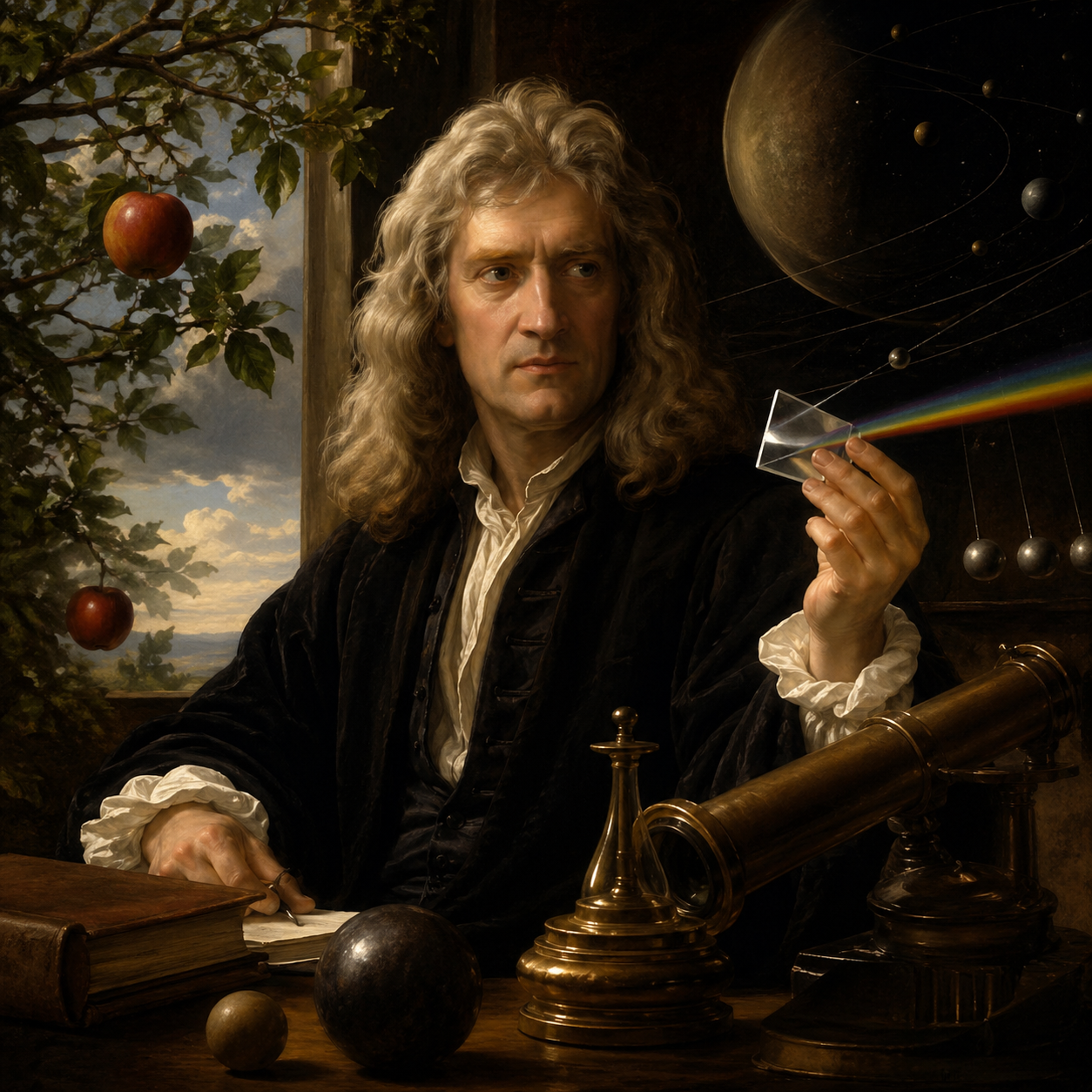
Isaac Newton — "The changing of bodies into light, and light into bodies, is very conformable to…"
The changing of bodies into light, and light into bodies, is very conformable to the course of Nature.
The changing of bodies into light, and light into bodies, is very conformable to the course of Nature.
Click any product to generate a realistic preview. Up to 3 at a time.
* Initial load can take up to 90 seconds — revising the preview in another color is nearly instant.
"For it is the property of true philosophy to deduce the causes of all natural effects from the simplest possible principles."
"The causes of gravity are not yet discovered. It is by experiments and observations that we are to know them."
"I do not define time, space, place, and motion, as being well known to all."
"What is it that induces a man to be a philosopher? It is not the love of truth, but the love of fame, or the love of novelty, or the love of power."
"Gravity explains the motions of the planets, but it cannot explain who sets the planets in motion."
Found in 1 providers: deepseek
1 source checked
Matter and light can transform into each other — and Newton considered this perfectly natural, consistent with how the universe works. In modern terms, it anticipates Einstein's E=mc², the principle that mass and energy are fundamentally equivalent. Newton saw the universe as operating through deep, unified principles, and this interconvertibility of light and physical substance was, to him, simply nature following its own elegant logic.
Newton devoted years to optics, famously splitting white light into the spectrum with a prism and writing Opticks in 1704 — the book this quote comes from. He also pursued alchemy obsessively and secretly, fixated on transforming matter. This quote bridges both passions: light as a physical phenomenon and the conversion of substances. His belief in nature's deep unity drove both pursuits, making matter-light interchange feel inevitable to him.
Newton lived during the Scientific Revolution, when natural philosophers were dismantling alchemical tradition and building modern chemistry and physics. The nature of light was fiercely debated — Newton championed the corpuscular theory that light consists of particles, making its interchangeability with matter plausible. Alchemy's long fixation on material transformation still pervaded intellectual life. This was an era when the boundary between matter and energy, solid and radiant, was genuinely open and philosophically contested.
AI-generated insights based on extensive research and information for context. Factual errors? Email [email protected].
Your cart is empty