Laozi — "The great square has no corners. The great vessel is never full. The great sound…"
The great square has no corners. The great vessel is never full. The great sound is inaudible. The great image has no form.
The great square has no corners. The great vessel is never full. The great sound is inaudible. The great image has no form.
Click any product to generate a realistic preview. Up to 3 at a time.
* Initial load can take up to 90 seconds — revising the preview in another color is nearly instant.
"By letting it go it all gets done. The world is won by those who let it go. But when you try and try. The world is beyond the winning."
"The more you prohibit, the more evil there will be."
"The Tao never does anything, yet through it all things are done."
"Governing a large country is like cooking a small fish. You spoil it with too much poking."
"The greatest villain is the one who tries to do good."
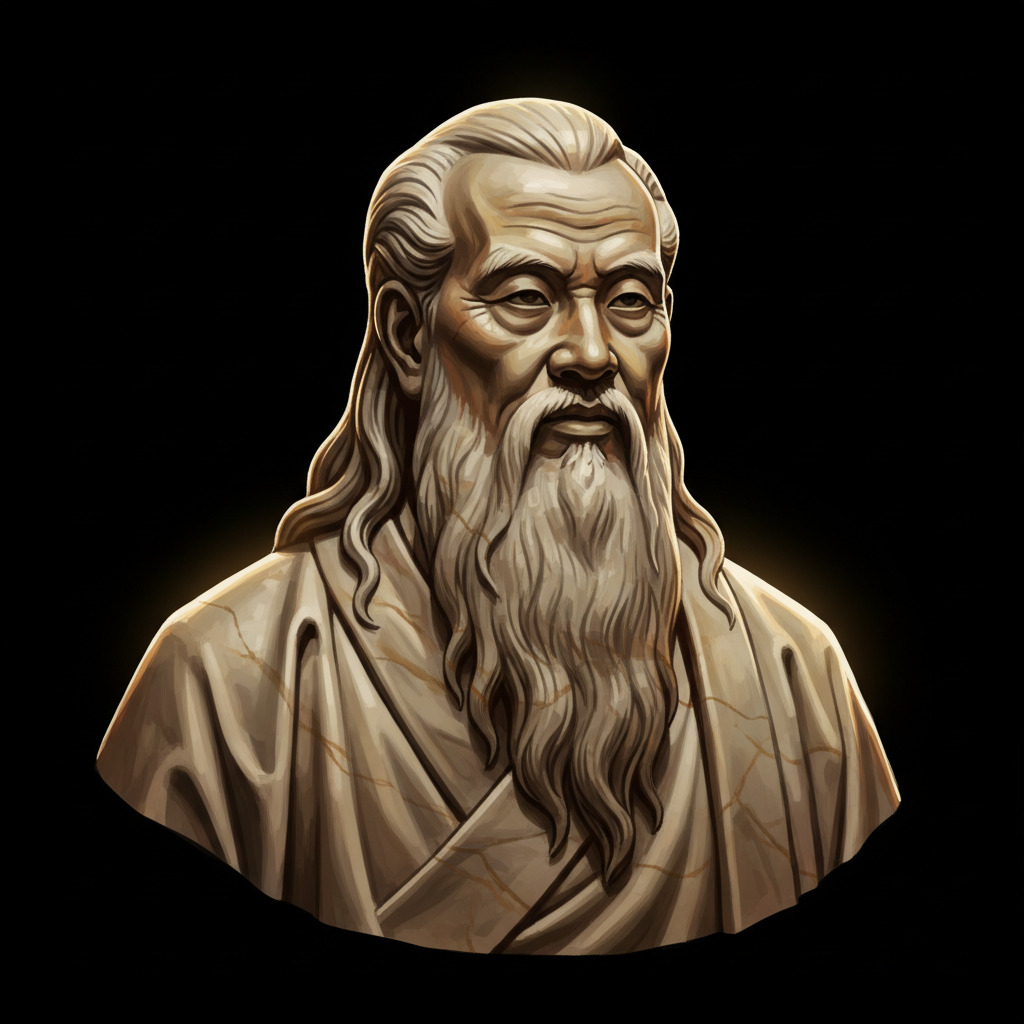
Reputed founder of Taoism and author of the Tao Te Ching, whose wu wei (effortless action) shaped East Asian philosophy. Closely associated with Zhuangzi (later Taoist who extended Laozi's framework). For an intellectual contrast, see Confucius, near-contemporary Chinese sage of social ritual and duty — Confucius systematized social order through ritual and hierarchy; Laozi argued that all such systems were the disease, not the cure — the two founding poles of Chinese moral philosophy.
Found in 1 providers: grok
1 source checked
True greatness transcends the limitations we normally associate with things. A perfect square is so vast its corners disappear. A perfect vessel cannot be filled because its capacity is infinite. A perfect sound operates beyond hearing. A perfect image has no fixed shape. Ultimate qualities escape definition because defining something requires drawing boundaries, and the greatest things have none.
Laozi built his entire philosophy around paradox and the inadequacy of fixed categories. As the legendary author of the Tao Te Ching, he taught that the Tao which can be named is not the eternal Tao. This passage reflects his core conviction that reality exceeds language, and that a sage recognizes greatness precisely by its refusal to fit human measurements, definitions, or visible boundaries.
Laozi lived during the turbulent Spring and Autumn period of ancient China, when rival states fought constantly and Confucian thinkers were codifying rigid social rituals and hierarchies. His paradoxes pushed back against that obsession with formal definitions, rank, and measurable virtue. In an era demanding clear rules and named roles, insisting that the greatest things have no edges was a radical challenge to the prevailing intellectual order.
AI-generated insights based on extensive research and information for context. Factual errors? Email [email protected].
Your cart is empty