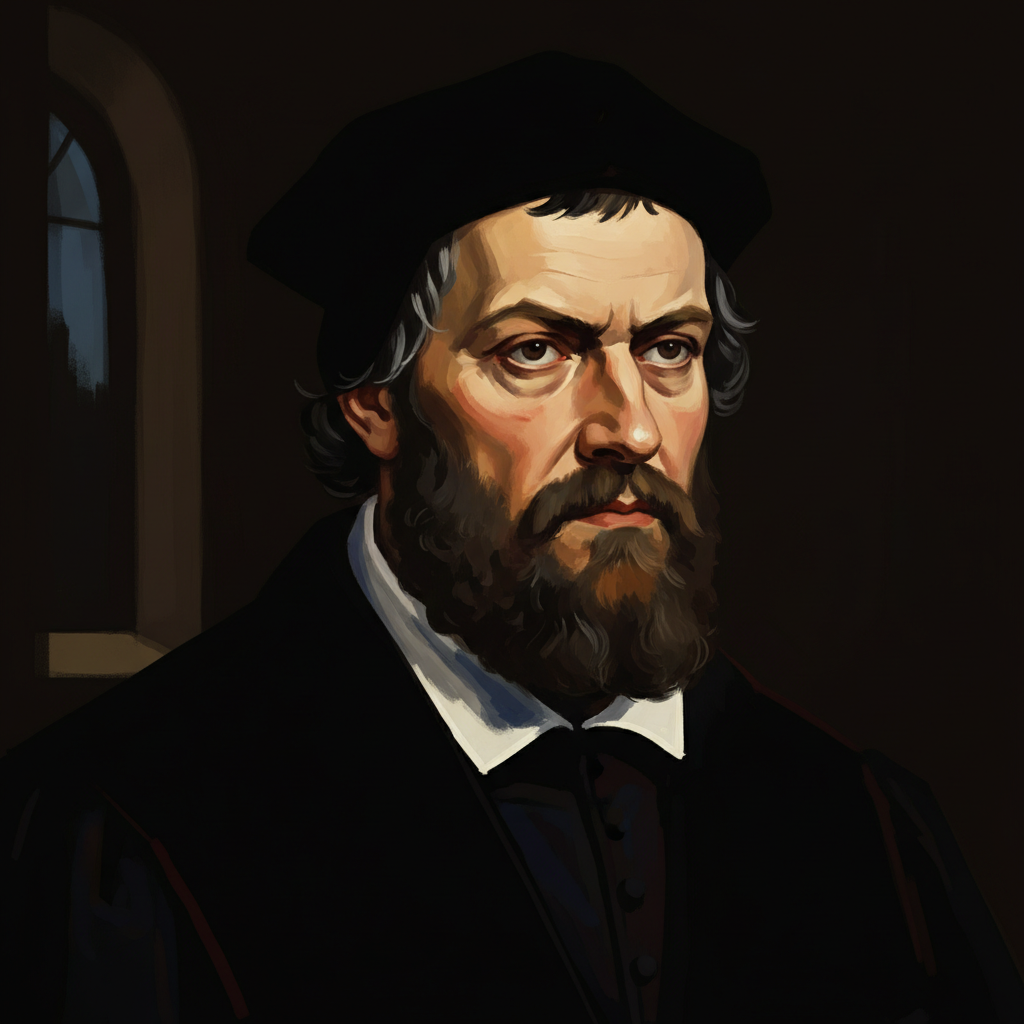
Martin Luther — "The greatest blessing of all is to have a wife who is pious, God-fearing, and do…"
The greatest blessing of all is to have a wife who is pious, God-fearing, and domestic.
The greatest blessing of all is to have a wife who is pious, God-fearing, and domestic.
Click any product to generate a realistic preview. Up to 3 at a time.
* Initial load can take up to 90 seconds — revising the preview in another color is nearly instant.
"Why should the Devil have all the good tunes?"
"I am much afraid that schools will prove to be great gates of hell unless they diligently labor in explaining the Holy Scriptures, engraving them in the hearts of youth. I advise no one to place his c…"
"A flail, an ax, a hoe, a spade be put into their hands so young, strong Jews and Jewesses could earn their bread in the sweat of their brow."
"Melanchthon is a miserable little worm of a man."
"I resist the devil, and often it is with a fart that I chase him away. When he tempts me with silly sins I say, 'Devil, yesterday I broke wind too. Have you written it down on your list?'"
German theologian whose 95 Theses (1517) launched the Protestant Reformation and broke the Catholic Church's monopoly on Western Christianity. Closely associated with Philipp Melanchthon (Lutheran systematizer) and John Calvin (later Reformer who built on Luther's break). For an intellectual contrast, see Pope Leo X, Renaissance pope (1513-1521) — Leo X's indulgence sales triggered Luther's break and Leo excommunicated him in 1521 — Luther's entire Reformation is structured as a direct answer to the indulgence-funded Vatican Leo represented.
Found in 1 providers: grok
1 source checked
A happy, faithful home life with a devoted spouse is the most valuable thing a person can have, outweighing wealth, status, or worldly achievement. The speaker ranks a supportive, religiously committed partner who manages the household well above every other earthly gift, framing marriage and domestic harmony as the true source of human flourishing rather than career success or public recognition.
Luther, a former monk, broke with centuries of Catholic teaching by marrying ex-nun Katharina von Bora in 1525, turning his home into a model Protestant parsonage. He credited Katie's piety and management of the Black Cloister with his stability during fierce theological battles. His writings repeatedly elevated marriage as a sacred calling, rejecting clerical celibacy and championing the Christian household as spiritually equal to monastic life.
In early-modern 16th-century Germany, celibate clergy were considered spiritually superior and marriage was a lesser state. The Reformation upended this, reframing family life as a holy vocation. Amid religious wars, plague outbreaks, and social upheaval, a stable, faith-centered household was both a theological statement against Rome and practical survival. Women ran complex domestic economies—brewing, gardening, childcare, hosting students—making a capable, devout wife genuinely foundational to a reformer's public work.
AI-generated insights based on extensive research and information for context. Factual errors? Email [email protected].
Your cart is empty