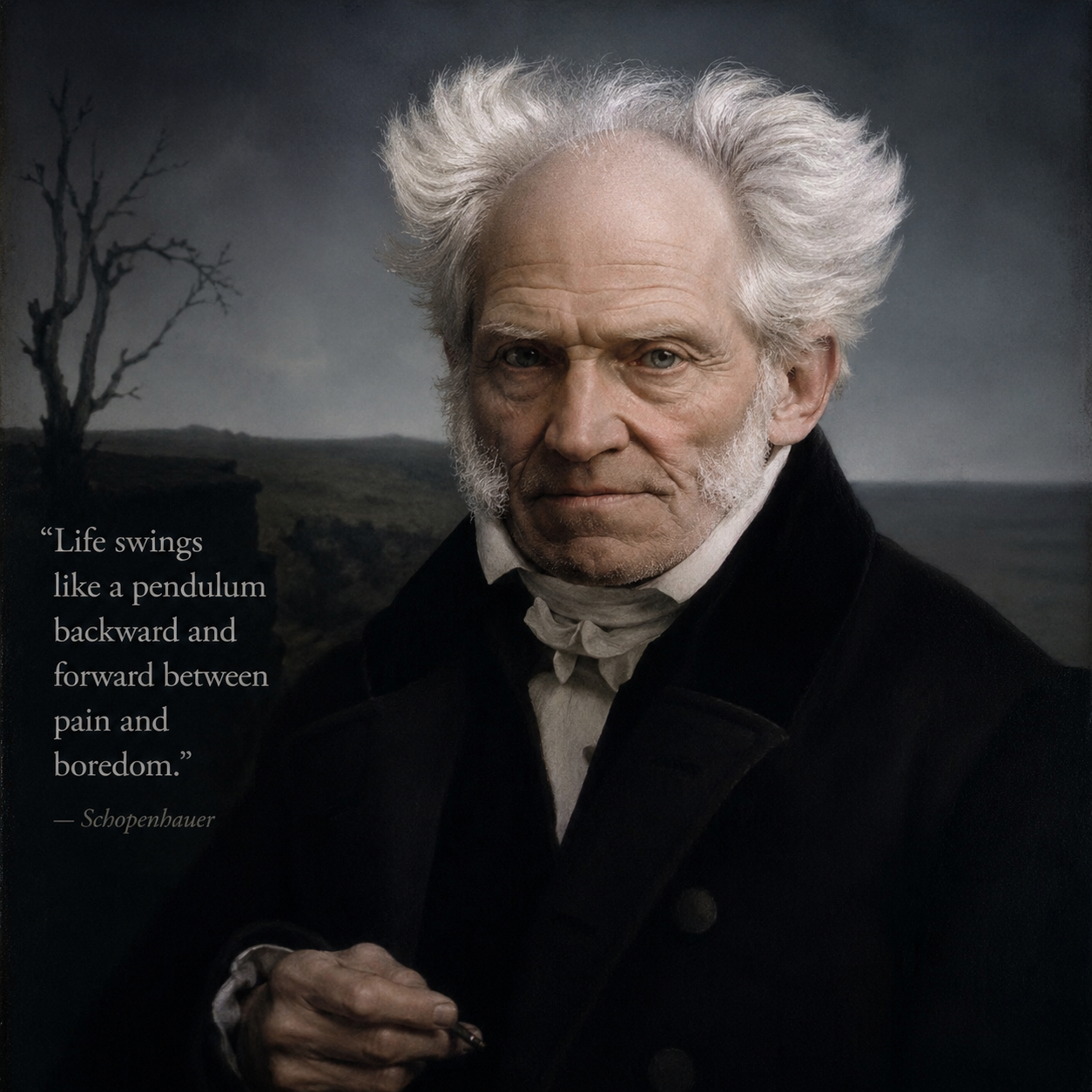
Arthur Schopenhauer — "The greatest evil of all is boredom."
The greatest evil of all is boredom.
The greatest evil of all is boredom.
Click any product to generate a realistic preview. Up to 3 at a time.
* Initial load can take up to 90 seconds — revising the preview in another color is nearly instant.
"There is no absurdity so palpable but that it may be firmly planted in the human head if you only begin to inculcate it before the age of five, by constantly repeating it with an air of great solemnit…"
"The world is a stage on which a tragedy is performed, and the actors are all madmen."
"The world is a collection of unhappy beings."
"Women are directly fitted for acting as the nurses and educators of our early childhood, by the fact that they are themselves childish, frivolous and short-sighted."
"It is a wise thing to be polite; consequently, it is a stupid thing to be rude. To make enemies by unnecessary and willful incivility, is just as insane a proceeding as to set your house on fire."
German philosopher of pessimism whose The World as Will and Representation (1819) defined the suffering-and-renunciation tradition. Closely associated with Immanuel Kant (the system Schopenhauer built on and revised). For an intellectual contrast, see G.W.F. Hegel, German Idealist of the rational unfolding of Spirit — Schopenhauer scheduled his Berlin lectures opposite Hegel's and spent decades attacking Hegel's optimistic system as deliberately mystifying nonsense — the foundational rivalry of 19th-century German philosophy.
The standard scholarly entry points to Arthur Schopenhauer's work: Bryan Magee (Oxford, populariser-philosopher) — The Philosophy of Schopenhauer (1983); Christopher Janaway (Southampton, Schopenhauer specialist) — Self and World in Schopenhauer's Philosophy (1989); David E. Cartwright (Wisconsin–Whitewater) — Schopenhauer: A Biography (2010). These are the works graduate seminars cite when teaching Arthur Schopenhauer.
Your cart is empty