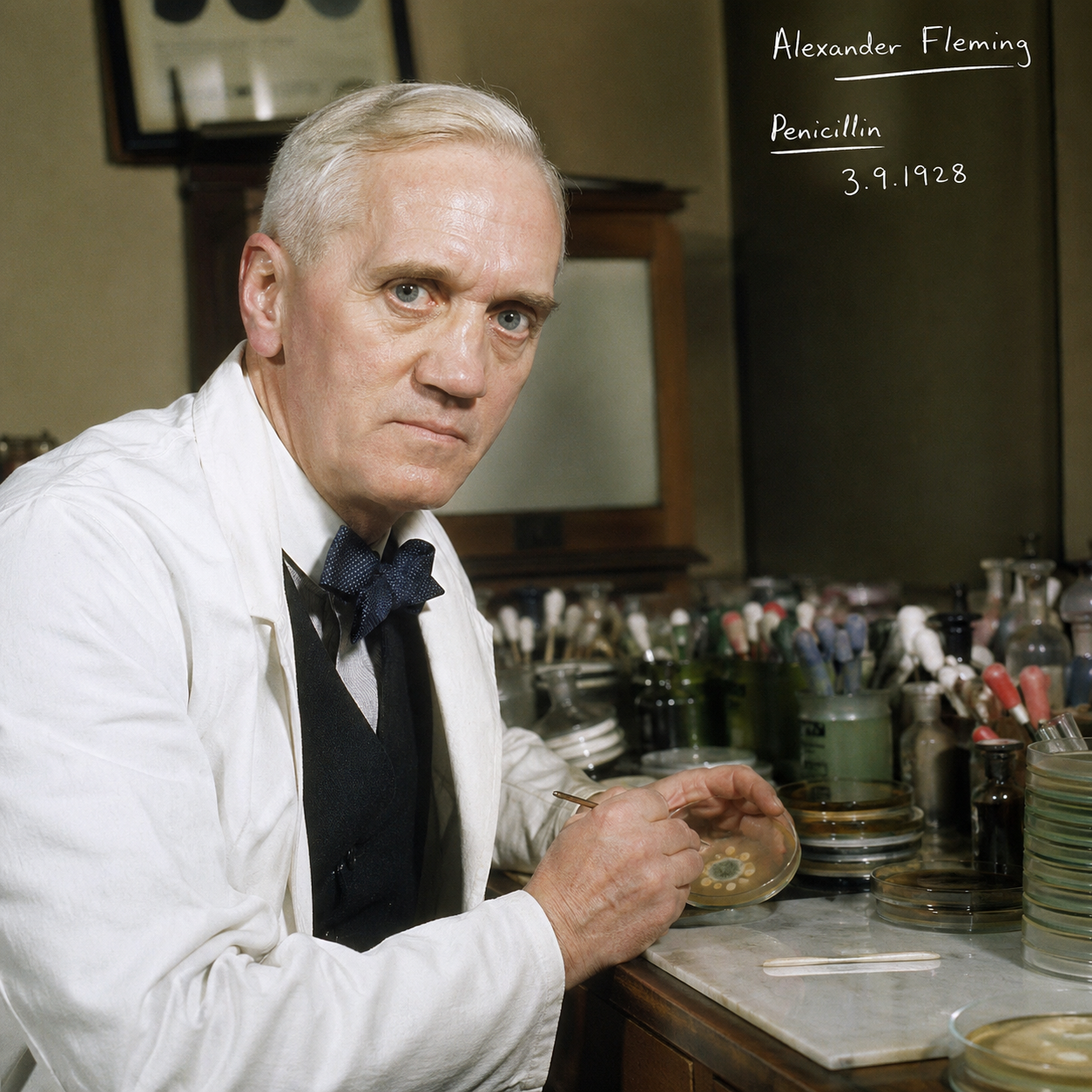
Alexander Fleming — "The greatest reward for a scientist is the advancement of knowledge."
The greatest reward for a scientist is the advancement of knowledge.
The greatest reward for a scientist is the advancement of knowledge.
Click any product to generate a realistic preview. Up to 3 at a time.
* Initial load can take up to 90 seconds — revising the preview in another color is nearly instant.
"It is not wise to be too dogmatic in science. One must always be prepared to change one's mind."
"I am not an orator, but a simple bacteriologist."
"The discovery of penicillin was a matter of chance, but the application of it was a matter of hard work."
"The public will not understand the dangers of using penicillin indiscriminately."
"The mould was very interesting. I cultured it and found it produced a powerful antibacterial substance. It was very effective against staphylococci and other Gram-positive pathogenic bacteria."
Found in 1 providers: grok
1 source checked
What truly drives a scientist isn't money, fame, or prestigious awards — it's knowing that human understanding has moved forward because of their work. Discovering something genuinely new, pushing the boundary of what's known, is the ultimate payoff. No prize or public recognition matches the satisfaction of contributing a piece of knowledge that will outlast you and benefit those who come after.
Fleming discovered penicillin in 1928 by noticing that mold had killed bacteria on a contaminated petri dish — a chance observation he had the curiosity to pursue. He spent years advocating for its significance before others acted on it. He consistently deflected personal glory, calling penicillin nature's gift rather than his own achievement. His Nobel Prize in 1945 came after penicillin had already saved thousands of lives, vindicating his patience over profit.
Fleming worked in the early to mid 20th century, a period when science was being weaponized and commercialized at unprecedented speed — two World Wars had proven that research could determine national survival. Penicillin itself saved hundreds of thousands of Allied soldiers in World War II. Against pressure to produce militarily and commercially useful results, insisting that advancing knowledge for its own sake was the highest reward was a quietly countercultural position.
AI-generated insights based on extensive research and information for context. Factual errors? Email [email protected].
Your cart is empty