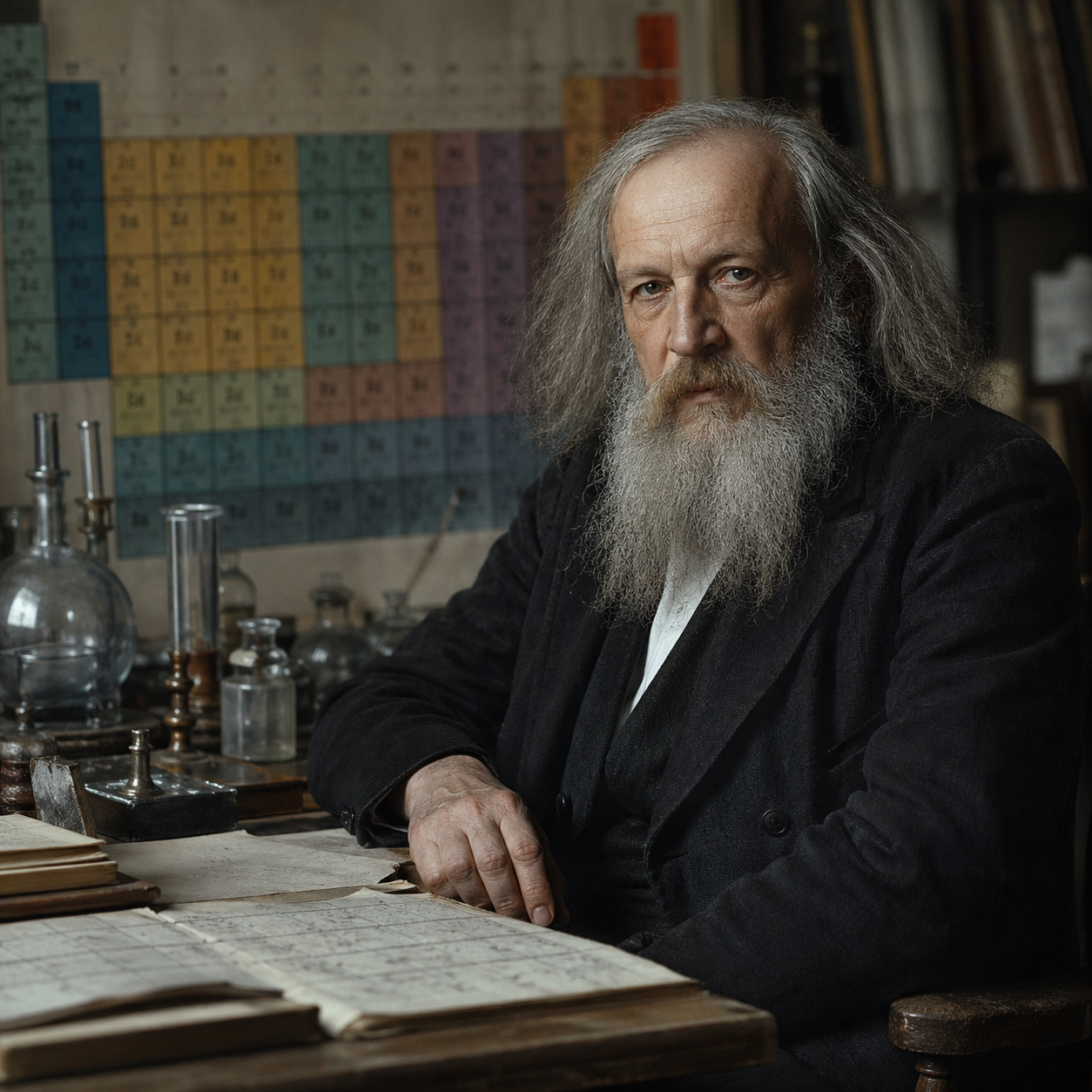
Dmitri Mendeleev — "The law of periodicity was a result of the accumulation of a large number of fac…"
The law of periodicity was a result of the accumulation of a large number of facts.
The law of periodicity was a result of the accumulation of a large number of facts.
Click any product to generate a realistic preview. Up to 3 at a time.
* Initial load can take up to 90 seconds — revising the preview in another color is nearly instant.
"The essence of chemistry lies not in the pursuit of knowledge alone, but also in the pursuit of truth."
"The spirit of scientific inquiry must be cultivated in all children."
"The edifice of science not only requires material, but also a plan. Without the material, the plan alone is but a castle in the air—a mere possibility; whilst the material without a plan is but useles…"
"The periodic law is the most important generalization in chemistry, and it has no equal in any other branch of science."
"I saw in a dream a table where all the elements fell into place as required."
Found in 1 providers: deepseek
1 source checked
Big scientific breakthroughs don't come from a single flash of genius. They emerge after researchers gather, measure, and compare huge amounts of data until a pattern finally becomes obvious. The quote says the periodic law wasn't invented out of thin air; it was the natural conclusion once enough evidence about the elements had piled up. Discovery, in other words, is mostly patient collection followed by recognizing the order already hiding in the facts.
Mendeleev spent years cataloging atomic weights, properties, and behaviors of every known element before arranging them into his 1869 table. He famously wrote each element on a card and shuffled them like solitaire until the periodicity appeared. He credited methodical data-gathering, not inspiration, and boldly left gaps predicting undiscovered elements like gallium and germanium, which were later found with the properties he forecast, vindicating his fact-driven method.
The mid-to-late 1800s was chemistry's cataloging age: Dalton's atomic theory was maturing, Cannizzaro had standardized atomic weights at the 1860 Karlsruhe Congress, and dozens of new elements were being isolated through spectroscopy and electrolysis. Scientists across Europe were racing to classify them, with Meyer, Newlands, and Odling proposing rival schemes. Mendeleev's statement reflects the era's positivist faith that rigorous empirical accumulation, not speculation, would unveil nature's underlying laws.
AI-generated insights based on extensive research and information for context. Factual errors? Email [email protected].
Your cart is empty