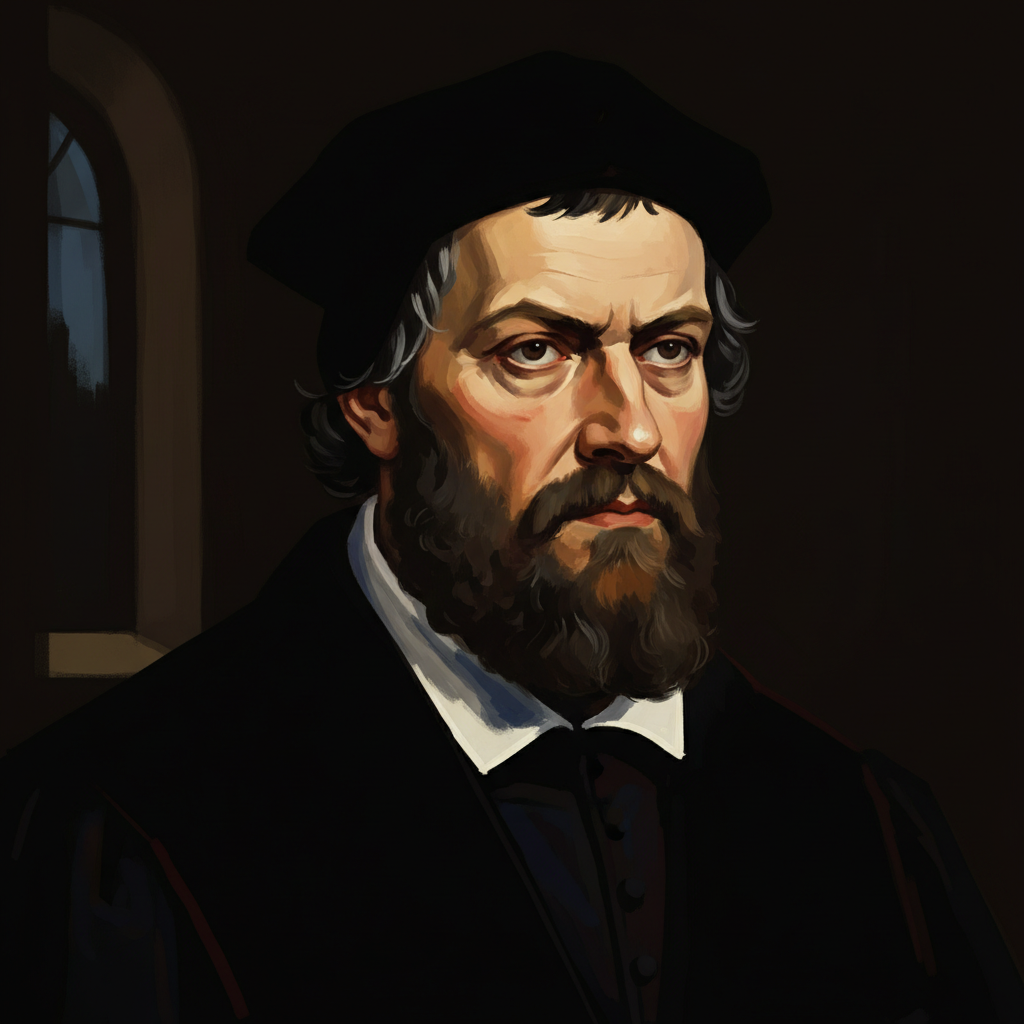
Martin Luther — "The mad mob does not ask how it could be better, only that it be different. And …"
The mad mob does not ask how it could be better, only that it be different. And when it then becomes worse, it must change again.
The mad mob does not ask how it could be better, only that it be different. And when it then becomes worse, it must change again.
Click any product to generate a realistic preview. Up to 3 at a time.
* Initial load can take up to 90 seconds — revising the preview in another color is nearly instant.
"You are an extraordinary creature, being neither God nor man. Perhaps you are the devil himself."
"I am a peasant, a son of a peasant; my father, grandfather, all my ancestors were genuine peasants."
"I feel much freer now that I am certain the pope is the Antichrist."
"If I am to be a Christian, I must be a Jew."
"If you wish to make a good prayer, go into your closet, lock the door, and throw the key out the window."
German theologian whose 95 Theses (1517) launched the Protestant Reformation and broke the Catholic Church's monopoly on Western Christianity. Closely associated with Philipp Melanchthon (Lutheran systematizer) and John Calvin (later Reformer who built on Luther's break). For an intellectual contrast, see Pope Leo X, Renaissance pope (1513-1521) — Leo X's indulgence sales triggered Luther's break and Leo excommunicated him in 1521 — Luther's entire Reformation is structured as a direct answer to the indulgence-funded Vatican Leo represented.
Found in 1 providers: deepseek
1 source checked
People driven by crowd mentality don't actually want improvement—they just want change for its own sake. They push for something new without asking whether it's better, and when the new thing turns out worse, they demand another change. It's restless dissatisfaction mistaking motion for progress, with no standard guiding what 'better' even means. The cycle repeats because novelty, not quality, is the goal.
Luther watched his Reformation spark revolts he never intended, including the 1525 Peasants' War where commoners twisted his theology into violent uprising. Having challenged papal authority himself, he grew wary of crowds who mistook rebellion for reform. This quote captures his hard-earned distinction between principled change grounded in Scripture and mob-driven upheaval. He spent his later years condemning radicals who, in his view, wanted disruption without doctrine.
Early modern Europe was convulsing with upheaval—Luther's 95 Theses in 1517 cracked open religious, political, and peasant revolts across the Holy Roman Empire. Printing presses spread grievances faster than solutions. Peasants stormed monasteries; princes seized church lands; radical preachers promised utopias. When the Peasants' War collapsed in 1525 with 100,000 dead, Luther's warning rang true: crowds had demanded change, gotten worse outcomes, and were already demanding the next upheaval.
AI-generated insights based on extensive research and information for context. Factual errors? Email [email protected].
Your cart is empty