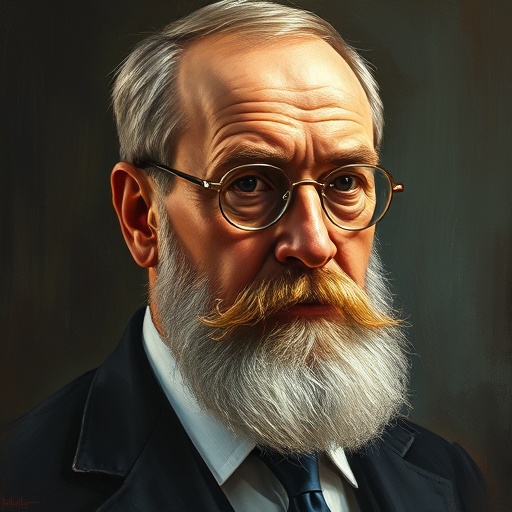
Robert Koch — "The microscope is the most important instrument in bacteriology."
The microscope is the most important instrument in bacteriology.
The microscope is the most important instrument in bacteriology.
Click any product to generate a realistic preview. Up to 3 at a time.
* Initial load can take up to 90 seconds — revising the preview in another color is nearly instant.
"I have always believed that hard work and dedication lead to success in science."
"My greatest satisfaction comes from knowing that my discoveries have saved lives."
"The prevention of disease is far more important than its cure."
"It was a great moment when I first saw the tubercle bacilli under the microscope."
"As soon as I had found the tubercle bacillus, I found it also in the sputum of phthisical patients."
Found in 1 providers: grok
1 source checked
Bacteriology cannot function without directly observing bacteria, and the microscope makes that possible. It transforms invisible microorganisms into concrete, identifiable entities. Without it, pathogens remain theoretical and disease causation stays guesswork. With it, scientists can see, classify, and study specific germs responsible for illness. The quote is a foundational claim: the right instrument does not merely assist the science — it is the prerequisite that makes the science exist at all.
Koch's career proved this claim repeatedly. He identified Mycobacterium tuberculosis in 1882, Vibrio cholerae in 1883, and refined the anthrax life cycle — all through disciplined microscopy. He pioneered bacterial staining techniques and microphotography, making pathogens documentable for the first time. His Koch's Postulates required isolating and visually confirming pathogens under the microscope. His 1905 Nobel Prize rested entirely on this empirical foundation. For Koch, the microscope was the non-negotiable bridge between hypothesis and proof.
In Koch's active years (1870s–1905), medicine was abandoning miasma theory — the belief that 'bad air' caused disease — in favor of germ theory. Improved achromatic lenses and new aniline staining techniques finally made bacteria distinctly visible. Tuberculosis killed roughly one in seven Europeans. The microscope was not merely a laboratory tool; it was civilization-altering. Identifying TB's specific bacterial cause directly enabled the development of targeted treatments and transformed how humanity understood, tracked, and eventually controlled infectious disease.
AI-generated insights based on extensive research and information for context. Factual errors? Email [email protected].
Your cart is empty