Gregor Mendel — "The numerical relations of the different forms in the successive generations are…"
The numerical relations of the different forms in the successive generations are constant.
The numerical relations of the different forms in the successive generations are constant.
Click any product to generate a realistic preview. Up to 3 at a time.
* Initial load can take up to 90 seconds — revising the preview in another color is nearly instant.
"My experiments with single traits all lead to the same result: that from the seeds of hybrids, plants are obtained half of which in turn carry the hybrid trait (Aa), the other half, however, receive t…"
"Thus, on the average, among four plants two have the hybrid trait Aa, one the parental trait A, and the other the parental trait a. Therefore, 2Aa+ A +a or A + 2Aa + a is the empirical simple series f…"
"Whether they will retain the characteristics of the hybrid, or whether they will show variations, will be determined by next year's observations."
"The value and utility of any experiment are determined by the fitness of the material to the purpose for which it is used."
"My scientific studies have afforded me great gratification; and I am convinced that it will not be long before the scientific world will become acquainted with the results of my experiments."
Found in 1 providers: grok
1 source checked
When traits pass from parents to offspring across generations, the ratios of different trait forms follow fixed, predictable mathematical patterns. Heredity isn't random — it obeys precise statistical laws. Cross plants with dominant and recessive traits, and roughly 3 out of 4 offspring will show the dominant form, generation after generation. Mendel's insight was that biological inheritance could be reduced to repeatable numbers, making it measurable and scientifically testable.
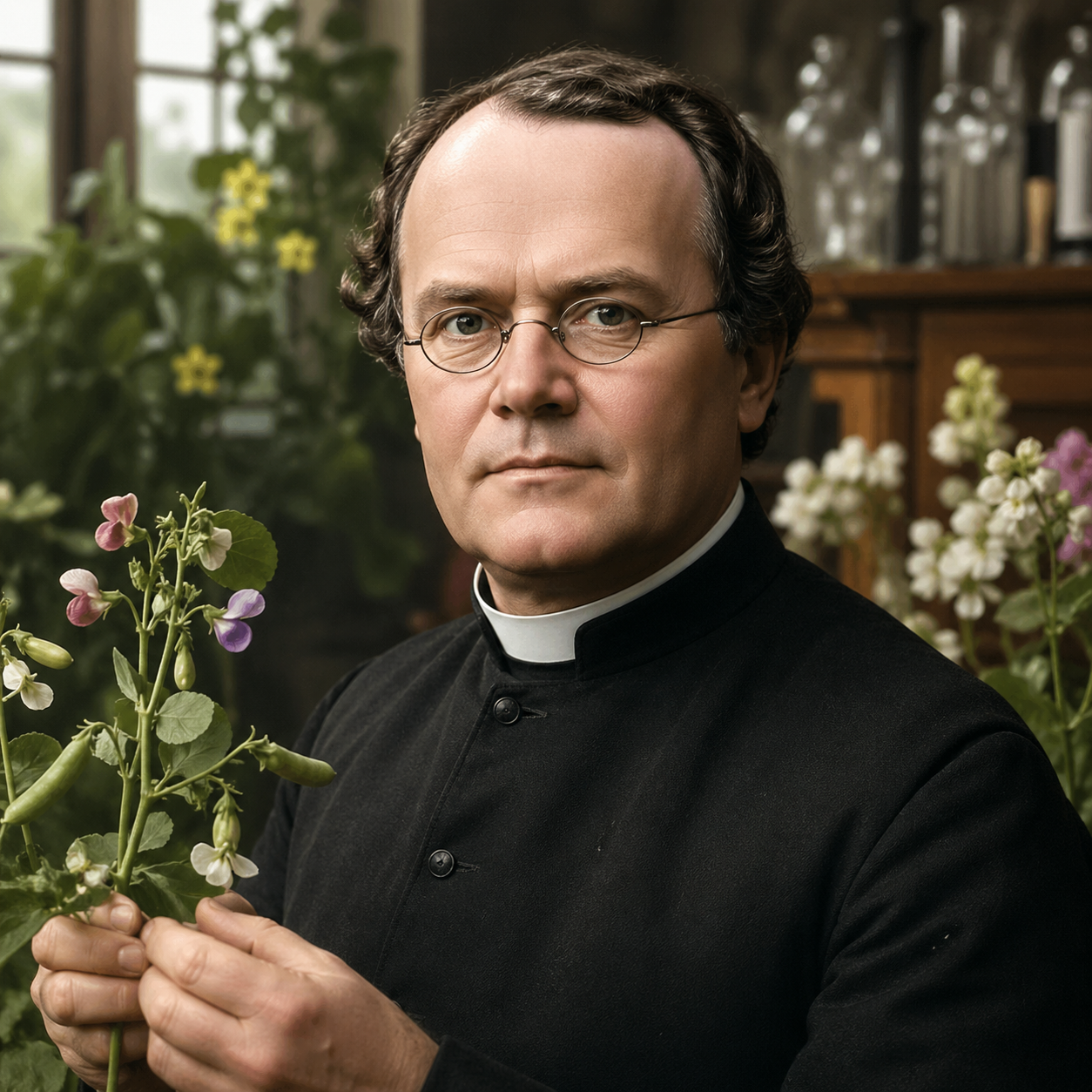
Mendel spent eight years cross-breeding pea plants in the monastery garden at Brno, hand-pollinating thousands of plants and meticulously counting seeds across seven traits. His entire method depended on recording exact numbers across multiple generations. The 3:1 dominant-to-recessive ratio he discovered wasn't a rough observation — it was a mathematical constant he verified repeatedly. This quote is essentially his scientific thesis: that the chaos of biological variation conceals underlying numerical order.
Mendel published in 1866, seven years after Darwin's Origin of Species upended biology. Scientists knew traits were inherited but had no mechanism — blending inheritance, where offspring simply averaged parental traits, was widely accepted. Chromosomes and DNA were undiscovered. Mendel's insistence that inheritance followed fixed ratios challenged the belief that heredity was fluid and unmeasurable. His era's lack of statistical thinking in biology meant his work was ignored for 35 years until rediscovered in 1900.
AI-generated insights based on extensive research and information for context. Factual errors? Email [email protected].
Your cart is empty