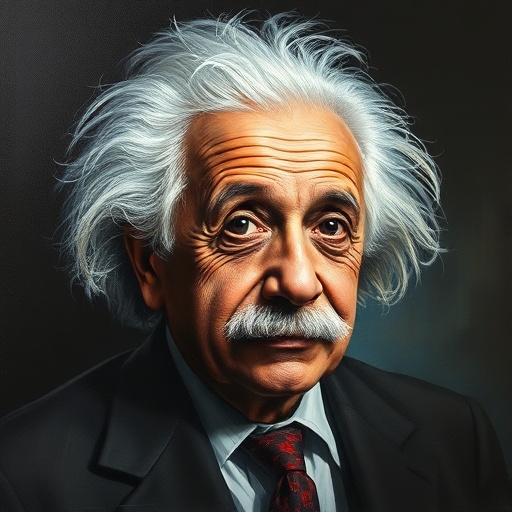
Albert Einstein — "The only way to escape the corrupting influence of praise is to go on working."
The only way to escape the corrupting influence of praise is to go on working.
The only way to escape the corrupting influence of praise is to go on working.
Click any product to generate a realistic preview. Up to 3 at a time.
* Initial load can take up to 90 seconds — revising the preview in another color is nearly instant.
"Imagination is the preview of life's coming attractions."
"I am a deeply religious nonbeliever. This is a somewhat new kind of religion."
"The important thing is not to stop questioning. Curiosity has its own reason for existence."
"The Jews are a community bound together by ties of blood and tradition, not of religion only."
"If A is a success in life, then A equals x plus y plus z. Work is x; y is play; and z is keeping your mouth shut."
Found in 1 providers: grok
1 source checked
Praise feels rewarding but quietly corrupts—it shifts your focus from doing the work to protecting your reputation and seeking more applause. Sustained effort is the only counter: when you stay absorbed in the task itself, you remain answerable to the work rather than to your audience. Continuing to work keeps ego subordinate to purpose, preventing acclaim from becoming the goal rather than the byproduct.
After 1919 eclipse observations confirmed general relativity, Einstein became the world's first modern celebrity scientist—mobbed by crowds, trailed by reporters, lionized across continents. He found the attention burdensome and intellectually dangerous. Despite global fame, he kept publishing, teaching, and pursuing unified field theory until his death. His commitment to continued labor over self-promotion reflected a lifelong belief that scientific integrity depended on detachment from public adulation.
Einstein rose to prominence as mass media—radio, global newspapers, newsreels—made celebrity culture possible at unprecedented scale. The interwar decades celebrated scientists as heroes and geniuses, projecting Einstein's face worldwide. Simultaneously, nationalism was weaponizing science for propaganda, making the line between genuine inquiry and public performance increasingly fraught. Remaining absorbed in work rather than cultivating a public image was a deliberate stance against the era's cult of personality.
AI-generated insights based on extensive research and information for context. Factual errors? Email [email protected].
Your cart is empty