Alexander Fleming — "The power of observation is crucial in scientific research."
The power of observation is crucial in scientific research.
The power of observation is crucial in scientific research.
Click any product to generate a realistic preview. Up to 3 at a time.
* Initial load can take up to 90 seconds — revising the preview in another color is nearly instant.
"It is not often that one finds a substance that is both highly bactericidal and non-toxic to animal tissues."
"My greatest satisfaction comes from knowing that my work has saved countless lives."
"It is a happy accident that the mold grew on my plate, but it was not an accident that I recognized it."
"The story of penicillin has been told so often that it is almost a cliché."
"The greatest discovery of my life was not penicillin, but the fact that I was wrong about something."
Found in 1 providers: grok
1 source checked
Careful, attentive observation — noticing what's actually happening rather than what you expect to see — is the foundation of scientific discovery. Breakthroughs don't arrive purely from controlled experiments and prior hypotheses; they demand being alert enough to recognize anomalies, accidents, and unexpected results that most researchers dismiss as noise. The keenest scientific minds are those whose eyes and judgment catch what others walk past without noticing.
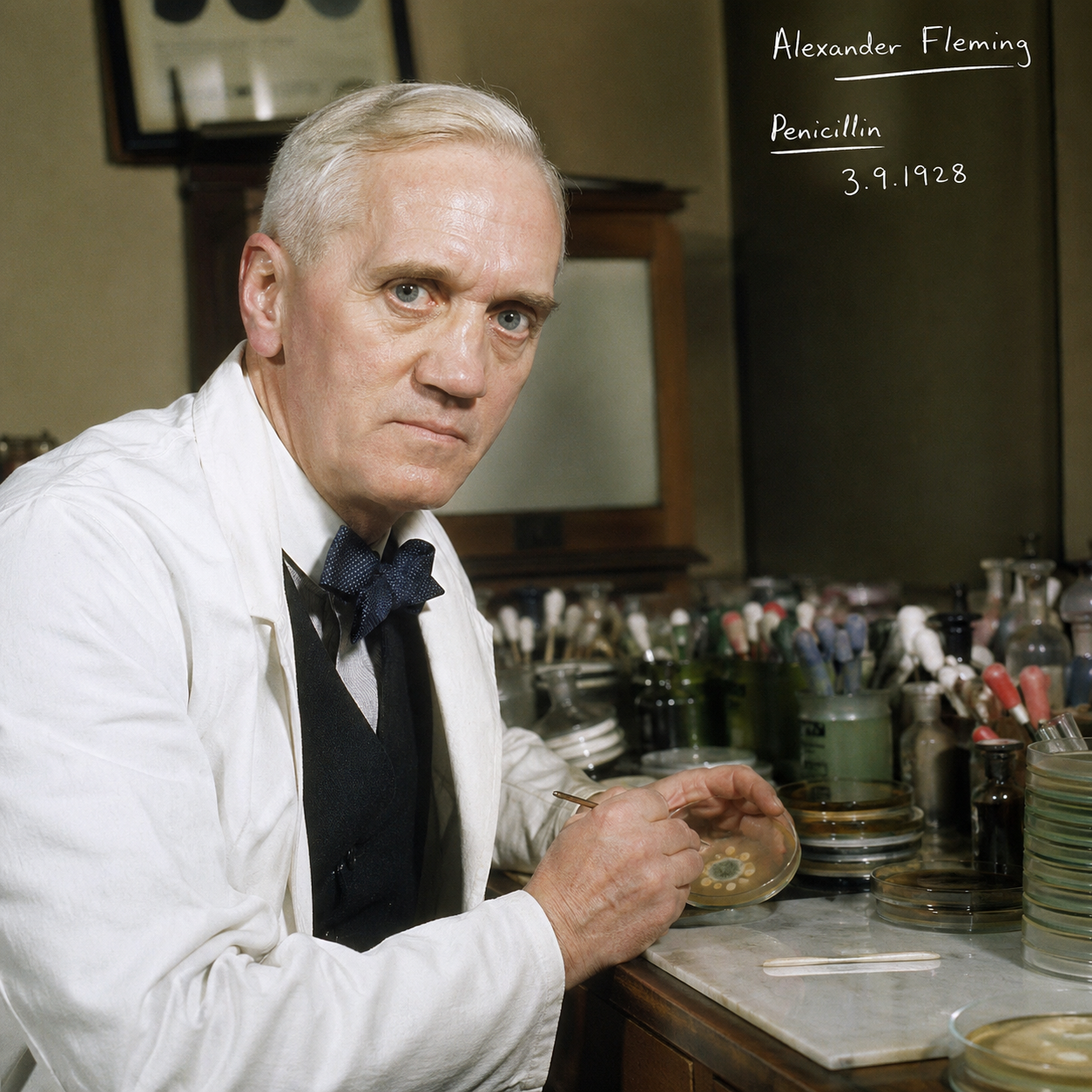
Fleming's career was built on this exact skill. In 1922 he noticed his nasal mucus was killing bacteria in a culture dish, leading to lysozyme's discovery. In 1928 he returned from vacation to find a contaminated petri dish where Penicillium mold had killed surrounding bacteria — a plate most researchers would discard. He recognized its significance instead. Both landmark discoveries came not from planned experiments but from his disciplined, trained eye.
Fleming worked during early 20th-century medicine's transformation from art to systematic science. His WWI service treating infected wounds showed him firsthand how bacterial infections killed more soldiers than combat. The 1920s–1940s brought intense pressure for rapid antibacterial breakthroughs, with researchers racing to develop chemical treatments like sulfonamides. Amid this urgency, Fleming's patient, unhurried observation — attending carefully to what experiments revealed rather than forcing them to confirm expectations — stood as a vital corrective.
AI-generated insights based on extensive research and information for context. Factual errors? Email [email protected].
Your cart is empty