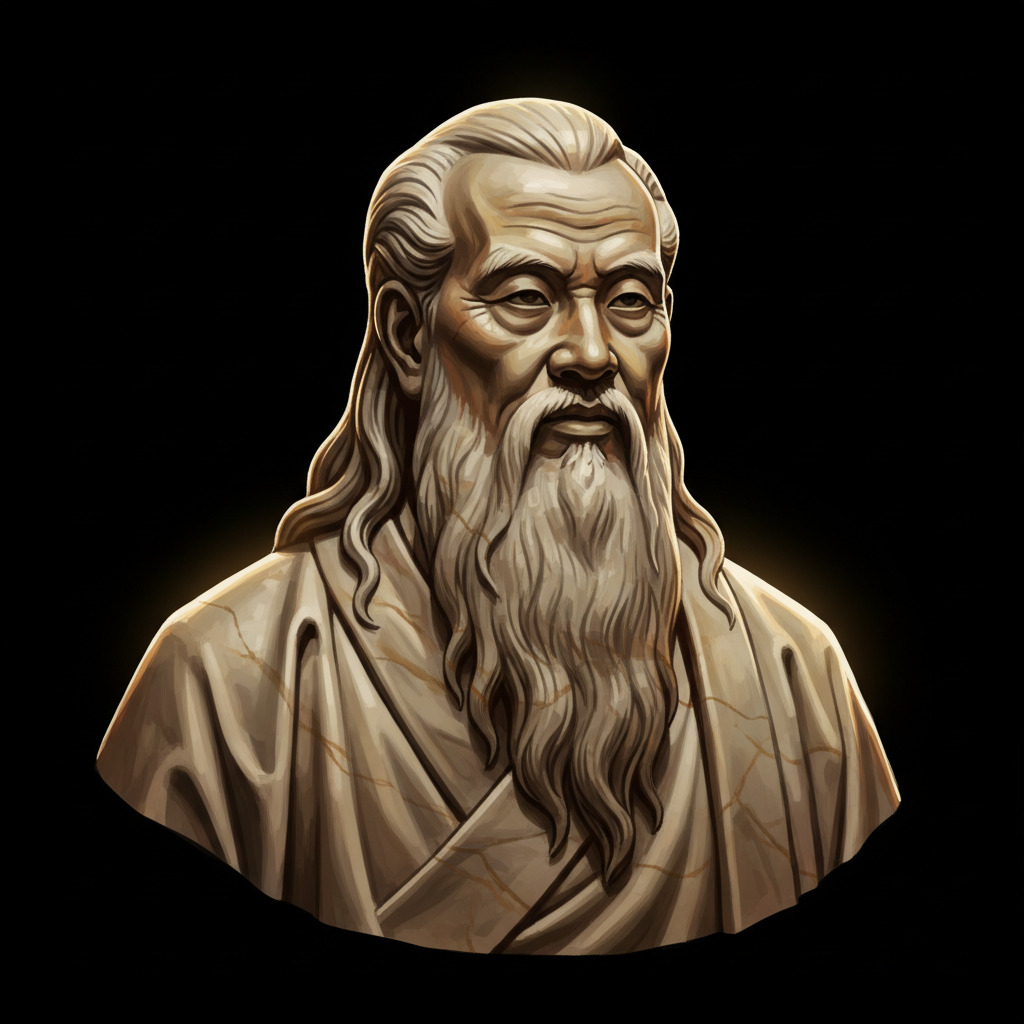
Laozi — "The sage, because he does not contend, is therefore without reproach."
The sage, because he does not contend, is therefore without reproach.
The sage, because he does not contend, is therefore without reproach.
Click any product to generate a realistic preview. Up to 3 at a time.
* Initial load can take up to 90 seconds — revising the preview in another color is nearly instant.
"He who acts destroys; he who grasps loses."
"He (the sage) wants all things to follow their own nature, but dares not act."
"The greatest villain is the one who tries to do good."
"The great square has no corners. The great vessel is never full. The great sound is inaudible. The great image has no form."
"The greatest flaw is to desire more."
Reputed founder of Taoism and author of the Tao Te Ching, whose wu wei (effortless action) shaped East Asian philosophy. Closely associated with Zhuangzi (later Taoist who extended Laozi's framework). For an intellectual contrast, see Confucius, near-contemporary Chinese sage of social ritual and duty — Confucius systematized social order through ritual and hierarchy; Laozi argued that all such systems were the disease, not the cure — the two founding poles of Chinese moral philosophy.
Found in 1 providers: grok
1 source checked
A wise person avoids arguing, competing, and fighting for status or being right. Because they never push against others, no one can find fault with them or hold grievances. There is nothing to criticize in someone who makes no enemies, claims no victories, and demands no recognition. By stepping out of rivalry entirely, they stay free of blame, resentment, and the reputational damage that comes from constant striving.
Laozi is credited as the founder of Taoism and author of the Tao Te Ching, which teaches wu wei, or effortless non-action. Legend says he served as a palace archivist in the Zhou court but withdrew from public life, disillusioned with political ambition. This saying reflects his core conviction that yielding and humility outlast aggression, and mirrors his own choice to walk away from court rivalries rather than compete for influence within them.
Laozi reportedly lived during the late Zhou dynasty, likely the 6th century BCE, as centralized authority crumbled and rival states edged toward the Warring States period. Philosophers competed at courts, offering rulers strategies to dominate neighbors. Against this backdrop of ambition, warfare, and constant contention, Laozi's praise of non-contention was a radical counter-voice, shared alongside Confucian ethics and early Legalist thought during the Hundred Schools era of intellectual ferment.
AI-generated insights based on extensive research and information for context. Factual errors? Email [email protected].
Your cart is empty