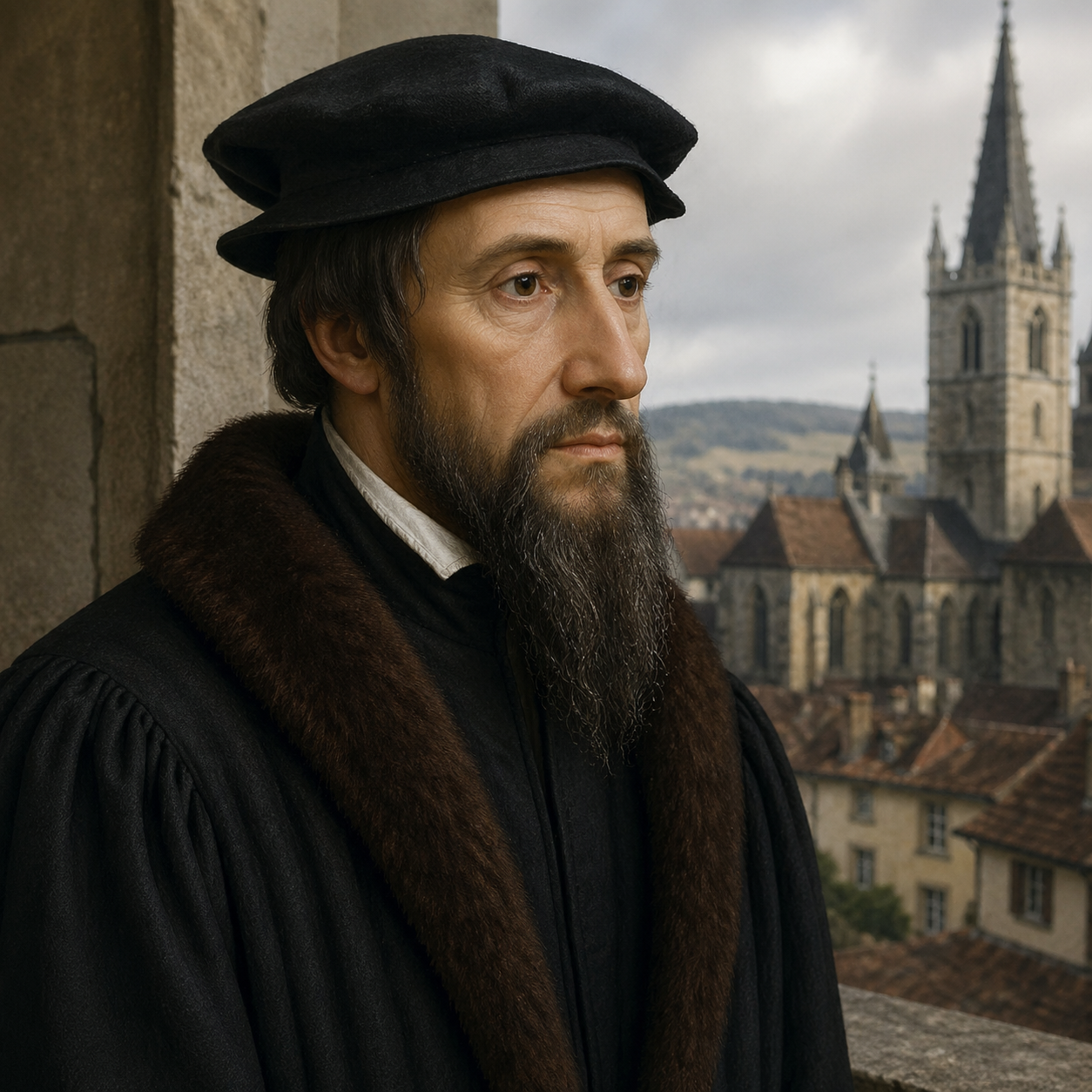
John Calvin — "The whole life of a Christian should be a meditation on death."
The whole life of a Christian should be a meditation on death.
The whole life of a Christian should be a meditation on death.
Click any product to generate a realistic preview. Up to 3 at a time.
* Initial load can take up to 90 seconds — revising the preview in another color is nearly instant.
"The executioner is a good physician for the church."
"God never abandons his own."
"But if we are elected in Christ, we cannot find in ourselves the reason of our election; neither can we, by any means, comprehend it in our own understanding."
"We are never so much ourselves as when we are in Christ."
"For I stay not to consider the extravagance of those who say that grace is offered equally and promiscuously to all."
French theologian whose Institutes of the Christian Religion (1536) systematized Protestant Reformed doctrine, including predestination. Closely associated with Martin Luther (Reformation founder, Calvin's predecessor). For an intellectual contrast, see Jacobus Arminius, Dutch Reformed theologian (1560-1609) — Arminius's rejection of strict double-predestination founded Arminianism — the theological tradition modern Methodism, most evangelicalism, and Pentecostalism descend from. The Calvinist-Arminian debate has divided Protestantism for 400 years.
Institutes of the Christian Religion, Book III, Chapter 9, Section 5
Date: 1559
Life & DeathFound in 1 providers: grok
1 source checked
Living with constant awareness of death means stripping away distractions, vanity, and worldly obsessions to focus on what genuinely matters. Calvin isn't advocating despair—he's urging intentional living. When you truly internalize that life ends, priorities clarify: petty grievances shrink, spiritual preparation becomes urgent, and moral choices carry real weight. Modern readers might recognize this as the ancient practice of memento mori—remember you will die—applied as a daily spiritual discipline.
Calvin's entire theology centered on human sinfulness, God's absolute sovereignty, and predestination—making death the pivotal reckoning point for every believer. He wrote his Institutes of the Christian Religion at 26, shaped Geneva into a model Reformed city, and endured exile and chronic illness throughout his life. For Calvin, confronting mortality wasn't morbid but essential: it maintained humility before God and dismantled the Catholic Church's comfortable doctrine that salvation could be earned or purchased.
Sixteenth-century Europe lived under constant mortal threat—recurring plague outbreaks, religious wars, and average life expectancy under 40. The Catholic Church had commercialized death anxiety through indulgences: pay money to reduce time in purgatory. Calvin's Reformation flatly rejected this transactional approach, insisting death and divine judgment couldn't be bought off. In Geneva and across Protestant territories, theological clarity about mortality was both spiritual necessity and a direct political challenge to Rome's grip on how Christians understood dying.
AI-generated insights based on extensive research and information for context. Factual errors? Email [email protected].
Your cart is empty