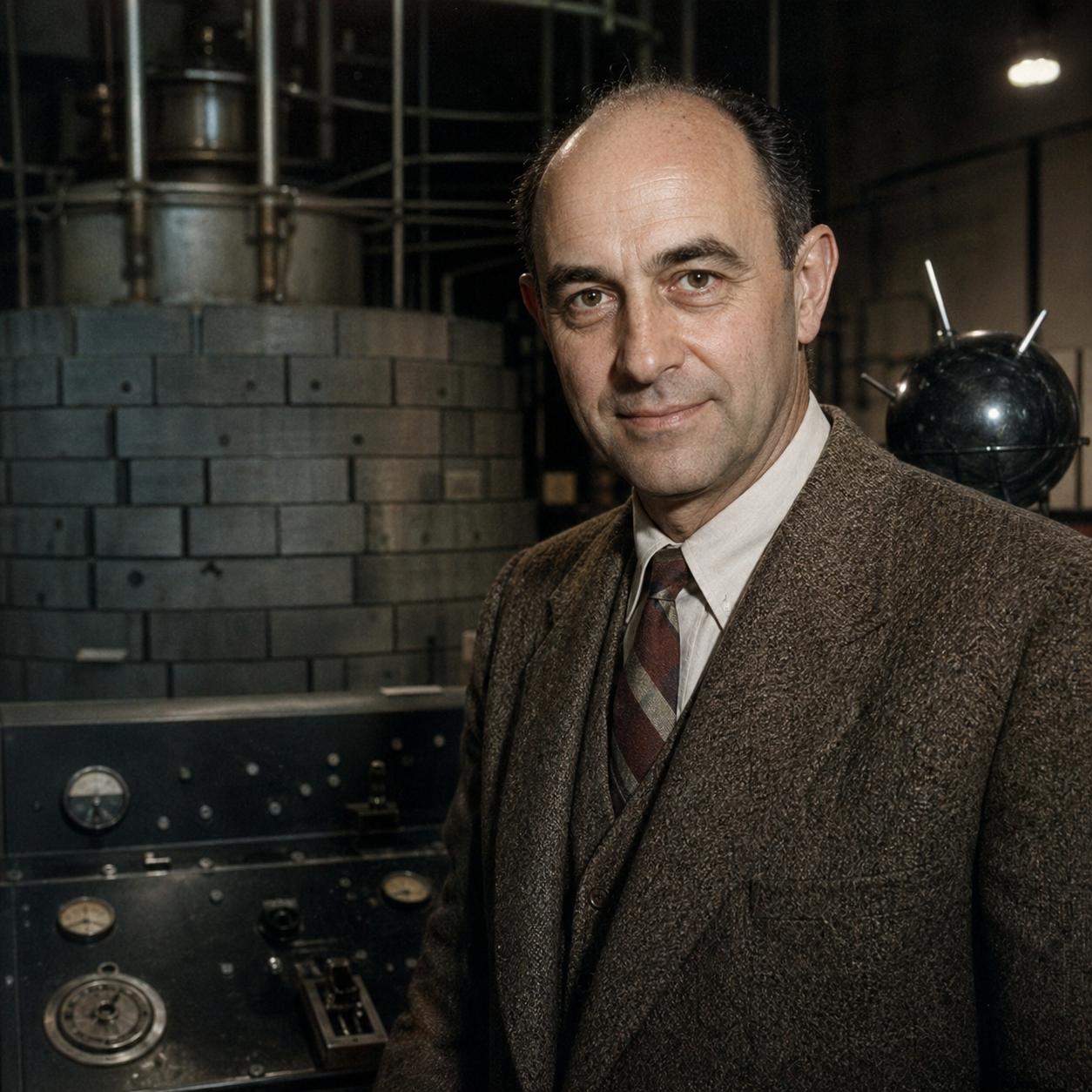
Enrico Fermi — "The world is full of interesting things to do with neutrons."
The world is full of interesting things to do with neutrons.
The world is full of interesting things to do with neutrons.
Click any product to generate a realistic preview. Up to 3 at a time.
* Initial load can take up to 90 seconds — revising the preview in another color is nearly instant.
"Don't ever tell anybody anything, or you'll never get anything done."
"Before the war, I was doing pure physics. Now I am doing applied physics. But it is still physics."
"Oh, anything with a probability of less than 20%."
"We are like children playing on the seashore, and we have found a few smooth pebbles and pretty shells, while the great ocean of truth lies undiscovered before us."
"Young man, if I could remember the names of these [muons, pions, etc.] particles, I would have been a botanist."
Found in 1 providers: grok
1 source checked
Neutrons — subatomic particles with no electric charge — can slip into atomic nuclei in ways charged particles cannot, triggering a remarkable range of reactions: radioactivity, fission, material analysis, and energy release. The statement captures a scientist's sense of boundless possibility: one particle opens a seemingly inexhaustible landscape of experiments and applications. Curiosity, optimism, and practicality fused into a single offhand remark.
Fermi proved this with his life's work. In 1934, he discovered slow neutrons trigger far more radioactivity than fast ones — a Nobel Prize-winning finding. In 1942 he built Chicago Pile-1, the first nuclear reactor, running on controlled neutron chain reactions. Known for hands-on intuition over abstraction, Fermi saw particles as tools to use, not just phenomena to observe. Neutrons were his instrument.
The neutron was discovered by James Chadwick in 1932; Fermi began exploring its potential almost immediately. Within fifteen years, neutron physics had powered the Manhattan Project, created the atomic bomb, and launched the nuclear age. The 1930s–1950s were defined by physics reshaping civilization — neutrons could generate electricity, destroy cities, or treat cancer. What Fermi called "interesting things" became the central tension of 20th-century geopolitics.
AI-generated insights based on extensive research and information for context. Factual errors? Email [email protected].
Your cart is empty