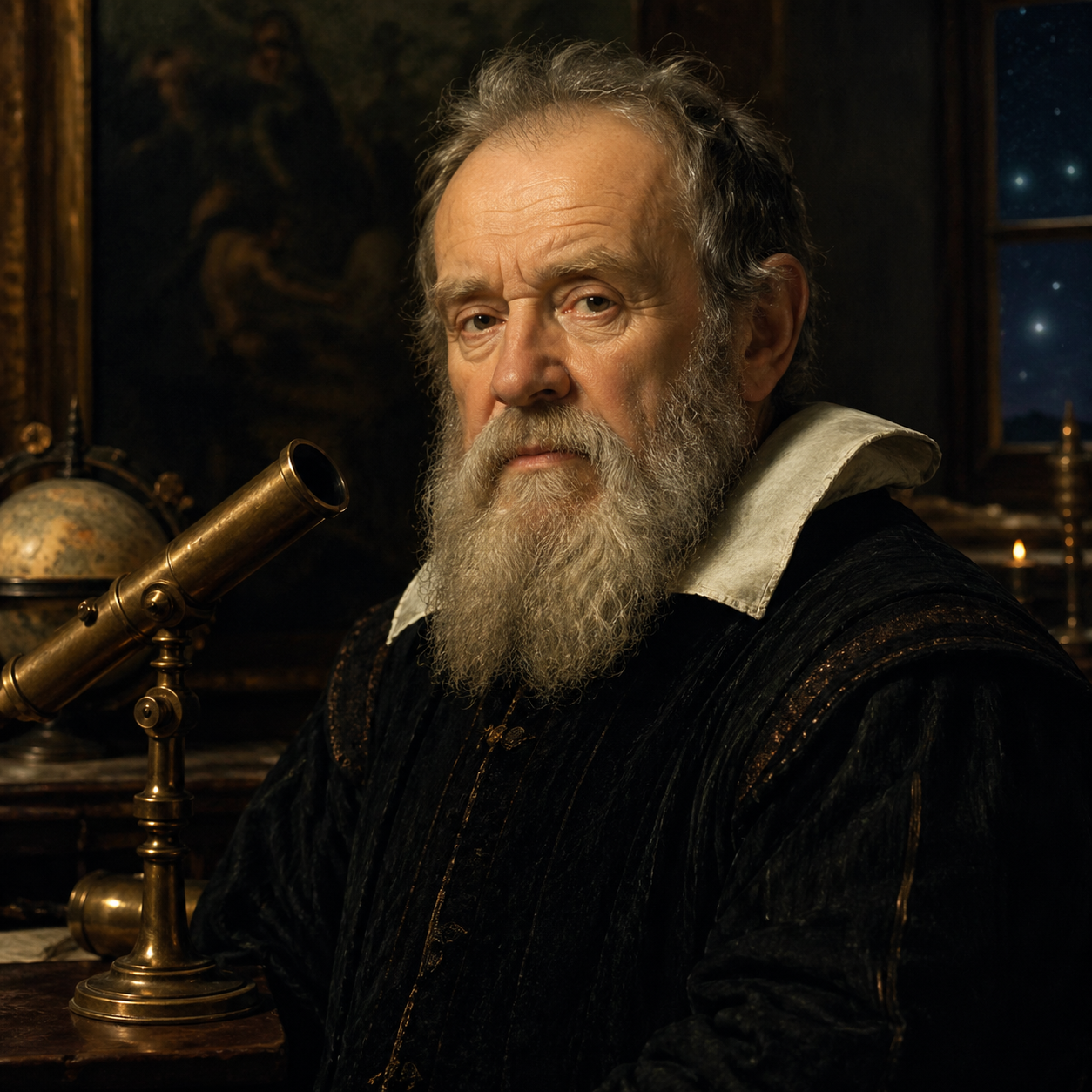
Galileo Galilei — "Who would set a limit to the mind of man? Who would dare assert that we know all…"
Who would set a limit to the mind of man? Who would dare assert that we know all there is to be known?
Who would set a limit to the mind of man? Who would dare assert that we know all there is to be known?
Click any product to generate a realistic preview. Up to 3 at a time.
* Initial load can take up to 90 seconds — revising the preview in another color is nearly instant.
"Nature is relentless and unchangeable, and it is indifferent as to whether its hidden reasons and actions are understandable to man or not."
"I hold it to be an error to believe that the truths of faith and the truths of science are contradictory."
"The sun, with all those planets revolving around it and dependent on it, can still ripen a bunch of grapes as if it had nothing else in the universe to do."
"The senses, being the interpreters of natural effects, are the only door to scientific knowledge."
"It is necessary to examine the actual structure of the universe, and not to cling to old ideas."
Found in 1 providers: grok
1 source checked
Human knowledge has no ceiling — anyone who claims we've reached the edge of understanding is wrong. The mind is boundless, and declaring final answers shuts down the very curiosity that drives discovery. Genuine intelligence means staying open to what we don't yet know, treating every answer as a doorway rather than a destination.
Galileo spent his life dismantling assumptions others treated as settled fact — Earth's central position, the heavens' perfection, Aristotelian physics. Facing Inquisition pressure to recant heliocentrism, he knew firsthand how institutions enforce false certainty. His telescopic discoveries constantly revealed that accepted cosmology was incomplete, making this defiance of intellectual limits deeply personal.
The early modern period pitted emerging empirical science against entrenched Church doctrine and Aristotelian scholasticism, both claiming comprehensive truth. The Inquisition could imprison or execute heretics who challenged official knowledge. Yet the printing press and global exploration were exploding what Europeans knew of nature and geography, making the boundaries of knowledge visibly, urgently contested.
AI-generated insights based on extensive research and information for context. Factual errors? Email [email protected].
Your cart is empty