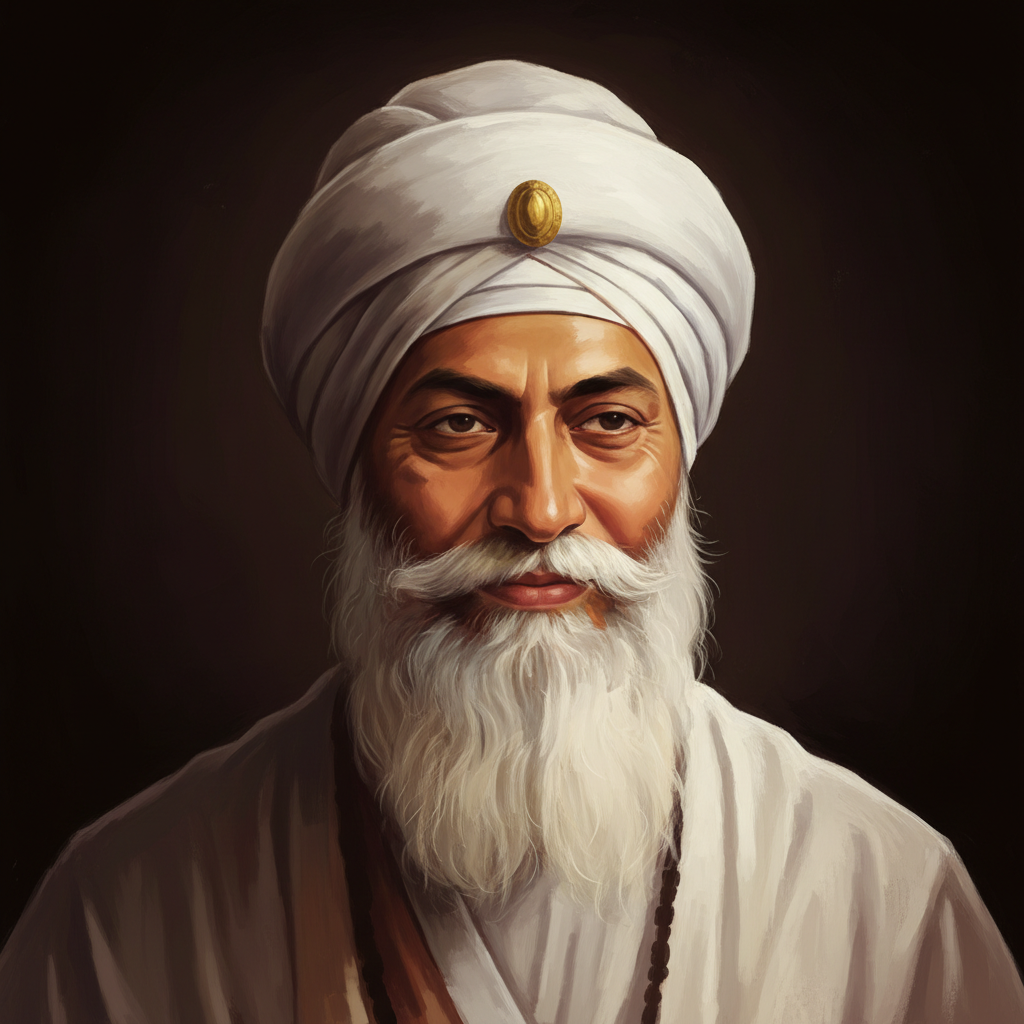
Guru Nanak — "Na Ham Hindu Na Musalmaan - I am not a Hindu, nor am I a Muslim."
Na Ham Hindu Na Musalmaan - I am not a Hindu, nor am I a Muslim.
Na Ham Hindu Na Musalmaan - I am not a Hindu, nor am I a Muslim.
Click any product to generate a realistic preview. Up to 3 at a time.
* Initial load can take up to 90 seconds — revising the preview in another color is nearly instant.
"Those who have loved are those that have found God."
"The world is a drama, staged in a dream."
"Without fear, there is no love for God."
"If we worship stone idols of gods and goddesses (or any other kind of idol for that matter), they can't give anything, (so) I don't ask anything from them. Their Poojaa is like churning water and hopi…"
"If a person bathes at sixty-eight holy places, but does not cleanse their mind, what good is it?"
Founder of Sikhism and the first of the Ten Sikh Gurus, whose teachings of one universal God and rejection of caste shaped Punjab. Closely associated with Kabir (mystical poet whose verses appear in the Sikh Guru Granth Sahib). For an intellectual contrast, see Brahmanical orthodoxy, the Hindu caste-and-ritual establishment of his era — Sikhism was founded as a deliberate alternative to both Hindu ritual hierarchy and Islamic exclusivism — Nanak's universalism was a structural rejection of caste and priestly mediation.
Guru Granth Sahib, Ang 1136, upon his reappearance from the Bein River
Date: c. 1499 CE
WisdomFound in 1 providers: gemini
1 source checked
This statement rejects fixed religious labels and the boundaries they create between people. Rather than claiming allegiance to one tradition over another, the speaker points to a shared human and spiritual identity that sits beneath inherited categories. It is a refusal to be boxed in by community, ritual, or birth identity, and an insistence that ultimate truth is not owned by any single faith group.
Guru Nanak founded Sikhism around this exact conviction. Born a Hindu in Punjab, he traveled extensively, studied both traditions, and chose disciples from both communities, including his lifelong Muslim companion Mardana. His teaching of Ik Onkar, one universal creator, flowed directly from this refusal of sectarian identity. He built a path that drew from, yet transcended, both Hindu and Islamic frameworks of his surroundings.
Nanak lived from 1469 to 1539 in Punjab under expanding Islamic rule, soon the early Mughal era. Hindu and Muslim communities coexisted uneasily, divided by caste, ritual purity codes, jizya taxation, and occasional violence. The Bhakti and Sufi movements were already blurring devotional boundaries. Declaring neither Hindu nor Muslim was a radical social act that challenged clerical authority, caste hierarchy, and the political assumption that religious identity determined a person's worth and rights.
AI-generated insights based on extensive research and information for context. Factual errors? Email [email protected].
Your cart is empty