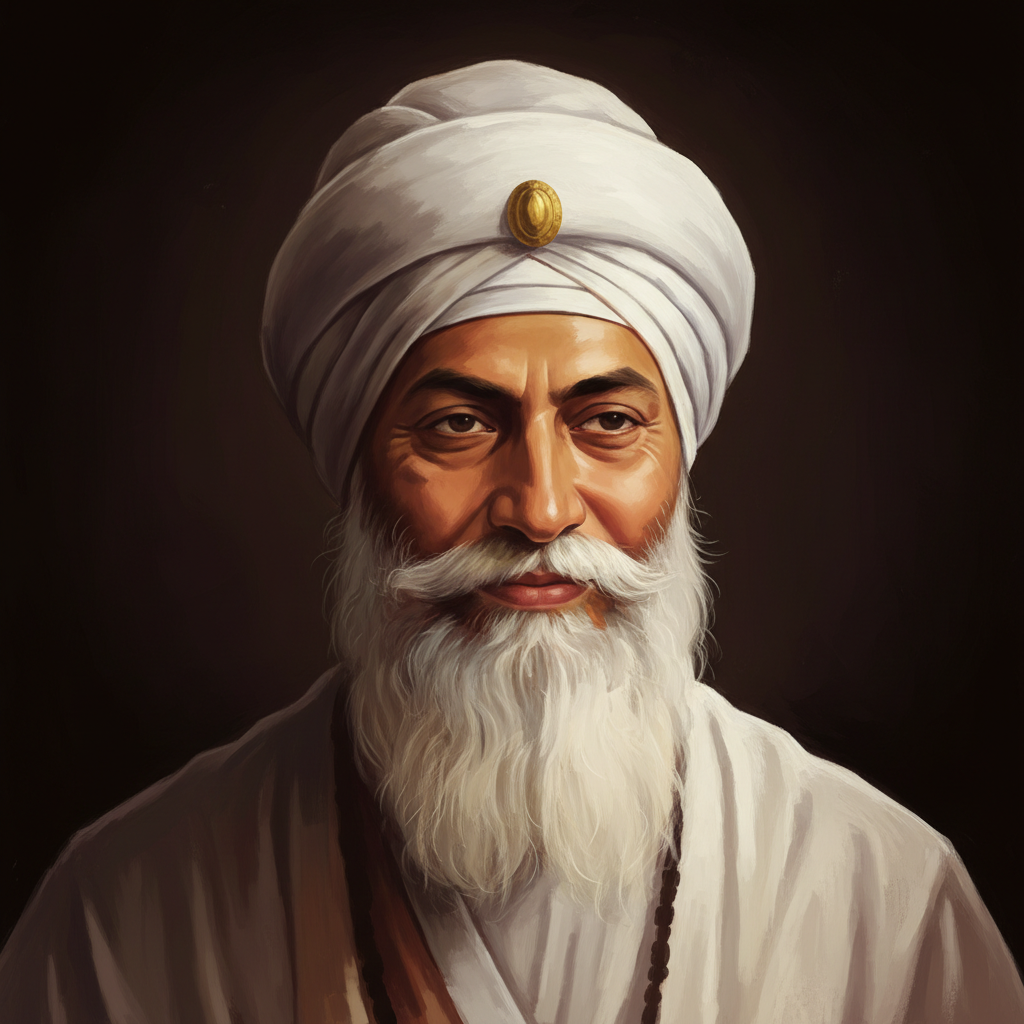
Guru Nanak — "If a person bathes at sixty-eight holy places, but does not cleanse their mind, …"
If a person bathes at sixty-eight holy places, but does not cleanse their mind, what good is it?
If a person bathes at sixty-eight holy places, but does not cleanse their mind, what good is it?
Click any product to generate a realistic preview. Up to 3 at a time.
* Initial load can take up to 90 seconds — revising the preview in another color is nearly instant.
"By His Command, all forms came into being, by His Command, life descended into them."
"Realization of Truth is higher than all else. Higher still is truthful living."
"The True Guru is the Giver of peace and tranquility."
"If we worship stone idols of gods and goddesses (or any other kind of idol for that matter), they can't give anything, (so) I don't ask anything from them. Their Poojaa is like churning water and hopi…"
"Religion consists not in words; He who looks on all men as equal is religious."
Founder of Sikhism and the first of the Ten Sikh Gurus, whose teachings of one universal God and rejection of caste shaped Punjab. Closely associated with Kabir (mystical poet whose verses appear in the Sikh Guru Granth Sahib). For an intellectual contrast, see Brahmanical orthodoxy, the Hindu caste-and-ritual establishment of his era — Sikhism was founded as a deliberate alternative to both Hindu ritual hierarchy and Islamic exclusivism — Nanak's universalism was a structural rejection of caste and priestly mediation.
Found in 1 providers: gemini
1 source checked
External rituals mean nothing if your inner life stays corrupt. You can visit every sacred site, perform every ceremony, and check every religious box, but if your mind still harbors greed, anger, pride, or dishonesty, none of it counts. Real purity is internal. Cleaning the body or touching holy water does nothing for a polluted heart. Fix what's inside first; the outward gestures only matter when they reflect a transformed inner state.
Guru Nanak built Sikhism on exactly this rejection of ritualism. He famously traveled to Hindu and Muslim pilgrimage sites not to worship but to challenge empty ceremony, reportedly turning his feet toward Mecca to show God is everywhere. As founder, he taught that honest living, remembrance of the divine name, and sharing with others mattered far more than caste rules, fasting, or sacred bathing. This saying is a direct distillation of his core reformist message.
In early modern South Asia (late 1400s–early 1500s), Hindu pilgrimage circuits like the 68 tirthas and Muslim hajj dominated popular religion, while Brahmin priests and Islamic clerics enforced ritual purity codes. Caste exclusion, ceremonial bathing, and fee-based rites were deeply entrenched. Nanak emerged during this Bhakti-Sufi ferment, alongside figures like Kabir, who likewise attacked hollow formalism and insisted inner devotion transcended sectarian boundaries between Hindu and Muslim practice.
AI-generated insights based on extensive research and information for context. Factual errors? Email [email protected].
Your cart is empty