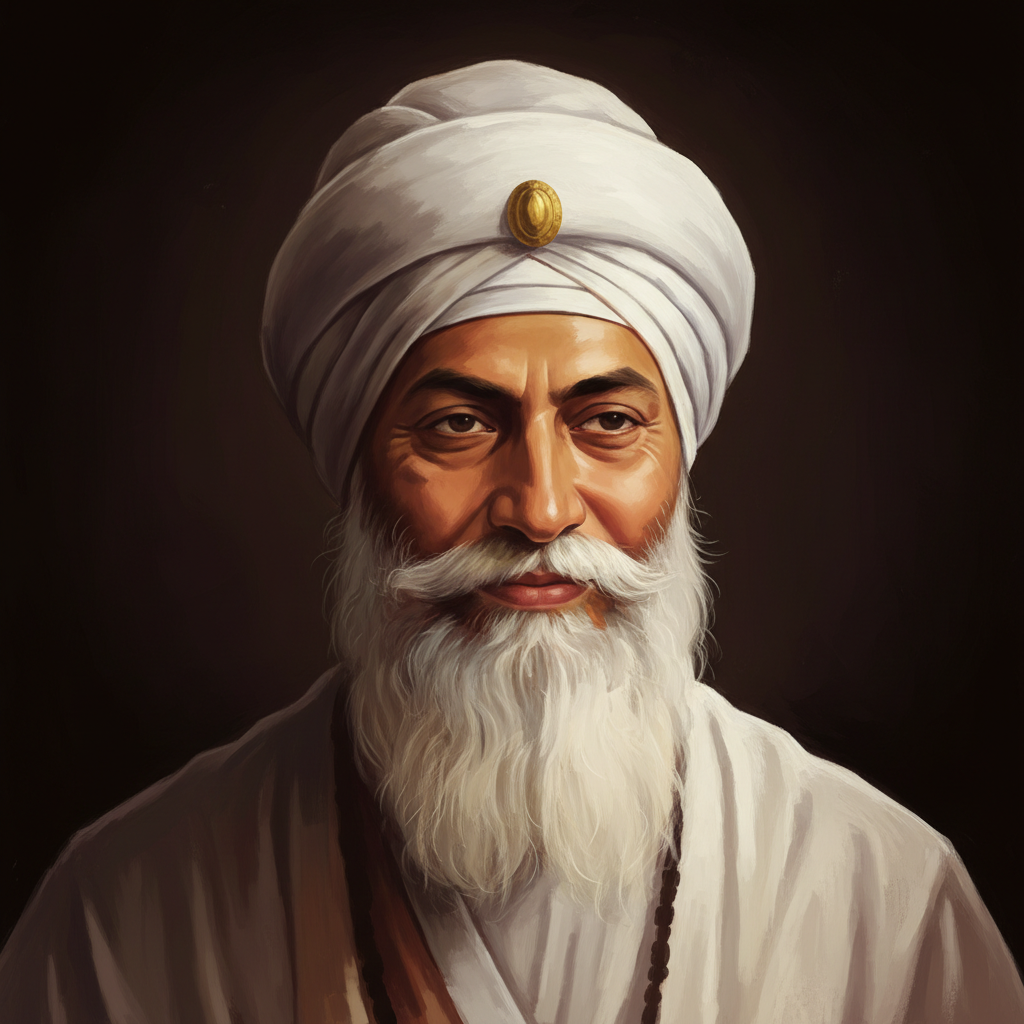
Guru Nanak — "He who practices truth, contentment, and compassion, he alone is a true Yogi."
He who practices truth, contentment, and compassion, he alone is a true Yogi.
He who practices truth, contentment, and compassion, he alone is a true Yogi.
Click any product to generate a realistic preview. Up to 3 at a time.
* Initial load can take up to 90 seconds — revising the preview in another color is nearly instant.
"Serve others with love and devotion. And remember where you put your keys afterwards."
"Do not wish evil for others. Do not speak ill of others. Do not obstruct anyone's activities."
"That one plant should be sown and another be produced cannot happen; whatever seed is sown, a plant of that kind even comes forth."
"He who serves the Guru, he alone finds peace."
"May your spirit be uplifted and your internet connection be stable."
Founder of Sikhism and the first of the Ten Sikh Gurus, whose teachings of one universal God and rejection of caste shaped Punjab. Closely associated with Kabir (mystical poet whose verses appear in the Sikh Guru Granth Sahib). For an intellectual contrast, see Brahmanical orthodoxy, the Hindu caste-and-ritual establishment of his era — Sikhism was founded as a deliberate alternative to both Hindu ritual hierarchy and Islamic exclusivism — Nanak's universalism was a structural rejection of caste and priestly mediation.
Japji Sahib, Pauri 28, Guru Granth Sahib (interpretation)
Date: c. 15th-16th century CE
InspirationalFound in 2 providers: gemini,grok
2 sources checked
Real spiritual accomplishment is not defined by rituals, robes, withdrawal from society, or physical disciplines. What actually makes someone holy is how they live day to day: telling the truth, being satisfied with what they have instead of grasping for more, and treating others with active kindness. Anyone who builds their life around these three qualities has already reached what seekers chase through elaborate practices, regardless of title or tradition.
Guru Nanak spent decades on long journeys meeting yogis, Sufis, Brahmins, and ascetics, and consistently rejected their emphasis on external renunciation. As the founder of Sikhism he built his teaching around householder life, honest labor (kirat karni), and sharing with others (vand chakna). This line distills that program: he redefined the word Yogi away from forest hermits and toward ordinary people practicing truth, contentment, and compassion inside everyday society.
In early modern South Asia (late 1400s to 1500s), religious life was dominated by caste Brahmanism, Hindu ascetic orders like the Nath yogis, and the expanding Mughal-era Islamic establishment. Spiritual authority rested on ritual purity, Sanskrit or Arabic learning, and withdrawal from the world. Guru Nanak wrote during this Bhakti and Sant ferment, when poet-saints like Kabir were already challenging that monopoly, and his redefinition of a true Yogi directly confronted entrenched clerical and ascetic power.
AI-generated insights based on extensive research and information for context. Factual errors? Email [email protected].
Your cart is empty