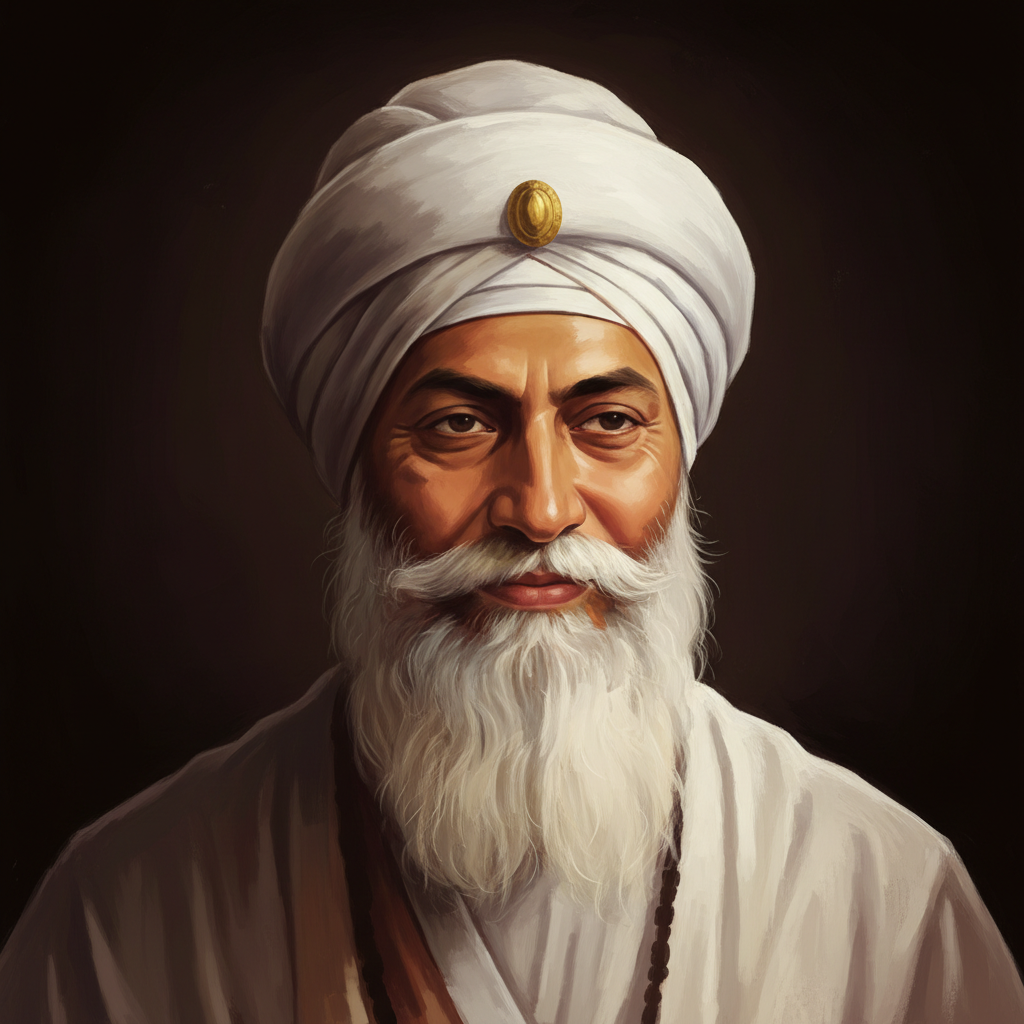
Guru Nanak — "He who serves the Guru, he alone finds peace."
He who serves the Guru, he alone finds peace.
He who serves the Guru, he alone finds peace.
Click any product to generate a realistic preview. Up to 3 at a time.
* Initial load can take up to 90 seconds — revising the preview in another color is nearly instant.
"Caste has no power in the hereafter; the only judge is truth."
"He who has no enemies, and is without hatred, and who sees God in all beings, he is a true saint."
"Without the Guru, no one has found God."
"May your days be blessed and your phone battery never die mid-conversation."
"There is but One God, His Name is Truth, He is the Creator, Fearless, without hatred, Immortal, Unborn, Self-existent, by the Guru's Grace."
Founder of Sikhism and the first of the Ten Sikh Gurus, whose teachings of one universal God and rejection of caste shaped Punjab. Closely associated with Kabir (mystical poet whose verses appear in the Sikh Guru Granth Sahib). For an intellectual contrast, see Brahmanical orthodoxy, the Hindu caste-and-ritual establishment of his era — Sikhism was founded as a deliberate alternative to both Hindu ritual hierarchy and Islamic exclusivism — Nanak's universalism was a structural rejection of caste and priestly mediation.
Found in 1 providers: grok
1 source checked
Real peace comes not from wealth, status, or ritual but from dedicating yourself to a true teacher and living by their guidance. Serving the Guru means more than obedience; it means absorbing wisdom, practicing humility, and letting that teaching reshape how you act in daily life. The inner calm people chase through pleasure or achievement only arrives when the ego steps aside and a genuine spiritual guide becomes the center of one's efforts.
Guru Nanak founded Sikhism on the idea that a living teacher, the Guru, channels divine wisdom and that sincere seva (selfless service) dissolves the ego. He rejected caste ritual, idol worship, and empty pilgrimage, insisting instead on devotion, honest labor, and sharing. His own life, wandering across South Asia teaching and founding the community at Kartarpur, modeled service as the path to union with the one formless God he called Ik Onkar.
Nanak lived 1469 to 1539 in Punjab, where Hindu caste hierarchy, Brahmin ritualism, and the newly arrived Mughal order created deep religious tension and social inequality. Babur's invasions devastated the region during his lifetime. Ordinary people were squeezed by priests demanding fees, rulers demanding tribute, and rigid rules about purity. Nanak's teaching that peace is found through a Guru, not ritual or birth, offered a direct, egalitarian alternative that cut across both Hindu and Islamic orthodoxy.
AI-generated insights based on extensive research and information for context. Factual errors? Email [email protected].
Your cart is empty