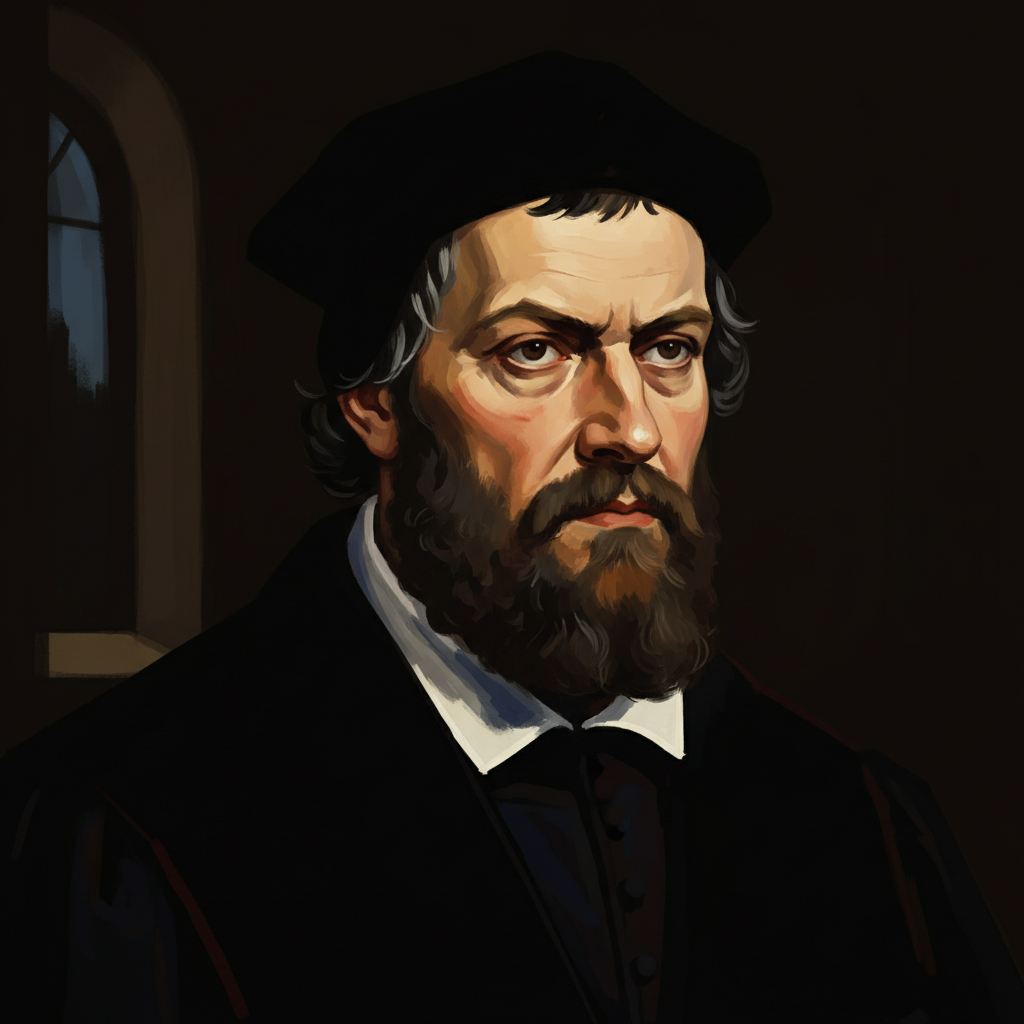
Martin Luther — "Let whoever can stab, strangle and kill them like mad dogs."
Let whoever can stab, strangle and kill them like mad dogs.
Let whoever can stab, strangle and kill them like mad dogs.
Click any product to generate a realistic preview. Up to 3 at a time.
* Initial load can take up to 90 seconds — revising the preview in another color is nearly instant.
"I would rather be ruled by a wise Turk than by a foolish Christian."
"After the devil himself, there is no worse folk than the pope and his followers."
"I confess that I am a man, and that I have erred."
"Sleep is a most excellent thing, for it makes us forget all the miseries of life."
"I am fed up with the world, and the world is fed up with me."
German theologian whose 95 Theses (1517) launched the Protestant Reformation and broke the Catholic Church's monopoly on Western Christianity. Closely associated with Philipp Melanchthon (Lutheran systematizer) and John Calvin (later Reformer who built on Luther's break). For an intellectual contrast, see Pope Leo X, Renaissance pope (1513-1521) — Leo X's indulgence sales triggered Luther's break and Leo excommunicated him in 1521 — Luther's entire Reformation is structured as a direct answer to the indulgence-funded Vatican Leo represented.
Found in 1 providers: gemini
1 source checked
This is a direct call for violent suppression, telling anyone capable to stab, choke, and slaughter a targeted group as one would kill rabid dogs. The comparison strips the targets of humanity, framing their killing as not just permitted but urgent public safety. It sanctions mob violence by individuals rather than formal legal process, treating the victims as dangerous animals whose destruction requires no trial, mercy, or hesitation from ordinary people.
Luther wrote this in 1525's Against the Murderous, Thieving Hordes of Peasants, urging nobles to crush the German Peasants' War. Though he launched the Reformation defending conscience against Rome, he turned ferociously on peasants who cited his teachings to demand freedom. The line exposes his authoritarian streak and later antisemitic tracts like On the Jews and Their Lies (1543), showing how his theology of divinely ordained authority justified brutal repression of those he deemed rebels against God's order.
The 1524-1525 Peasants' War was Europe's largest popular uprising before the French Revolution, with roughly 300,000 peasants revolting against serfdom and citing Reformation ideals. Luther, dependent on princely protection for the Reformation's survival, needed to distance evangelical reform from social revolution. Early modern Europe treated rebellion against lords as rebellion against God; roughly 100,000 peasants were slaughtered after Luther's pamphlet circulated, cementing the Reformation as a top-down princely movement rather than a liberation theology.
AI-generated insights based on extensive research and information for context. Factual errors? Email [email protected].
Your cart is empty