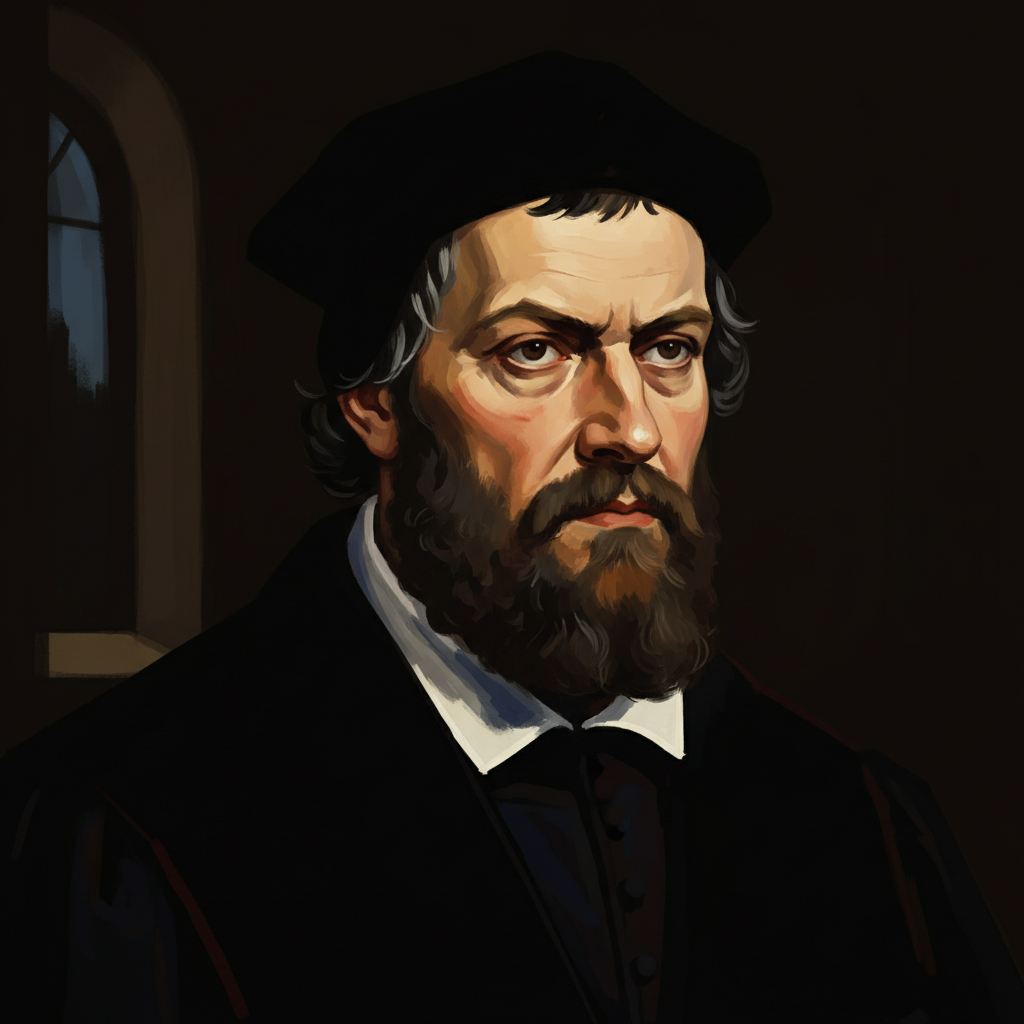
Martin Luther — "I confess that I am a man, and that I have erred."
I confess that I am a man, and that I have erred.
I confess that I am a man, and that I have erred.
Click any product to generate a realistic preview. Up to 3 at a time.
* Initial load can take up to 90 seconds — revising the preview in another color is nearly instant.
"The greatest gift of God is a pious, cheerful, God-fearing wife."
"The more one reads the Bible, the more one loves it."
"With threefold horrible sins against God and men have these peasants loaded themselves, for which they have deserved a manifold death of body and soul."
"We are saved by faith alone, but the faith that saves is never alone."
"Whatever your heart clings to and confides in, that is really your God."
German theologian whose 95 Theses (1517) launched the Protestant Reformation and broke the Catholic Church's monopoly on Western Christianity. Closely associated with Philipp Melanchthon (Lutheran systematizer) and John Calvin (later Reformer who built on Luther's break). For an intellectual contrast, see Pope Leo X, Renaissance pope (1513-1521) — Leo X's indulgence sales triggered Luther's break and Leo excommunicated him in 1521 — Luther's entire Reformation is structured as a direct answer to the indulgence-funded Vatican Leo represented.
Found in 1 providers: grok
1 source checked
The speaker openly admits being human and making mistakes. Rather than defending a position as flawless, he acknowledges fallibility as a basic condition of being a person. It is a candid concession that certainty has limits and that even strongly held views or public stances can be wrong, inviting correction and honest reconsideration instead of pretending to infallibility.
Luther built his reform on conscience bound to Scripture, not on personal perfection. He frequently admitted harsh temper, doubts, and tactical missteps while refusing to recant core doctrines at Worms in 1521. As a monk-turned-professor who challenged the pope, owning his humanity undercut accusations of arrogance and modeled the priesthood-of-all-believers idea that pastors and reformers are sinners saved by grace, not infallible authorities.
In early modern Europe, the papacy claimed doctrinal infallibility and church councils were treated as near-unquestionable. Luther's 95 Theses (1517) and the Diet of Worms (1521) detonated that assumption during a Europe already shaken by the printing press, Renaissance humanism, and rising vernacular literacy. Admitting ordinary human error was a radical stance that implicitly challenged papal authority, fueled the Reformation, and reframed religious truth as something to be tested against Scripture rather than accepted by decree.
AI-generated insights based on extensive research and information for context. Factual errors? Email [email protected].
Your cart is empty