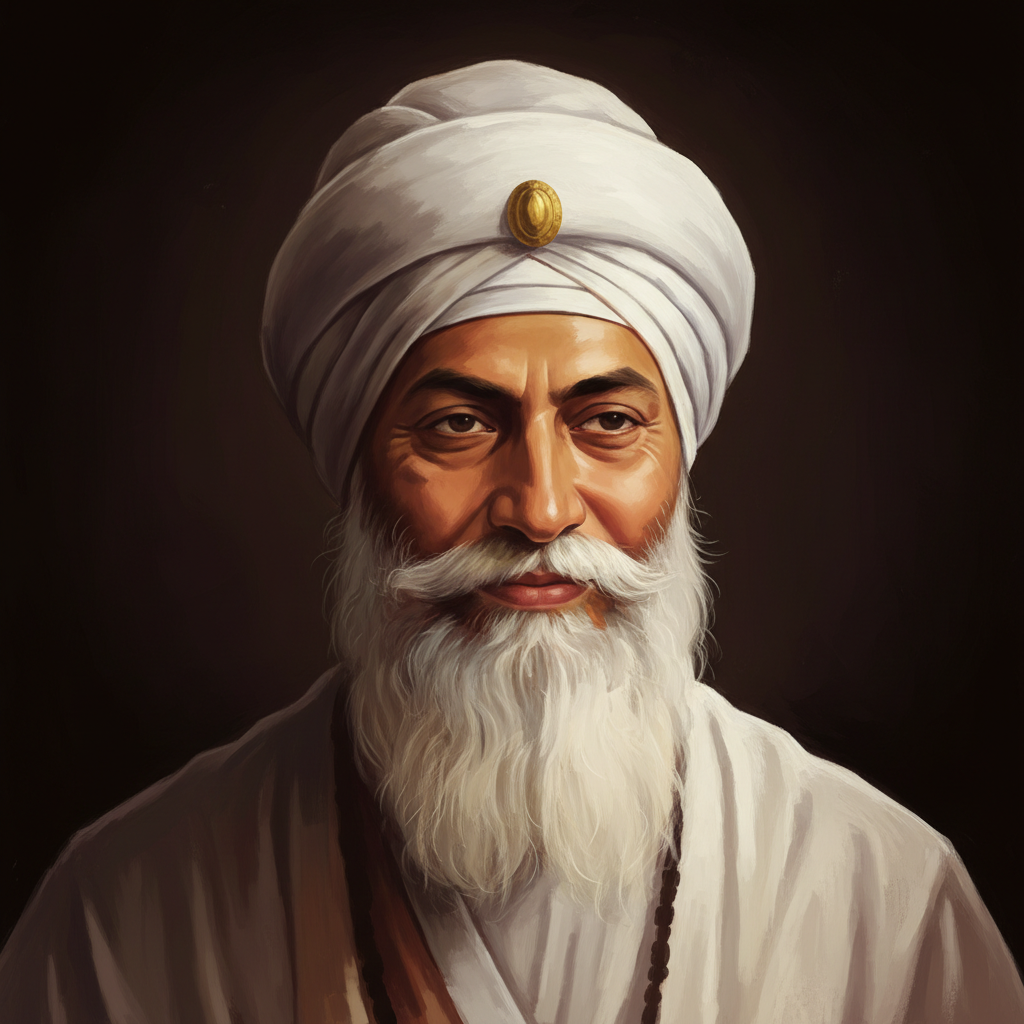
Guru Nanak — "Keep your mind pure, like the lotus in the water, untouched by its impurities."
Keep your mind pure, like the lotus in the water, untouched by its impurities.
Keep your mind pure, like the lotus in the water, untouched by its impurities.
Click any product to generate a realistic preview. Up to 3 at a time.
* Initial load can take up to 90 seconds — revising the preview in another color is nearly instant.
"The nights are wasted sleeping, and the days are wasted eating; the human spends his life in vain."
"The mind is like a wild elephant; it must be tamed by the Guru's Word."
"Without virtues, there is no devotion."
"Before becoming a Muslim, a Hindu, a Christian, a Jew, let us become a Human."
"If you must speak, speak only the Truth."
Founder of Sikhism and the first of the Ten Sikh Gurus, whose teachings of one universal God and rejection of caste shaped Punjab. Closely associated with Kabir (mystical poet whose verses appear in the Sikh Guru Granth Sahib). For an intellectual contrast, see Brahmanical orthodoxy, the Hindu caste-and-ritual establishment of his era — Sikhism was founded as a deliberate alternative to both Hindu ritual hierarchy and Islamic exclusivism — Nanak's universalism was a structural rejection of caste and priestly mediation.
Found in 1 providers: gemini
1 source checked
Stay mentally clean and untainted even while living in a corrupt or messy world. Just as a lotus grows in muddy water yet its petals remain dry and spotless, a person can engage with daily life, work, relationships, and society without letting greed, anger, or negativity stick to them. Detachment doesn't require fleeing the world; it requires keeping inner clarity intact while fully participating in it.
Guru Nanak rejected withdrawal-based asceticism, teaching householder spirituality where one works honestly, shares earnings, and remembers the divine while engaged in worldly affairs. He famously refused to abandon family or trade for forest renunciation, and the lotus image captures his central principle of being 'in the world but not of it.' This reflects his vocation as a traveling teacher who walked through markets, courts, and pilgrimage sites without attachment.
Guru Nanak (1469-1539) lived during a turbulent early-modern Punjab marked by Lodi-then-Mughal political upheaval, Babur's invasions, rigid Hindu caste hierarchies, and rote Islamic ritualism. Religious life was dominated by priests, pandits, and qazis who emphasized external purity, pilgrimage, and ceremony. Nanak's lotus teaching directly challenged this performative piety, insisting inner purity mattered more than caste status, ritual bathing, or renunciate robes—a radical message in a society obsessed with outward religious markers.
AI-generated insights based on extensive research and information for context. Factual errors? Email [email protected].
Your cart is empty