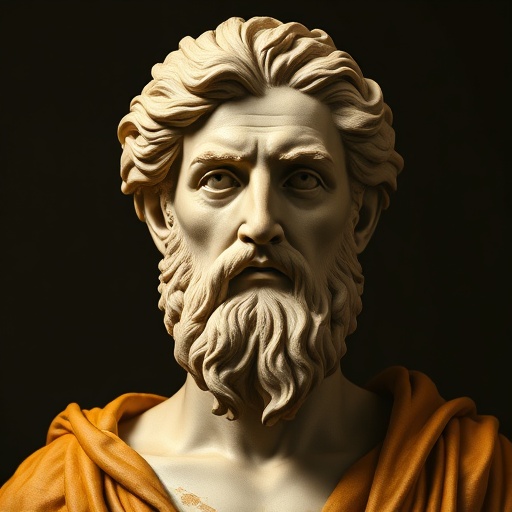
Archimedes — "Give me the place to stand, and I shall move the earth."
Give me the place to stand, and I shall move the earth.
Give me the place to stand, and I shall move the earth.
Click any product to generate a realistic preview. Up to 3 at a time.
* Initial load can take up to 90 seconds — revising the preview in another color is nearly instant.
"The center of gravity of any triangle is the point of intersection of its medians."
"Take the case of a cube and a sphere, and see which is the more beautiful body."
"The surface of any segment of a sphere is equal to a circle whose radius is the straight line drawn from the vertex of the segment to any point on the circumference of its base."
"The method of exhaustion is a powerful tool."
"The proportion of any sphere to the cylinder circumscribing it is as 2 to 3."
Assertion in demonstrating the principle of the lever, as quoted by Pappus of Alexandria.
Date: c. 250 BCE (approximate, statement made much earlier than Pappus's account)
GeneralFound in 3 providers: deepseek,gemini,grok
3 sources checked
Pure leverage: if you have a firm enough foundation and a long enough lever, you can move anything — even the earth. The quote cuts through impossibility by reframing the problem: brute force is never the answer; position and the right tool are. In modern terms, it means finding the strategic advantage, the angle, the platform that makes a seemingly insurmountable task achievable with minimal effort.
Archimedes proved the mathematics of the lever and pulley, then used them practically — reportedly moving a fully-loaded warship single-handedly to demonstrate their power to King Hiero II of Syracuse. He spent his career applying geometry to physical reality: calculating pi, deriving areas of curves, designing war machines. This quote is his philosophy made literal — the man who treated mathematics as engineering leverage personified.
Archimedes lived in Syracuse (c. 287–212 BC) during the Hellenistic period, when Greek mathematics and engineering were merging to solve real military and civic problems. Roman expansion threatened Greek city-states, and Syracuse fought for survival. War machines — catapults, cranes, counterweights — were existential technology. In a world where mechanical advantage literally determined who lived or died, a principle about leverage was not metaphor; it was strategy.
AI-generated insights based on extensive research and information for context. Factual errors? Email [email protected].
Your cart is empty