What it means
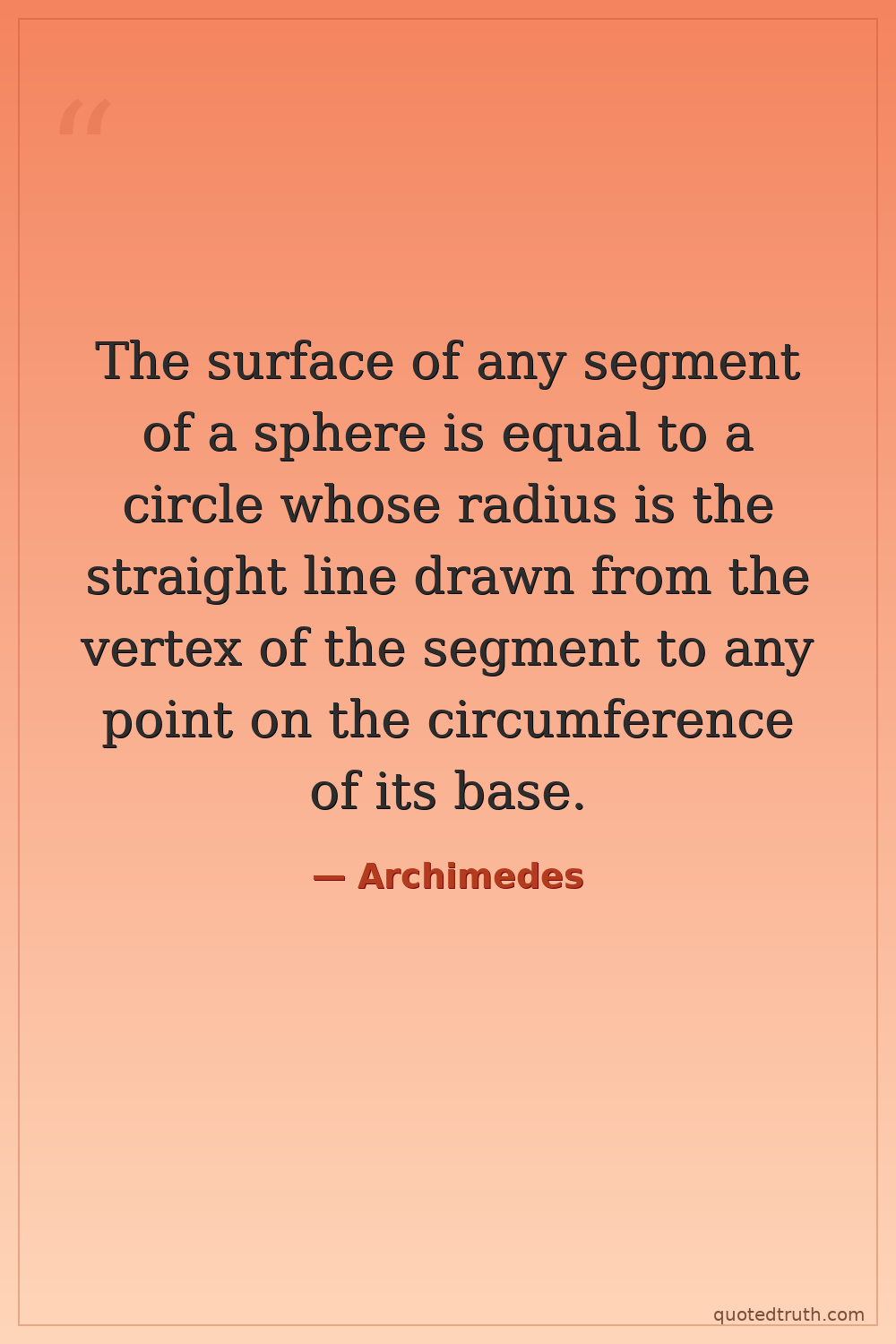
A spherical segment is a dome-shaped slice cut from a sphere. This theorem states its curved surface area equals that of a flat circle whose radius is the slant-line distance from the dome's peak straight down to any point on its circular base edge. In modern terms: area equals π times that slant distance squared. It transforms an abstract curved surface into a simple, calculable flat shape — a concrete, measurable equivalence.
Relevance to Archimedes
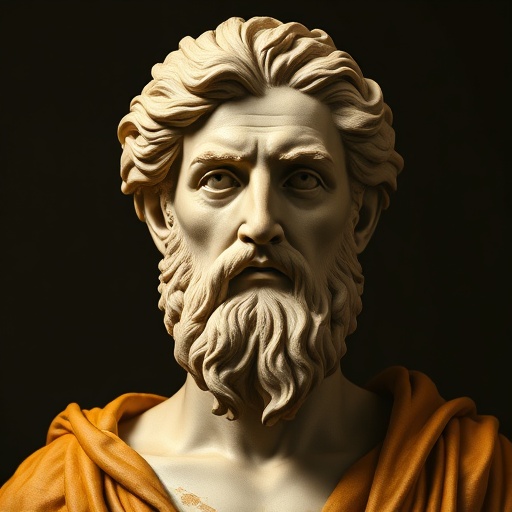
Archimedes devoted his career to measuring curved shapes that defeated other mathematicians. His treatise On the Sphere and Cylinder systematically catalogued results like this. He reportedly asked for a sphere inscribed in a cylinder carved on his tomb, showing how deeply he identified with such discoveries. This theorem exemplifies his signature method: proving that a complex curved surface is exactly equal to a simple flat figure, the core technique running through all his geometric masterworks.
The era
In third-century BC Greece, mathematics was purely geometric — no algebraic notation existed. Results had to be expressed as proportional relationships between shapes. Measuring curved surfaces was an open frontier; prior Greek work focused mainly on flat figures. Archimedes worked in Hellenistic Syracuse, where Greek learning had spread after Alexander's conquests. Roman military expansion threatened Greek city-states throughout this era — Archimedes himself died when Rome sacked Syracuse in 212 BC, making this intellectual golden age both brilliant and precarious.
AI-generated insights based on extensive research and information for context. Factual errors? Email [email protected].