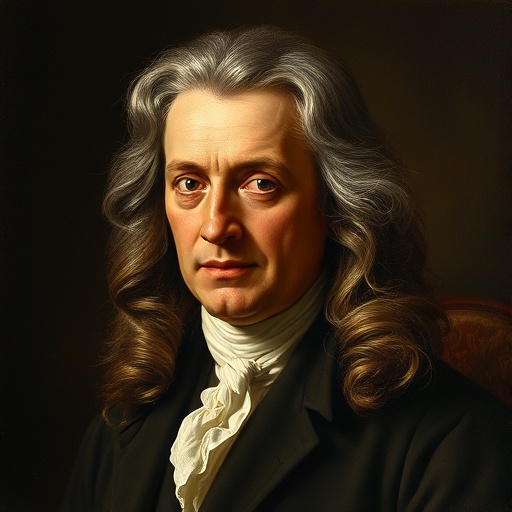
Isaac Newton — "I can calculate the motion of heavenly bodies, but not the madness of people."
I can calculate the motion of heavenly bodies, but not the madness of people.
I can calculate the motion of heavenly bodies, but not the madness of people.
Click any product to generate a realistic preview. Up to 3 at a time.
* Initial load can take up to 90 seconds — revising the preview in another color is nearly instant.
"God is the same God, always and everywhere. He is omnipresent not virtually only, but also substantially; for virtue cannot subsist without substance."
"I consider the world as a stage, and the actions of men as a play, in which every one acts a part."
"The changing of bodies into light, and light into bodies, is very conformable to the course of nature, which seems delighted with transmutations."
"The way to chastity is not to struggle directly with incontinent thoughts but to avert the thoughts by some employment, or by reading, or by meditating on other things."
"The changing of bodies into light, and light into bodies, is very conformable to the course of Nature."
Found in 3 providers: gemini,grok,deepseek
3 sources checked
Human behavior resists the logic that governs the physical world. No matter how precisely you can model planets, forces, or trajectories, people act on emotion, greed, fear, and irrationality. The quote captures a universal frustration: nature obeys discoverable laws, but crowds, markets, and individuals follow no formula. Even genius-level intellect cannot reliably predict or control what humans will do next.
Newton lost roughly £20,000—a staggering fortune—in England's South Sea Bubble collapse of 1720, reportedly speaking words nearly identical to this quote. Brilliant yet deeply socially withdrawn, he engaged in bitter disputes with Leibniz over calculus priority and Hooke over optics. His life's work centered on deterministic, rule-governed systems; the chaos of human motivation was his openly acknowledged blind spot.
The early modern period saw the Scientific Revolution transform Western thought—Newton's Principia Mathematica (1687) proved the universe operated on elegant mathematical laws. Yet the same era produced speculative financial disasters like England's South Sea Bubble (1720) and the Dutch Tulip Mania, revealing that human markets defied rational prediction. Enlightenment optimism about reason coexisted with irrational crowd behavior, making the limits of calculation a pressing cultural question.
AI-generated insights based on extensive research and information for context. Factual errors? Email [email protected].
Your cart is empty