What it means
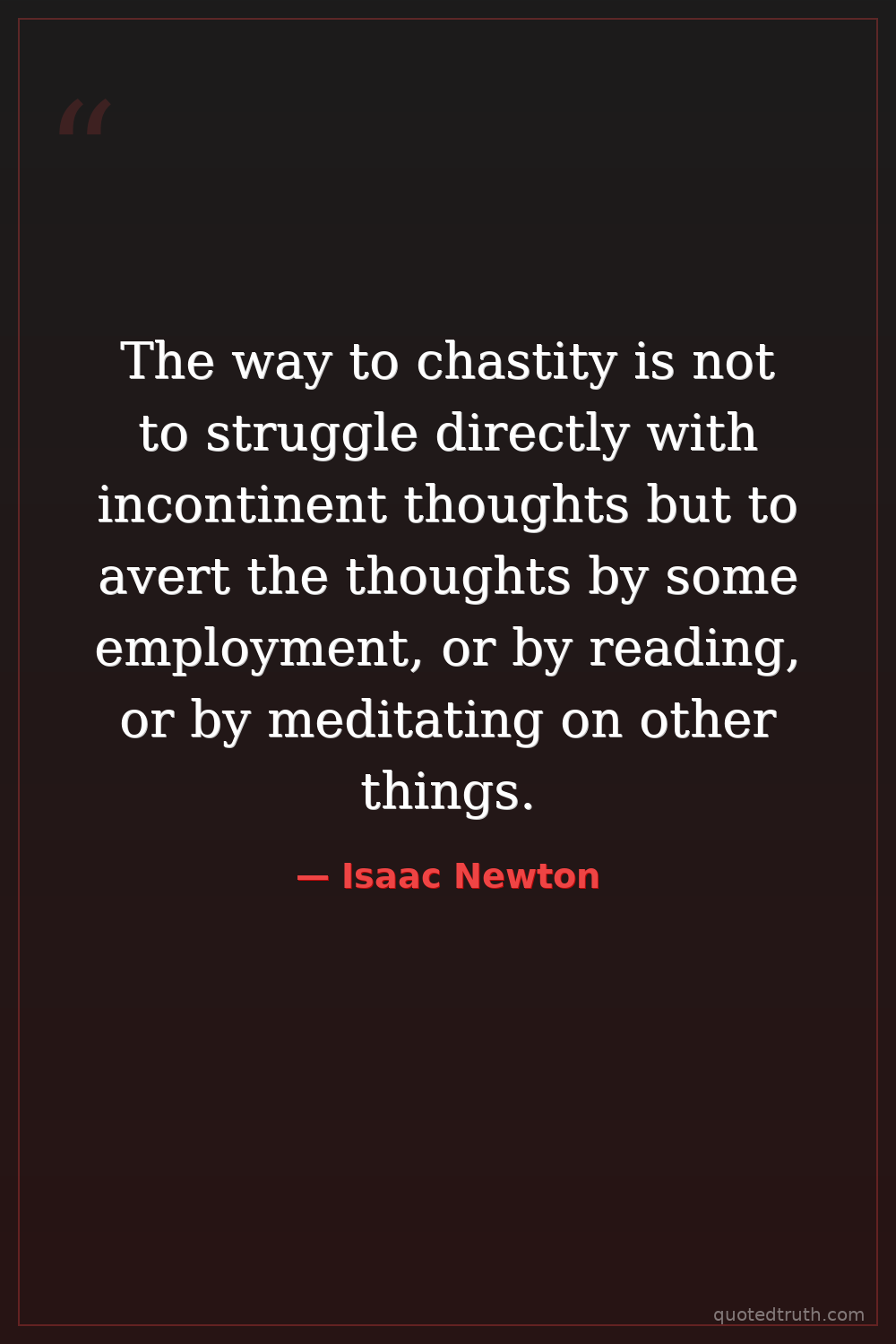
Fighting unwanted thoughts directly makes them stronger. Instead, redirect your mind through purposeful activity — work, reading, or deliberate focus on something else. This is cognitive redirection: willpower alone fails against intrusive thoughts, but genuine engagement in meaningful tasks naturally crowds them out. It anticipates modern behavioral psychology's finding that thought suppression backfires while distraction through absorption is far more effective for mental discipline.
Relevance to Isaac Newton
Newton was famously celibate his entire life, never marrying and likely dying a virgin. Deeply religious, he spent as much time on theology and biblical prophecy as on physics. He understood relentless intellectual work as moral discipline. His prescribed remedy — employment, reading, meditation — mirrors exactly how he lived: perpetually absorbed in mathematics, optics, alchemy, and scripture, using cognitive immersion as his personal strategy for maintaining a strictly ascetic existence.
The era
Newton lived in late 17th-century England, where Puritan moral strictness collided with the open licentiousness of Charles II's Restoration court. Protestant theology placed enormous weight on mastering sinful impulses, while Stoic philosophy — widely read among educated men — framed bodily self-governance as an intellectual virtue. Debates about sin, celibacy, and worldly temptation were culturally urgent. Moral self-mastery was inseparable from religious standing and scholarly credibility in Newton's world.
AI-generated insights based on extensive research and information for context. Factual errors? Email [email protected].