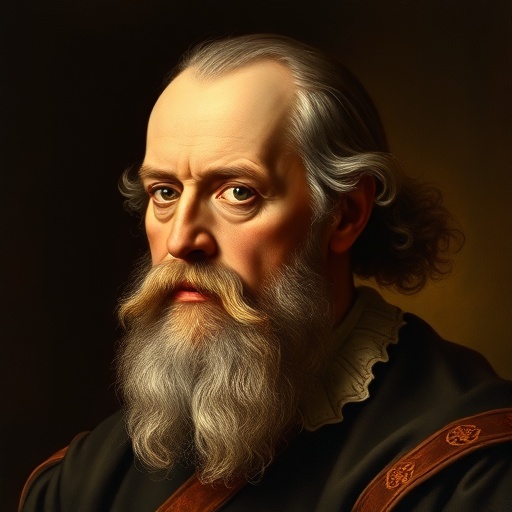
Galileo Galilei — "Measure what is measurable, and make measurable what is not so."
Measure what is measurable, and make measurable what is not so.
Measure what is measurable, and make measurable what is not so.
Click any product to generate a realistic preview. Up to 3 at a time.
* Initial load can take up to 90 seconds — revising the preview in another color is nearly instant.
"It is surely harmful to souls to make it a heresy to believe what has been proved."
"The senses, being the interpreters of natural effects, are the only door to scientific knowledge."
"To deny the evidence of one's own eyes, and to prefer to believe a doctrine which is contrary to all experience, shows a mind that is either very dull or very prejudiced."
"The greater the number of people who believe a proposition, the more likely it is to be false."
"It is a beautiful thing to know that the heavens are not immutable."
Found in 1 providers: grok
1 source checked
Focus on quantifying reality precisely, and when something seems impossible to measure, find a way to measure it anyway. Don't accept vague impressions or speculation as knowledge. Rigor demands turning qualitative observations into numbers you can test, compare, and build upon. This is the foundation of scientific method: if you can't measure it, you haven't truly understood it.
Galileo built telescopes to quantify celestial motion, measured falling objects with inclined planes and water clocks when stopwatches didn't exist, and demolished Aristotelian physics through precise experiment. He invented instruments including the thermoscope and geometric compass. His entire career was a demonstration of this principle: he made the previously unmeasurable — planetary orbits, acceleration, lunar craters — measurable.
In early modern Europe, natural philosophy relied heavily on Aristotelian authority and qualitative description. The Scientific Revolution was dismantling this tradition, demanding empirical evidence over inherited wisdom. Galileo worked during the Inquisition's height, yet pushed quantitative methods that threatened both Church doctrine and academic orthodoxy. His era desperately needed a framework replacing divine assertion with reproducible measurement.
AI-generated insights based on extensive research and information for context. Factual errors? Email [email protected].
Your cart is empty