Alan Turing — "If a machine can think, it might think more intelligently than we do, and then w…"
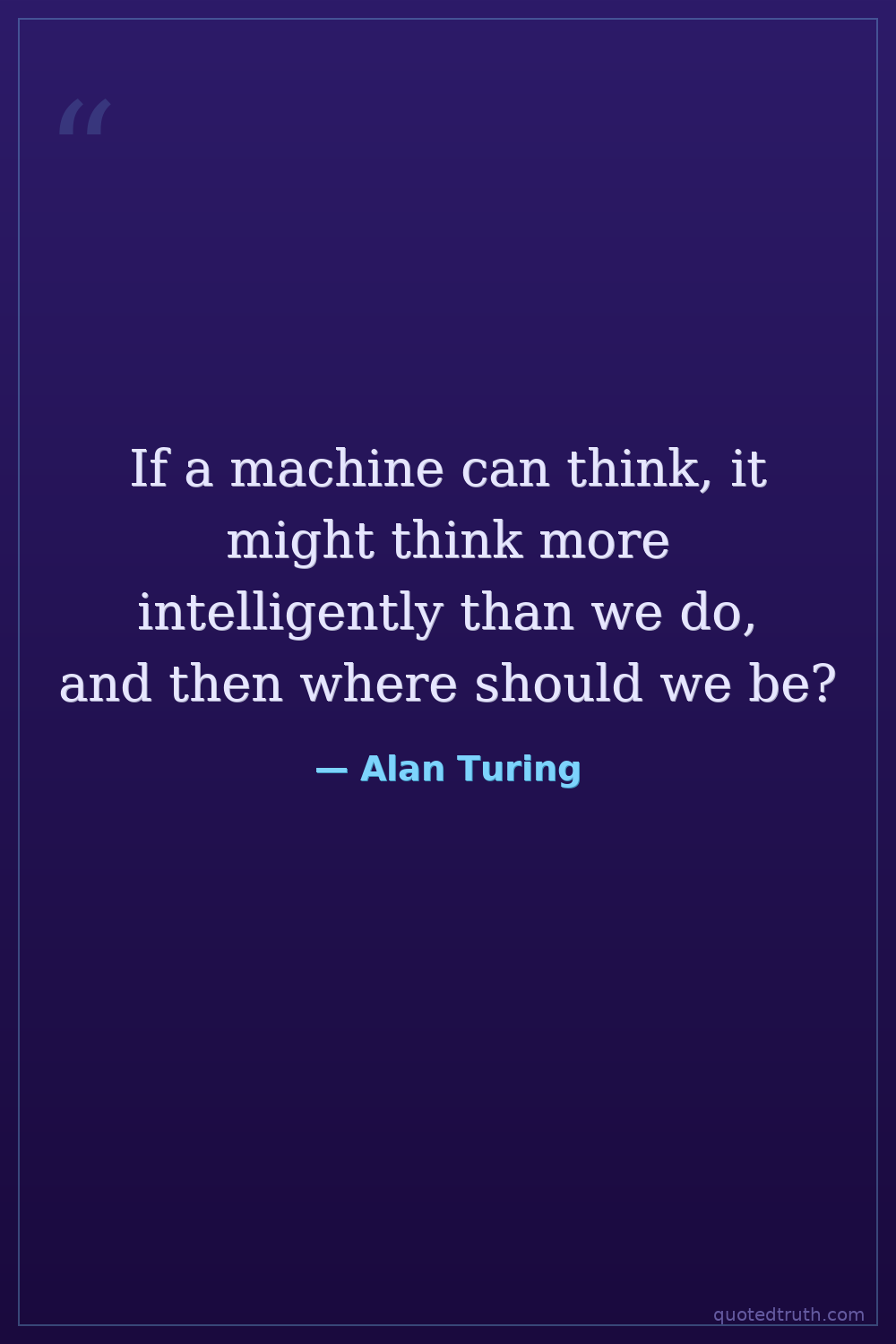
If a machine can think, it might think more intelligently than we do, and then where should we be?
If a machine can think, it might think more intelligently than we do, and then where should we be?
Click any product to generate a realistic preview. Up to 3 at a time.
* Initial load can take up to 90 seconds — revising the preview in another color is nearly instant.
"The machine has a definite state at any moment, which is determined by the instructions it has received and by the results of its previous operations."
"The human mind is a complex adaptive system."
"I am not concerned with whether a machine has feelings, but whether it can perform tasks that require intelligence."
"The machine should be able to communicate with human beings."
"Instead of trying to produce a programme to simulate the adult mind, why not rather try to produce one which simulates the child's? If this were then subjected to an appropriate course of education on…"
Found in 1 providers: gemini
1 source checked
The quote poses a direct challenge about the consequences of creating truly thinking machines. If a machine can think at all, nothing limits its intelligence to human levels—it could surpass us entirely. The phrase 'where should we be?' captures genuine uncertainty about humanity's place and purpose in a world where we are no longer the most intelligent entities. It is an early, precise framing of what we now call artificial general intelligence risk.
Turing's 1950 paper 'Computing Machinery and Intelligence' proposed the Turing Test to assess machine thought, proving he took this question seriously. Having broken the Enigma cipher at Bletchley Park using mechanical computation, he understood firsthand what machines could achieve. This quote reflects his characteristic intellectual honesty: not cheerleading for AI's promise but genuinely reckoning with its implications for human relevance and control—concerns central to his philosophy of mind.
In the early 1950s, electronic computers were barely public, and scientists were only beginning to grasp their potential. Norbert Wiener's 'Cybernetics' (1948) had just opened serious debates about machine intelligence and human control. Cold War pressures were accelerating computing research while the idea of a machine outthinking humans felt both newly conceivable and deeply unsettling. Turing's question arrived precisely when it first crossed from pure speculation into legitimate scientific possibility.
AI-generated insights based on extensive research and information for context. Factual errors? Email [email protected].
Your cart is empty