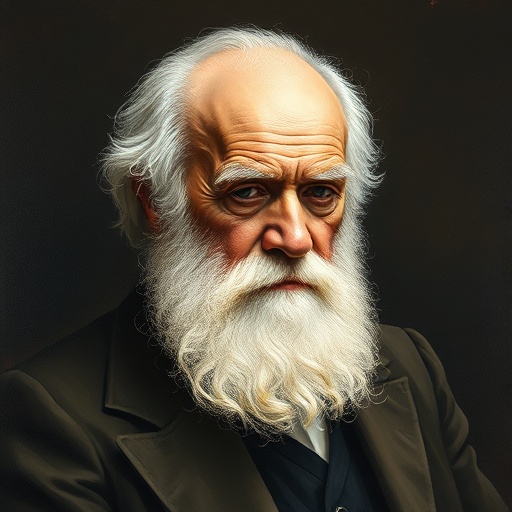
Charles Darwin — "We are like a judge who has to sum up and deliver judgment, not on the evidence …"
We are like a judge who has to sum up and deliver judgment, not on the evidence of witnesses, but on the arguments of counsel.
We are like a judge who has to sum up and deliver judgment, not on the evidence of witnesses, but on the arguments of counsel.
Click any product to generate a realistic preview. Up to 3 at a time.
* Initial load can take up to 90 seconds — revising the preview in another color is nearly instant.
"The world will not be inherited by the strongest, it will be inherited by those most able to change."
"An American monkey, after getting drunk on brandy, would never touch it again, and thus is much wiser than most men."
"Man has risen to the very summit of the organic scale; and the fact of his having thus risen, instead of having been aboriginally placed there, is the best proof of his power of development."
"I am turned into a sort of machine for observing facts and grinding out generalizations."
"Man selects only for his own good: Nature only for that of the being which she tends."
British naturalist whose On the Origin of Species (1859) established evolution by natural selection — the unifying theory of modern biology. Closely associated with Thomas Henry Huxley (his 'bulldog' public defender) and Alfred Russel Wallace (independent co-discoverer of natural selection). For an intellectual contrast, see William Paley, Anglican theologian and Natural Theology author (1743-1805) — Origin of Species is structurally a 400-page reply to Paley — Darwin admired Paley's watchmaker-argument as an undergraduate at Cambridge and then spent 20 years building the empirical machinery to displace him. The cleanest 'design argument vs natural selection' founding rebuttal in science.
The standard scholarly entry points to Charles Darwin's work: Janet Browne (Harvard, history of science) — Charles Darwin: Voyaging (1995) and The Power of Place (2002); Adrian Desmond (UCL, biographer) — Darwin: The Life of a Tormented Evolutionist (1991, with James Moore). These are the works graduate seminars cite when teaching Charles Darwin.
Found in 1 providers: grok
1 source checked
The quote compares intellectual reasoning to a courtroom judge who hears lawyers argue but never questions witnesses directly. It means we often must form conclusions from secondhand reasoning and constructed arguments rather than direct observation or raw evidence. The challenge is reaching sound judgment when you cannot access the facts yourself — only the interpretations and arguments that others present to you. Epistemic humility is required.
Darwin built the theory of evolution through accumulated inference — fossils, comparative anatomy, artificial breeding, geographic distribution — never witnessing speciation firsthand. His case rested entirely on persuasive argument rather than direct proof. Famously cautious, he delayed publishing On the Origin of Species for twenty years, obsessively refining his arguments. This quote reveals his philosophical self-awareness: even he was a judge evaluating arguments, not an eyewitness to the biological process he described.
Victorian science operated largely through inference and argument rather than controlled experiment. Geology, paleontology, and natural history built grand theories from fragmentary data. Natural theology — arguing God's existence from nature's design — had long set the standard for persuasion through reasoning. When Darwin published in 1859, public debate hinged on who argued most convincingly, not direct proof. Churches, scientific societies, and Parliament all functioned as judge-like bodies weighing competing intellectual counsel.
AI-generated insights based on extensive research and information for context. Factual errors? Email [email protected].
Your cart is empty