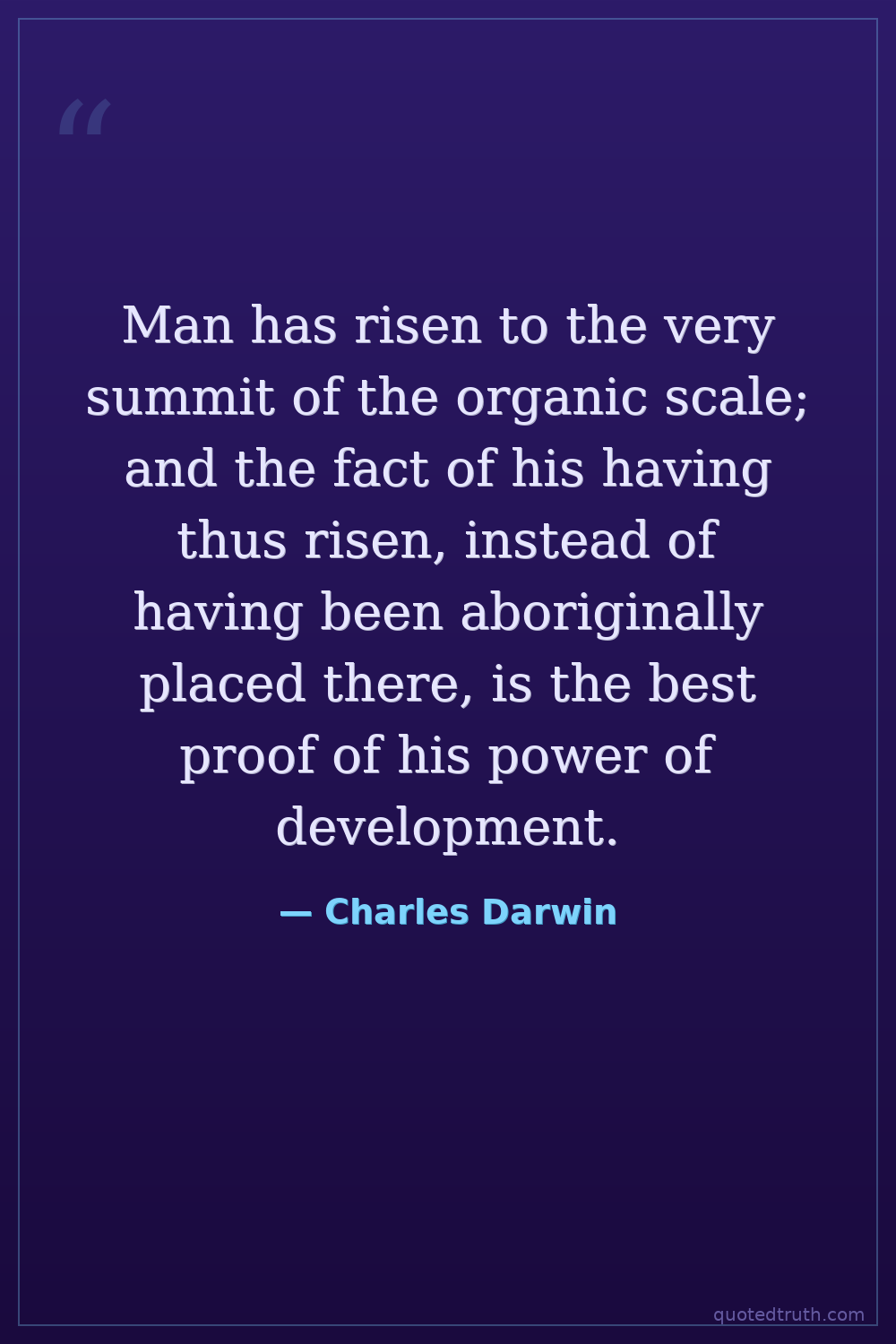
Charles Darwin — "Man has risen to the very summit of the organic scale; and the fact of his havin…"

Man has risen to the very summit of the organic scale; and the fact of his having thus risen, instead of having been aboriginally placed there, is the best proof of his power of development.
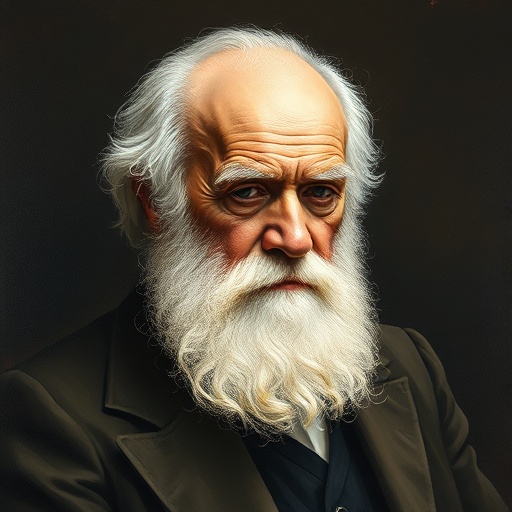
Charles Darwin — Charles Darwin Modern · Theory of evolution

Get This Quote & Author's Image Illustrated On:

Click any product to generate a realistic preview. Up to 3 at a time.
* Initial load can take up to 90 seconds — revising the preview in another color is nearly instant.

Kitchen

Apparel

Other

About Charles Darwin (1809-1882)

British naturalist whose On the Origin of Species (1859) established evolution by natural selection — the unifying theory of modern biology. Closely associated with Thomas Henry Huxley (his 'bulldog' public defender) and Alfred Russel Wallace (independent co-discoverer of natural selection). For an intellectual contrast, see William Paley, Anglican theologian and Natural Theology author (1743-1805) — Origin of Species is structurally a 400-page reply to Paley — Darwin admired Paley's watchmaker-argument as an undergraduate at Cambridge and then spent 20 years building the empirical machinery to displace him. The cleanest 'design argument vs natural selection' founding rebuttal in science.

The standard scholarly entry points to Charles Darwin's work: Janet Browne (Harvard, history of science) — Charles Darwin: Voyaging (1995) and The Power of Place (2002); Adrian Desmond (UCL, biographer) — Darwin: The Life of a Tormented Evolutionist (1991, with James Moore). These are the works graduate seminars cite when teaching Charles Darwin.
Details

The Descent of Man

Date: 1871

Power & Leadership

Verification

Unverifiable

Found in 1 providers: grok

1 source checked

Understanding this quote

What it means

Humans have climbed to the top of the biological hierarchy through natural processes rather than being placed there by design. The very fact that we developed gradually from simpler ancestors—instead of appearing fully formed—is the strongest evidence of life's capacity for growth and transformation. Rising is more impressive than starting at the top; our origins in lower organisms make our current complexity a testament to natural development's power.

Relevance to Charles Darwin

Darwin spent decades building the case that humanity was not specially created but descended from earlier primates—a conclusion he was personally cautious about, knowing its social cost. His 1871 book 'The Descent of Man' directly tackled human evolution. This quote reflects his core conviction that evolutionary ascent is not degradation but triumph: natural selection, the mechanism he discovered, could produce intelligent beings from simple ancestors through unguided incremental change.

The era

Darwin published this during the Victorian era, when the Church of England held enormous cultural authority and divine special creation of humanity was orthodox doctrine. 'The Descent of Man' (1871) ignited fierce public controversy. Industrial revolution-era optimism about human progress collided with deep religious anxiety about mankind's place in nature. Framing evolution as proof of human greatness—rather than humiliation—was Darwin's strategic attempt to make the science culturally palatable.

AI-generated insights based on extensive research and information for context. Factual errors? Email [email protected].

Your Cart

Your cart is empty