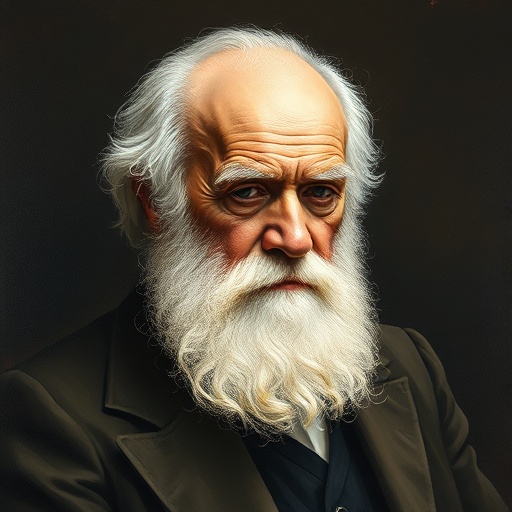
Charles Darwin — "The world will not be inherited by the strongest, it will be inherited by those …"
The world will not be inherited by the strongest, it will be inherited by those most able to change.
The world will not be inherited by the strongest, it will be inherited by those most able to change.
Click any product to generate a realistic preview. Up to 3 at a time.
* Initial load can take up to 90 seconds — revising the preview in another color is nearly instant.
"I have tried to be a good boy, and I have done my best."
"I see no good reason why the views given in this volume should shock the religious feelings of any one."
"Blushing is the most peculiar and most human of all expressions."
"Great is the power of steady misrepresentation."
"I am almost convinced that species are not (it is like confessing a murder) immutable."
British naturalist whose On the Origin of Species (1859) established evolution by natural selection — the unifying theory of modern biology. Closely associated with Thomas Henry Huxley (his 'bulldog' public defender) and Alfred Russel Wallace (independent co-discoverer of natural selection). For an intellectual contrast, see William Paley, Anglican theologian and Natural Theology author (1743-1805) — Origin of Species is structurally a 400-page reply to Paley — Darwin admired Paley's watchmaker-argument as an undergraduate at Cambridge and then spent 20 years building the empirical machinery to displace him. The cleanest 'design argument vs natural selection' founding rebuttal in science.
The standard scholarly entry points to Charles Darwin's work: Janet Browne (Harvard, history of science) — Charles Darwin: Voyaging (1995) and The Power of Place (2002); Adrian Desmond (UCL, biographer) — Darwin: The Life of a Tormented Evolutionist (1991, with James Moore). These are the works graduate seminars cite when teaching Charles Darwin.
Another common misattribution. Similar to the 'adaptable to change' quote.
Date: Uncertain
Power & LeadershipFound in 1 providers: grok
1 source checked
The quote argues that survival and long-term success belong not to the most powerful or dominant, but to those capable of adapting when circumstances shift. Strength alone becomes a liability when environments change; flexibility and responsiveness are the real competitive advantages. It rejects brute-force dominance as a sustainable strategy, framing adaptability as the ultimate survival trait in a world that constantly reshapes its demands.
Darwin spent five years aboard the HMS Beagle observing how isolated species diverged through gradual adaptation rather than raw dominance. His natural selection theory, published in On the Origin of Species (1859), demonstrated that species surviving geological upheaval possessed heritable variations suited to new conditions — not merely size or strength. His own career demanded intellectual flexibility to challenge entrenched creationist doctrine across decades of resistance.
Darwin published On the Origin of Species in 1859 amid the Industrial Revolution, when technological scale seemed to confirm that strength and size ruled. Yet the era also saw rapid species extinction and empire overreach, exposing dominance as fragile. Victorian debates over class, progress, and hierarchy made Darwin's reframing radical: environmental pressure selects for adaptability, not power — a principle that unsettled both natural science and social order.
AI-generated insights based on extensive research and information for context. Factual errors? Email [email protected].
Your cart is empty