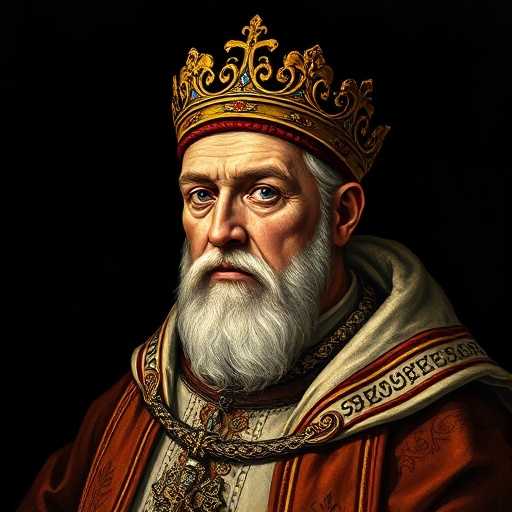
Pope Urban II — "Let those who go not put off the journey, but rent their lands and collect money…"
Let those who go not put off the journey, but rent their lands and collect money for their expenses.
Let those who go not put off the journey, but rent their lands and collect money for their expenses.
Click any product to generate a realistic preview. Up to 3 at a time.
* Initial load can take up to 90 seconds — revising the preview in another color is nearly instant.
"They torture Christians with unheard-of cruelties."
"Let those who have been hired for a few pieces of silver now receive an eternal reward."
"May your courage be increased, and your hearts be strengthened, for the Lord is with you."
"Let no obstacle impede you, but go forth, trusting in the Lord."
"The land of the Lord is now held by the infidels."
Pope (1088-1099) whose Council of Clermont speech (November 1095) launched the First Crusade — the founding event of nine centuries of Christian-Muslim military conflict. Closely associated with Pope Gregory VII (his predecessor on papal-imperial reform). For an intellectual contrast, see Saladin, Kurdish-Muslim Sultan of Egypt and Syria (1138-1193) — Saladin recaptured Jerusalem in 1187, undoing the First Crusade Urban II launched 92 years earlier. Saladin's chivalrous treatment of Christian prisoners became the canonical Muslim counter-image to Crusader brutality. The cleanest before/after pairing of the Crusades' moral arc.
Found in 1 providers: deepseek
1 source checked
This quote urges would-be crusaders to stop hesitating and prepare financially for the journey. Rather than spiritual encouragement alone, it delivers practical instruction: lease your lands to generate income, gather travel funds, and depart without further delay. It acknowledges that holy war requires worldly logistics — money, preparation, and commitment. The underlying message is urgency: God's cause cannot wait for the cautious or the financially unprepared.
Urban II launched the First Crusade at Clermont in 1095, mobilizing thousands of European knights and pilgrims. As a shrewd papal administrator trained in the Benedictine tradition, he understood that fervor alone could not sustain an army across thousands of miles. His insistence on securing funding before departing reflects pragmatic ecclesiastical leadership — he needed organized, supplied forces, not underfunded mobs. The People's Crusade's catastrophic early departure later vindicated exactly this caution.
In 1095 feudal Europe, a knight's wealth was entirely land-bound — converting it to travel cash required renting estates to tenants, sometimes for years. The Seljuk Turks had seized Jerusalem and Anatolia, severing pilgrimage routes Christians had used for centuries. With no professional armies or state financing, crusading depended on individual lords self-funding their expeditions. Urban's directive to rent lands was the era's equivalent of liquidating assets before an indefinite, potentially fatal undertaking.
AI-generated insights based on extensive research and information for context. Factual errors? Email [email protected].
Your cart is empty