What it means
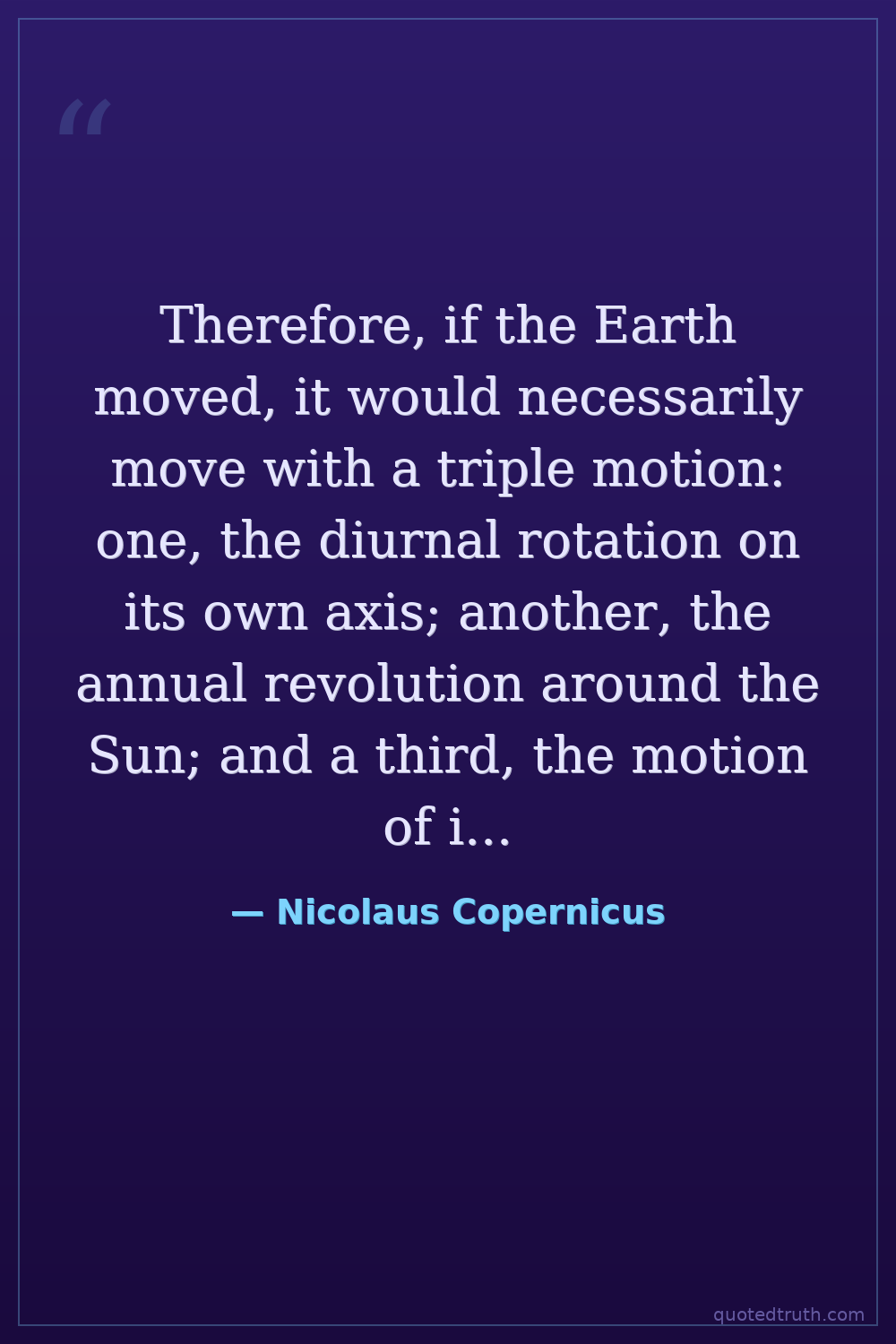
Earth, if it moves at all, must perform three distinct motions simultaneously: a daily spin on its own axis producing day and night, a yearly orbit around the Sun producing the seasons, and a slow wobble of its axial tilt explaining the gradual shift of equinoxes over centuries. Copernicus is laying out the full mechanical consequence of removing Earth from the cosmic center—motion must account for everything observers see in the sky.
Relevance to Nicolaus Copernicus
Copernicus spent over thirty years refining his heliocentric theory before publishing De Revolutionibus Orbium Coelestium in 1543, the year he died. A meticulous mathematician and Catholic church canon in Poland, he prioritized mathematical elegance and observational consistency. This passage shows his systematic logic: once Earth moves, every astronomical phenomenon demands explanation. His caution in publishing reflects awareness of theological stakes, yet his reasoning here is relentless and precise.
The era
In Copernicus's time, Ptolemaic geocentrism—Earth fixed at the universe's center—had been authoritative for 1,400 years, endorsed by Church doctrine and Aristotelian physics. The Renaissance was reviving classical texts and mathematical inquiry while the Protestant Reformation fractured Europe's intellectual consensus. Publishing a moving Earth risked ridicule and censure. Copernicus's careful framing of Earth's triple motion as mathematical necessity rather than physical fact was a deliberate strategy to defuse theological objections.
AI-generated insights based on extensive research and information for context. Factual errors? Email [email protected].