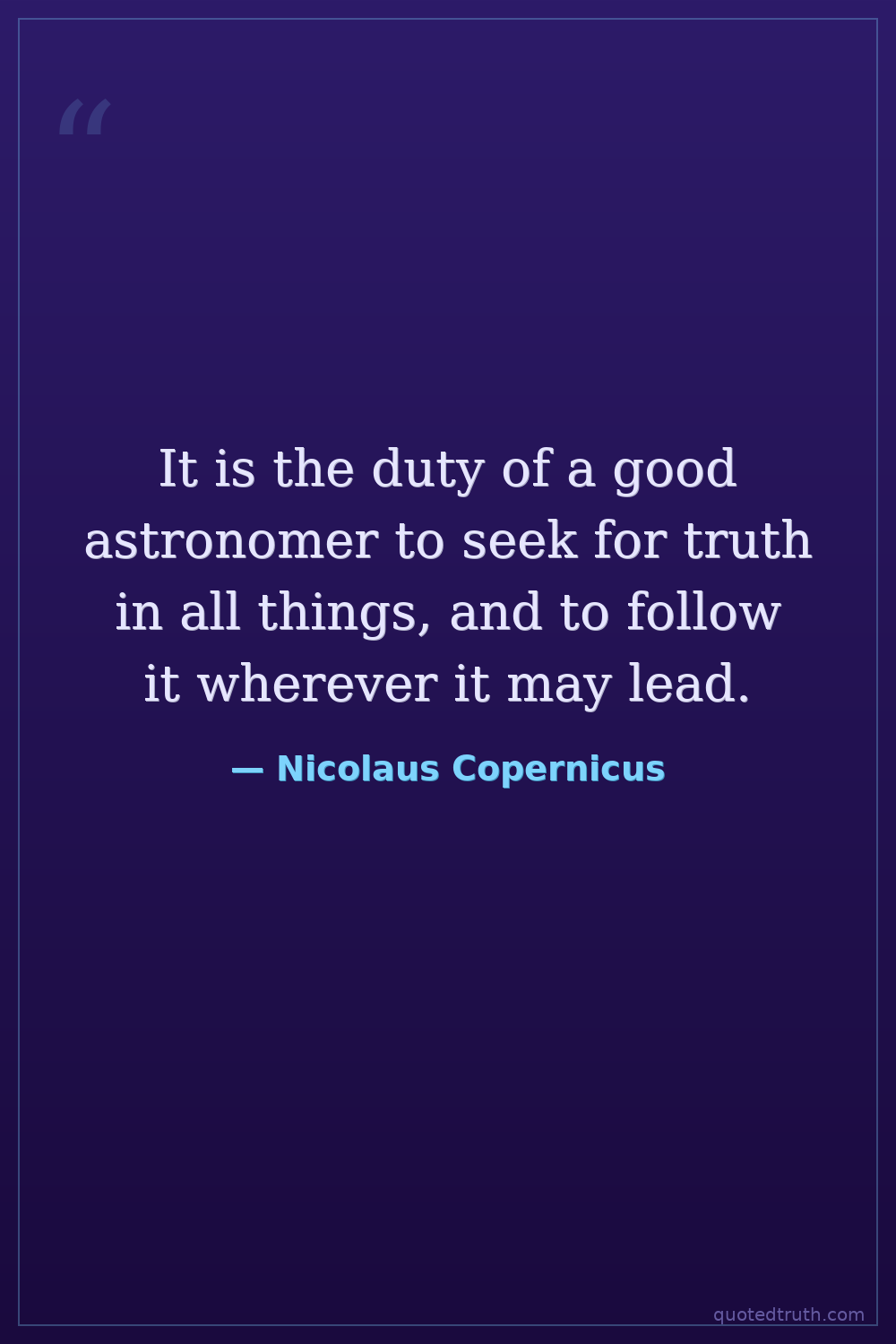
Nicolaus Copernicus — "It is the duty of a good astronomer to seek for truth in all things, and to foll…"
It is the duty of a good astronomer to seek for truth in all things, and to follow it wherever it may lead.
It is the duty of a good astronomer to seek for truth in all things, and to follow it wherever it may lead.
Click any product to generate a realistic preview. Up to 3 at a time.
* Initial load can take up to 90 seconds — revising the preview in another color is nearly instant.
"It is enough if the hypotheses save the phenomena."
"The massive bulk of the Earth does indeed shrink to insignificance in comparison with the size of the heavens."
"For if the earth should move from west to east, the fixed stars would appear to move from east to west."
"In the middle of all sits the Sun enthroned. In this most beautiful temple, could we place this luminary in any better position from which he can illuminate the whole at once?"
"Perhaps there will be babblers who, although completely ignorant of mathematics, nevertheless dare to pass judgment on these things, and because of some passage in Holy Scripture, want to distort my b…"
Attributed, general sentiment but not a direct quote from his major work.
Date: 16th Century (approx.)
WisdomFound in 1 providers: grok
1 source checked
Anyone genuinely pursuing knowledge has a professional and moral obligation to prioritize truth above comfort, consensus, or personal safety. You cannot call yourself a scientist — or any honest inquirer — while stopping short of conclusions that feel dangerous or unwelcome. The quote demands intellectual courage: start with rigorous observation, follow the evidence chain honestly, and accept whatever conclusion it reaches, even if it overturns everything people previously believed.
Copernicus spent roughly thirty years developing mathematical proof that Earth orbits the Sun, not vice versa — directly contradicting Church doctrine and the 1,400-year-old Ptolemaic consensus. As a Catholic canon, he faced profound institutional pressure. He delayed publishing De Revolutionibus Orbium Coelestium until 1543, reportedly receiving his printed copy on his deathbed. His life embodied this principle: he followed mathematical truth all the way to a conclusion that reordered humanity's place in the cosmos.
In early 16th-century Europe, the Catholic Church held supreme authority over both spiritual truth and natural philosophy. The geocentric Ptolemaic model had been doctrinal orthodoxy for over a millennium. The Renaissance was accelerating empirical inquiry, and the printing press was spreading heterodox ideas faster than institutions could contain them. Challenging cosmological consensus risked censure or worse. Within decades, Galileo would be tried for defending Copernicus's model — proof that following truth carried real, existential stakes.
AI-generated insights based on extensive research and information for context. Factual errors? Email [email protected].
Your cart is empty