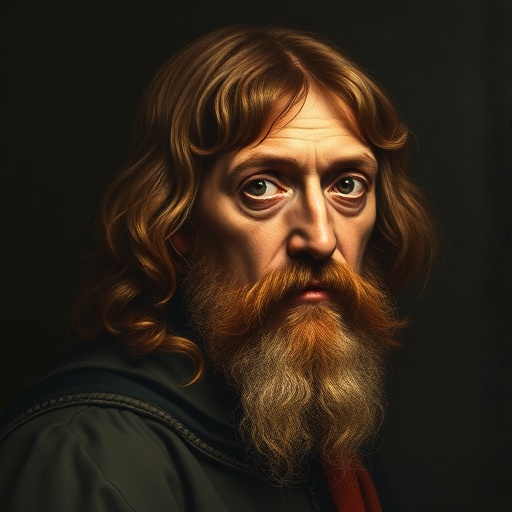
Nicolaus Copernicus — "The Sun, as if seated on a royal throne, governs the family of stars which wheel…"
The Sun, as if seated on a royal throne, governs the family of stars which wheel around it.
The Sun, as if seated on a royal throne, governs the family of stars which wheel around it.
Click any product to generate a realistic preview. Up to 3 at a time.
* Initial load can take up to 90 seconds — revising the preview in another color is nearly instant.
"The sphere of the fixed stars is immovable and embraces all things."
"The sphere is the most perfect of all figures, hence it is the form of the world."
"It is not the earth that is the center of the universe, but the sun."
"The order of the planets is this: Saturn, Jupiter, Mars, Earth, Venus, Mercury."
"When, therefore, I had long considered the uncertainty of the traditional mathematical doctrines concerning the order of the spheres of the universe, I began to be annoyed that no more accurate explan…"
De revolutionibus orbium coelestium (poetic description of the Sun's role)
Date: 1543
Power & LeadershipFound in 1 providers: grok
1 source checked
The Sun sits at the center of the cosmos like a king on a throne, with all the planets orbiting around it in an orderly, governed system. This reframes the solar system not as chaos but as a structured hierarchy with the Sun as sovereign ruler — a majestic, purposeful arrangement where celestial bodies follow predictable paths around one central, commanding authority.
Copernicus spent decades as a Polish canon and physician before publishing his revolutionary De Revolutionibus Orbium Coelestium in 1543. This quote captures the heliocentric model he defended against entrenched Ptolemaic geocentrism. His royal metaphor for the Sun reflects both his classical education and his need to make radical astronomy palatable — framing cosmic truth in the regal language his learned contemporaries would respect.
In the early 16th century, the Catholic Church and Aristotelian philosophy placed Earth immovably at the universe's center. Copernicus wrote during the Renaissance, when humanist scholarship began challenging ancient authorities. His heliocentric claim was so threatening that De Revolutionibus was published only as he lay dying. Framing the Sun as a monarch was a strategic rhetorical move, invoking divine order rather than pure mechanical theory to soften the blow.
AI-generated insights based on extensive research and information for context. Factual errors? Email [email protected].
Your cart is empty