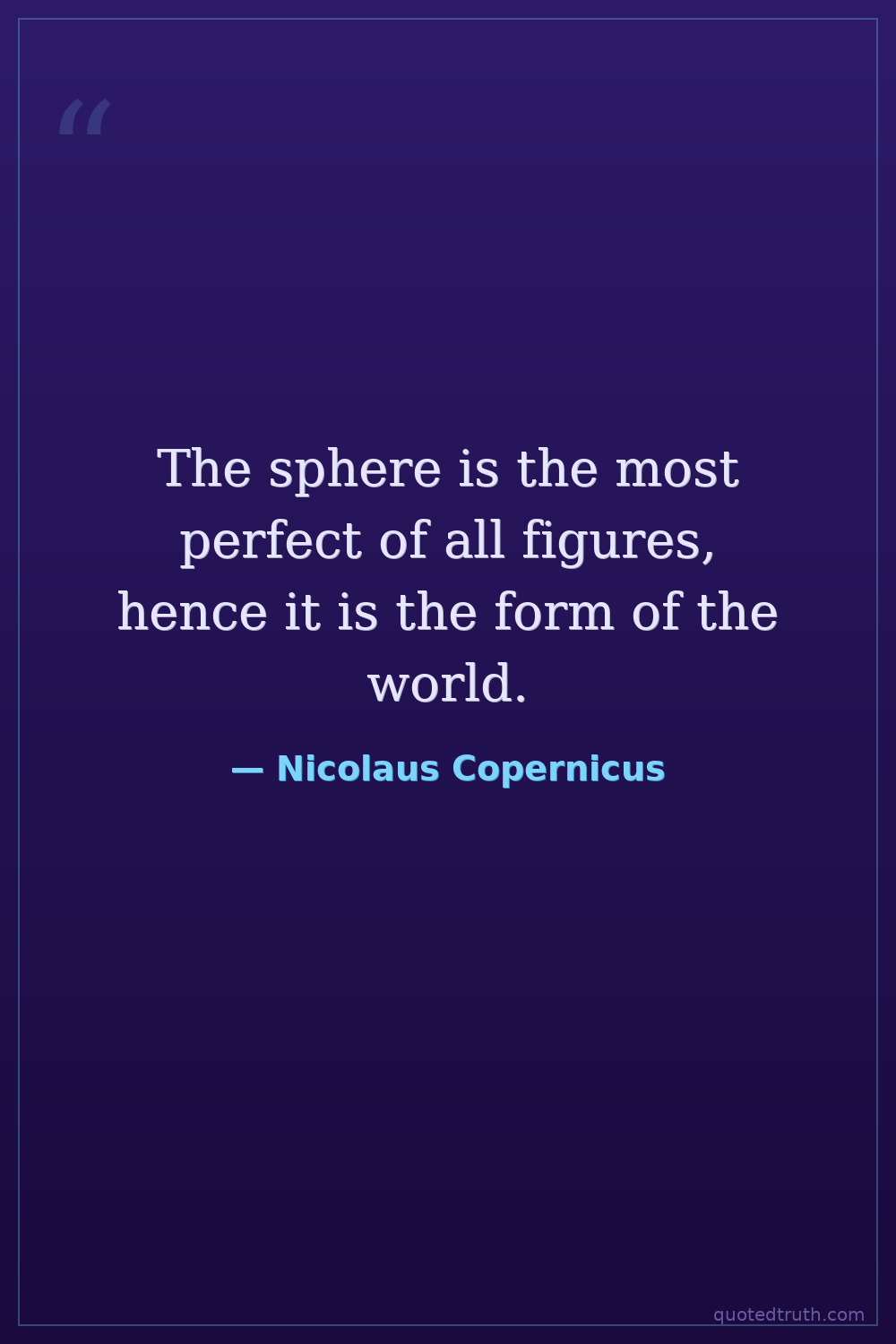
Nicolaus Copernicus — "The sphere is the most perfect of all figures, hence it is the form of the world…"
The sphere is the most perfect of all figures, hence it is the form of the world.
The sphere is the most perfect of all figures, hence it is the form of the world.
Click any product to generate a realistic preview. Up to 3 at a time.
* Initial load can take up to 90 seconds — revising the preview in another color is nearly instant.
"The earth has a spherical shape, for it is bounded on all sides by the circumference of a circle."
"I have been so long in preparing this work that I have almost despaired of publishing it."
"It is not the earth that is the center of the universe, but the sun."
"For the universe, wrought for us by the best and most orderly Workman of all, is a wonderful work."
"To attribute the motion of the earth to the sun is as absurd as to attribute the motion of the sun to the earth."
Found in 1 providers: grok
1 source checked
The sphere represents absolute geometric perfection — no edges, no hierarchy of directions, complete symmetry in every dimension. Copernicus argues that because the universe itself is the grandest possible creation, it must take the most perfect possible shape. This isn't mere aesthetics; it's a logical argument that cosmic form follows from cosmic dignity and order.
Copernicus spent decades meticulously modeling planetary orbits, and spherical geometry was foundational to his heliocentric system. His 1543 De Revolutionibus opens with this geometric conviction. As a trained mathematician and canon, he merged Platonic idealism with astronomical observation, believing mathematical perfection revealed divine design — the sphere wasn't just convenient, it was cosmologically necessary.
Renaissance Europe inherited ancient Greek reverence for perfect geometric forms, particularly from Plato's Timaeus and Aristotle's cosmology. In the early 1500s, the Church-sanctioned Ptolemaic universe placed Earth at the center of crystalline spheres. Copernicus's era assumed cosmic order was divinely geometric; his radical move wasn't rejecting spheres but repositioning what orbited what within that inherited perfect-sphere framework.
AI-generated insights based on extensive research and information for context. Factual errors? Email [email protected].
Your cart is empty