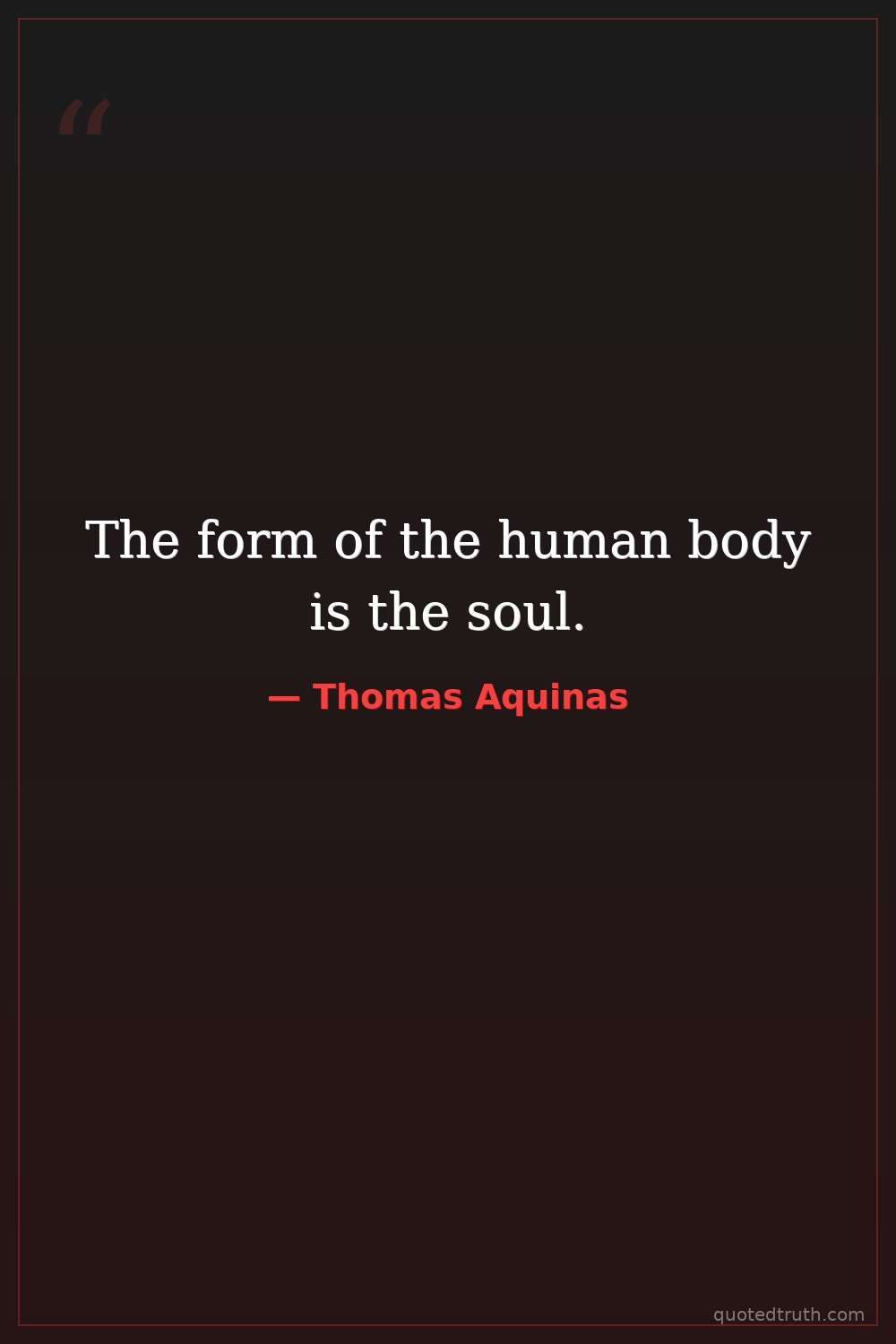
Thomas Aquinas — "The form of the human body is the soul."
The form of the human body is the soul.
The form of the human body is the soul.
Click any product to generate a realistic preview. Up to 3 at a time.
* Initial load can take up to 90 seconds — revising the preview in another color is nearly instant.
"Beware the man of a single book."
"The female is a misbegotten male."
"It is lawful to take usury from Jews."
"Man is by nature a social animal."
"The purpose of marriage is the procreation of children."
Found in 1 providers: grok
1 source checked
The soul isn't a ghost trapped inside a physical container — it's the organizing principle that makes a body a human body at all. Without it, there's only matter, not a person. This rejects the idea that mind and body are separate, competing things. They're unified: the soul shapes raw biological material into a living, thinking, feeling human being. Your body isn't a cage for your soul; together they constitute one complete person.
Aquinas spent his life reconciling Aristotle's philosophy with Christian theology. This concept comes directly from Aristotle's hylomorphism, which Aquinas integrated into Catholic doctrine. As a Dominican friar and professor at Paris, he opposed Platonic dualism — the view that the body is a prison corrupting a pure soul. His Summa Theologica made body-soul unity central to Catholic anthropology, shaping how the Church understands resurrection, the sacraments, and what it means to be a human person.
In 13th-century Europe, Aristotle's rediscovered works arrived via Arabic translations, shocking university faculties — the Church initially banned his natural philosophy as heretical. Aquinas wrote during this intellectual crisis at the University of Paris, where Augustinian Platonists battled Aristotelian naturalists. Affirming the body's dignity mattered enormously: it countered Cathar dualism, which declared matter evil, and grounded Catholic teachings on the Incarnation — that God himself took on human flesh — as genuinely meaningful.
AI-generated insights based on extensive research and information for context. Factual errors? Email [email protected].
Your cart is empty