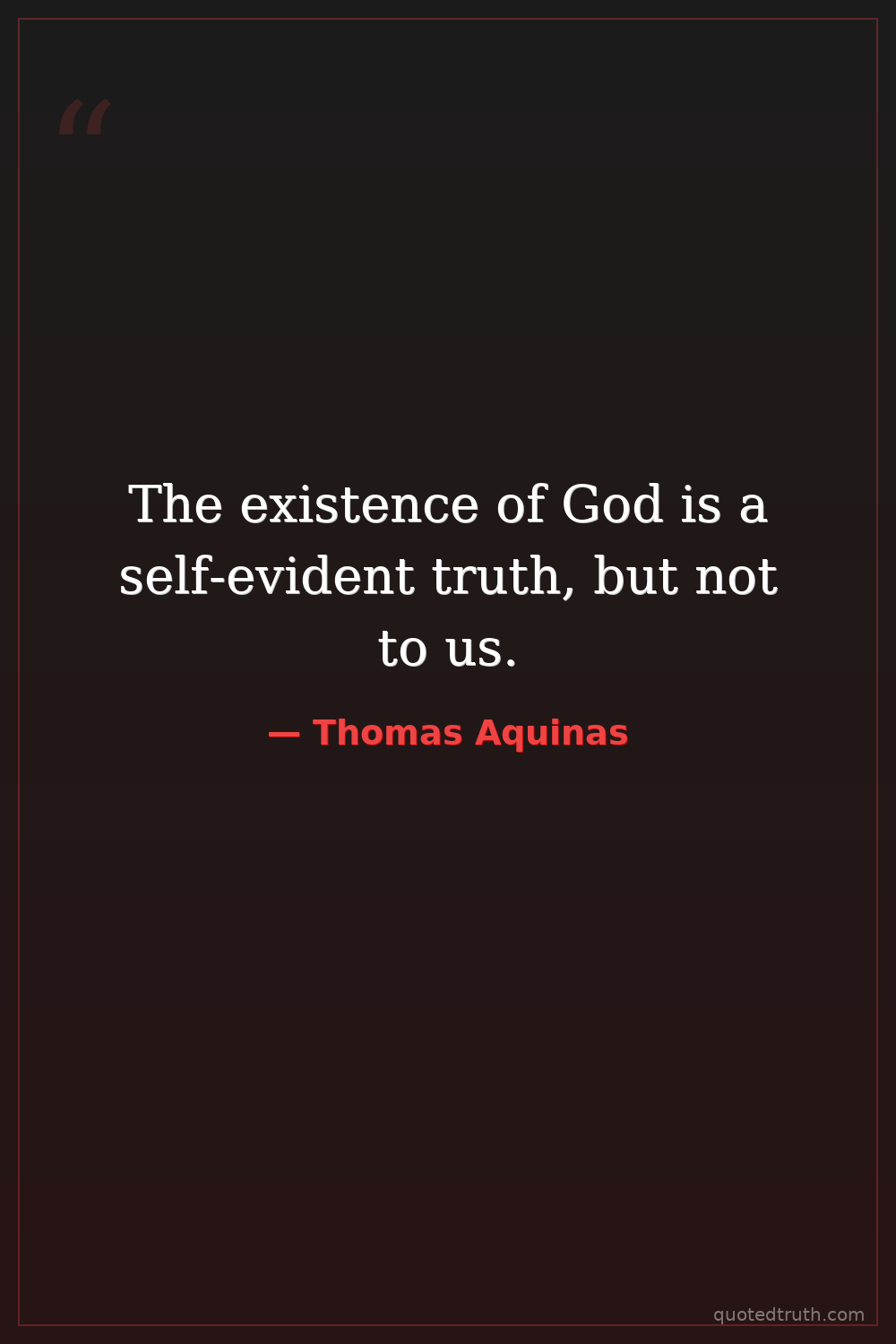
Thomas Aquinas — "The existence of God is a self-evident truth, but not to us."
The existence of God is a self-evident truth, but not to us.
The existence of God is a self-evident truth, but not to us.
Click any product to generate a realistic preview. Up to 3 at a time.
* Initial load can take up to 90 seconds — revising the preview in another color is nearly instant.
"Usury is a sin against justice."
"All that I have written seems like straw to me."
"Strictly speaking, woman is a monster of nature."
"The virtue of chastity is a part of temperance."
"The female is a misbegotten male."
Found in 1 providers: grok
1 source checked
God's existence is self-evident in itself — true by its very nature, requiring no external proof in the absolute sense. But human minds, limited and dependent on sensory experience, cannot perceive this directly. We lack the capacity to grasp God's essence immediately. So while God's existence is objectively necessary and undeniable, we still require logical reasoning and argument to arrive at that conclusion ourselves.
Aquinas, a 13th-century Dominican friar and author of the Summa Theologica, built his entire theological project on reconciling faith with Aristotelian reason. He explicitly rejected Anselm's claim that God's existence is immediately obvious to human intellect, then constructed his famous Five Ways — rational proofs from motion, causation, and contingency. This quote encapsulates his lifelong conviction that reason and revelation together guide us toward truths the mind cannot grasp on its own.
In 13th-century Europe, the Catholic Church held intellectual authority, and Aristotle's rediscovered works — filtered through Islamic scholars like Averroes — were reshaping philosophy. Many feared Aristotelian rationalism threatened faith. Aquinas navigated this tension by insisting God's existence could be demonstrated through reason, not merely asserted through scripture. His distinction between what is self-evident in itself versus to us addressed how a devout, hierarchical Christian society should ground its most fundamental belief.
AI-generated insights based on extensive research and information for context. Factual errors? Email [email protected].
Your cart is empty