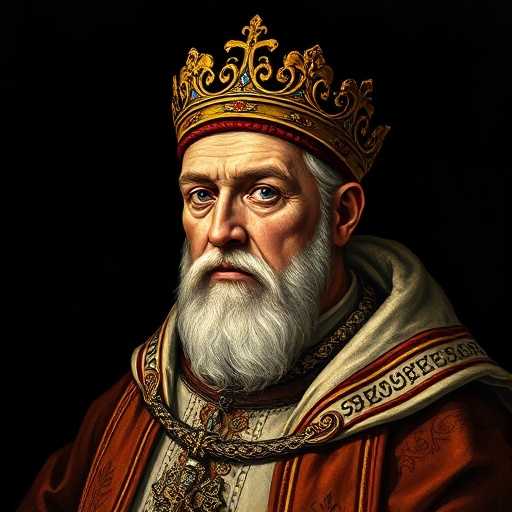
Pope Urban II — "Let this be your war-cry in battle: 'God wills it! God wills it!'"
Let this be your war-cry in battle: 'God wills it! God wills it!'
Let this be your war-cry in battle: 'God wills it! God wills it!'
Click any product to generate a realistic preview. Up to 3 at a time.
* Initial load can take up to 90 seconds — revising the preview in another color is nearly instant.
"Christ commands it."
"They destroy the altars, after having defiled them with their uncleanness. They circumcise the Christians, and the blood of the circumcision they either spread upon the altars or pour into the vases o…"
"All who die by the way, whether by land or by sea, or in battle against the pagans, shall have immediate remission of sins. This I grant them through the power of God with which I am invested."
"Go, therefore, with confidence to the battle of the Lord, knowing that He is with you."
"We desire that you, with all the faithful, should hasten to the aid of the Christians, and strive to deliver them from the hands of the pagans."
Pope (1088-1099) whose Council of Clermont speech (November 1095) launched the First Crusade — the founding event of nine centuries of Christian-Muslim military conflict. Closely associated with Pope Gregory VII (his predecessor on papal-imperial reform). For an intellectual contrast, see Saladin, Kurdish-Muslim Sultan of Egypt and Syria (1138-1193) — Saladin recaptured Jerusalem in 1187, undoing the First Crusade Urban II launched 92 years earlier. Saladin's chivalrous treatment of Christian prisoners became the canonical Muslim counter-image to Crusader brutality. The cleanest before/after pairing of the Crusades' moral arc.
Found in 1 providers: grok
1 source checked
A call to subordinate personal will entirely to divine command, transforming violence into sacred duty. The speaker urges combatants to silence doubt, fear, and self-interest by framing their actions as direct execution of God's wish—making refusal seem like defiance of heaven itself. The phrase functions as both motivational slogan and moral absolution, collapsing the distance between human decision and divine authorization.
Urban II uttered these exact words at the Council of Clermont in 1095, launching the First Crusade. As pope, his authority derived from claiming to speak for God on earth, making this cry the ultimate expression of his office. He wielded spiritual power to mobilize military force, recasting warfare as pilgrimage and soldiers as instruments of divine providence—the defining act of his entire papacy.
In 1095, the Seljuk Turks had seized Jerusalem and threatened Constantinople. Medieval Christendom understood history as God's unfolding plan, making holy war theologically coherent, not contradictory. Feudal knights needed religious legitimation for violence; the Church needed to redirect internecine European warfare outward. Urban's cry fused those pressures, birthing the crusading movement that would define Christian-Muslim relations for centuries.
AI-generated insights based on extensive research and information for context. Factual errors? Email [email protected].
Your cart is empty