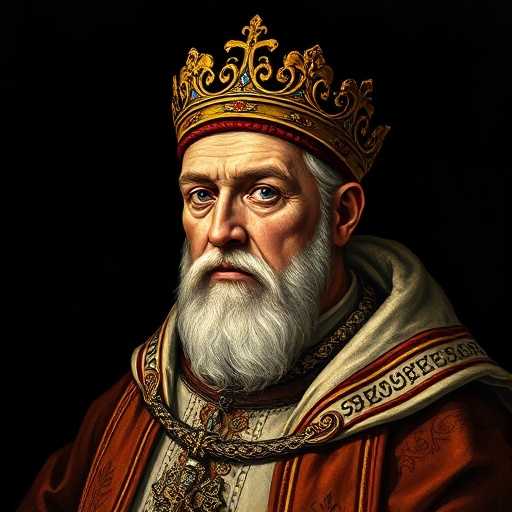
Pope Urban II — "Christ commands it."
Christ commands it.
Christ commands it.
Click any product to generate a realistic preview. Up to 3 at a time.
* Initial load can take up to 90 seconds — revising the preview in another color is nearly instant.
"The Most High has chosen you for this glorious task."
"Oh, how admirable is that salting! Truly, you must strive by the salt of wisdom to correct these foolish people, hastening open-mouthed after the pleasures of this world, lest putrefied by sins and un…"
"You are called shepherds; see that you do not act as hirelings. But be true shepherds, with your crooks always in your hands. Do not go to sleep, but guard on all sides the flock committed to you. For…"
"Let those who have been hired for a few pieces of silver now receive an eternal reward."
"The Turks, a race of Persians, have taken the Holy Land; they circumcise Christians and pour the blood from the circumcision on the altars or into baptismal fonts."
Pope (1088-1099) whose Council of Clermont speech (November 1095) launched the First Crusade — the founding event of nine centuries of Christian-Muslim military conflict. Closely associated with Pope Gregory VII (his predecessor on papal-imperial reform). For an intellectual contrast, see Saladin, Kurdish-Muslim Sultan of Egypt and Syria (1138-1193) — Saladin recaptured Jerusalem in 1187, undoing the First Crusade Urban II launched 92 years earlier. Saladin's chivalrous treatment of Christian prisoners became the canonical Muslim counter-image to Crusader brutality. The cleanest before/after pairing of the Crusades' moral arc.
Found in 1 providers: grok
1 source checked
"Christ commands it" asserts that an action carries divine obligation—not personal choice, not political calculation, but a direct order from God. It removes doubt, silences dissent, and transforms participants from volunteers into obedient servants of a higher will. In modern terms, it's the ultimate appeal to religious authority: whatever follows isn't yours to question. It unites a crowd under shared divine duty and makes refusal feel like disobedience to God himself.
Urban II delivered this mandate at the Council of Clermont in 1095, where crowds erupted with "Deus vult!"—God wills it. As a Cluniac monk turned pope, he was formed by the belief that the Church mediated divine will on earth. Framing the Crusade as Christ's direct command was both theologically sincere and politically shrewd: it elevated his call above any secular authority, compelling knights and kings to obey the vicar of Christ rather than weigh personal cost.
In 1095, Jerusalem had been under Muslim rule for centuries, Byzantine Christianity was buckling under Seljuk pressure, and the 1054 Great Schism had fractured Christendom. European knights were a restless, violent class seeking spiritual purpose. Pilgrimage routes were disrupted. Invoking Christ's direct command cut through feudal loyalties, ecclesiastical politics, and personal hesitation simultaneously, granting the Crusade a sacred legitimacy no pope, king, or emperor could claim through purely temporal authority alone.
AI-generated insights based on extensive research and information for context. Factual errors? Email [email protected].
Your cart is empty