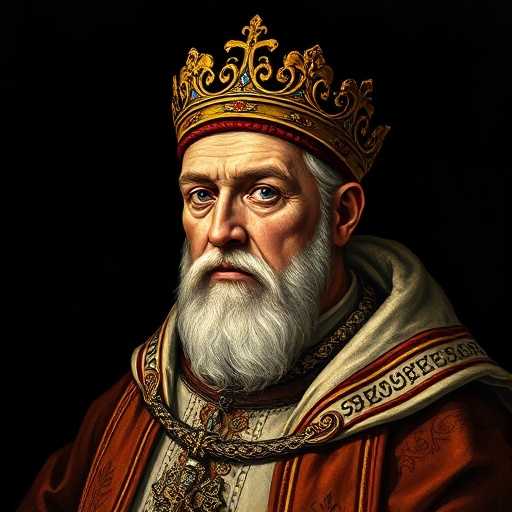
Pope Urban II — "Let those who have been accustomed to fight for a little gain against Christians…"
Let those who have been accustomed to fight for a little gain against Christians, now fight for an eternal reward against the infidels.
Let those who have been accustomed to fight for a little gain against Christians, now fight for an eternal reward against the infidels.
Click any product to generate a realistic preview. Up to 3 at a time.
* Initial load can take up to 90 seconds — revising the preview in another color is nearly instant.
"The Most High has chosen you for this glorious task."
"Go forth, therefore, and fear not; for the Lord God of hosts will be with you."
"Oh, what a disgrace if such a despised and base race, which worships demons, should conquer a people which has the faith of omnipotent God and has been made glorious with the name of Christ!"
"Christ commands it."
"Warriors who hear my voice, you who will go to war, rejoice, because you are taking up a legitimate war… Arm yourselves with the sword of the Maccabees and go to defend the house of Israel who is the …"
Pope (1088-1099) whose Council of Clermont speech (November 1095) launched the First Crusade — the founding event of nine centuries of Christian-Muslim military conflict. Closely associated with Pope Gregory VII (his predecessor on papal-imperial reform). For an intellectual contrast, see Saladin, Kurdish-Muslim Sultan of Egypt and Syria (1138-1193) — Saladin recaptured Jerusalem in 1187, undoing the First Crusade Urban II launched 92 years earlier. Saladin's chivalrous treatment of Christian prisoners became the canonical Muslim counter-image to Crusader brutality. The cleanest before/after pairing of the Crusades' moral arc.
Found in 1 providers: grok
1 source checked
This redirects the violent habits of European warriors away from fighting fellow Christians toward a declared holy war. It reframes combat as a spiritual transaction: petty earthly gains earned through civil fighting are worthless compared to the eternal salvation promised for fighting in God's name. The message is pointed—your capacity for violence has worth, but only when aimed at the right enemy. Heaven, not plunder, becomes the incentive.
Urban II preached these words at the Council of Clermont in November 1095, launching the First Crusade. As pope, he had spent years battling endemic feudal violence through the Church's Peace of God movement, which tried limiting when and against whom knights could fight. He believed channeling that warrior energy toward liberating Jerusalem could serve God and earn soldiers remission of sins—combining his role as spiritual authority with practical geopolitical strategy.
By 1095, Western Europe's feudal knights spent most of their time fighting each other over land—the Church had tried and largely failed to contain this through the Peace of God movement. The Byzantine Empire was crumbling under Seljuk Turkish pressure, and Jerusalem had been under Muslim rule for over 400 years. Urban's speech transformed this surplus of trained, landless violence into a papally sanctioned military expedition, offering spiritual indulgences to those who took up the cross.
AI-generated insights based on extensive research and information for context. Factual errors? Email [email protected].
Your cart is empty