What it means
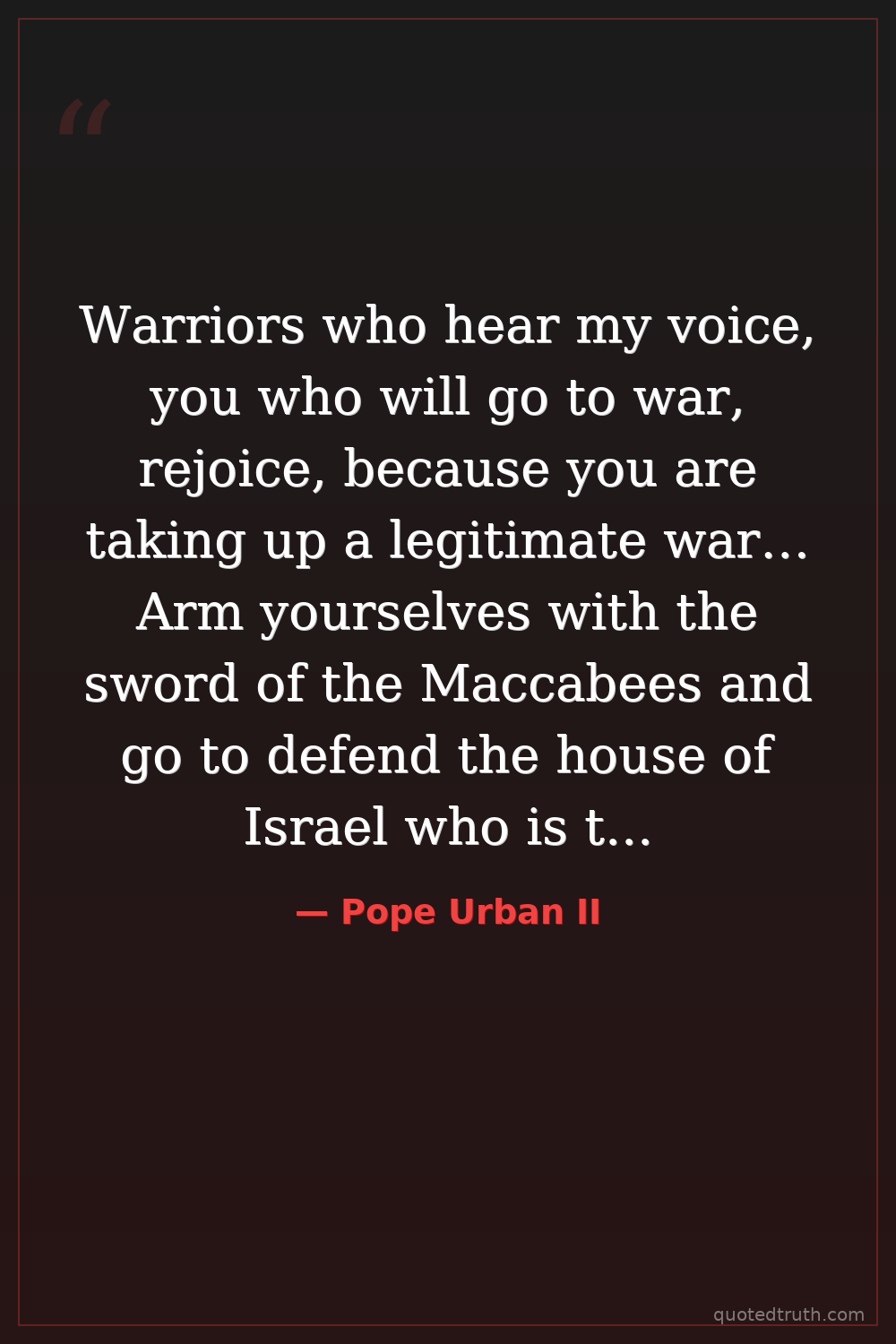
This is a rallying cry framing military conquest as divinely sanctioned obligation. Urban tells warriors their campaign is morally legitimate — not pillage but sacred defense. By invoking the Maccabees, ancient Jewish heroes who reclaimed Jerusalem's Temple, he draws a direct parallel: Crusaders are the new liberators of God's holy city. The image of Jerusalem as 'daughter of the Lord of Armies' transforms violent conquest into an act of familial, protective duty.
Relevance to Pope Urban II
Urban II spent years as a Cluniac monk before becoming pope, giving him deep scriptural fluency. His invocation of the Maccabees reveals careful theological craftsmanship — he knew his audience revered these Jewish warrior-martyrs. As a reform pope fighting the Investiture Controversy, he needed unambiguous moral authority. The phrase 'legitimate war' echoes Augustinian just-war doctrine he deliberately deployed to override church prohibitions against Christian-on-Christian violence and redirect that energy outward.
The era
By 1095, Seljuk Turks had seized Jerusalem and crushed Byzantine armies at Manzikert in 1071. Emperor Alexios I pleaded with Rome for military aid. European knights, trained for war but constrained by the Church's Peace of God edicts against internal feuding, needed redirection. Crusading offered the perfect synthesis: warrior culture legitimized by religious purpose. The Maccabees reference held special resonance — medieval Christians viewed them as the founding archetype of righteous holy warfare.
AI-generated insights based on extensive research and information for context. Factual errors? Email [email protected].