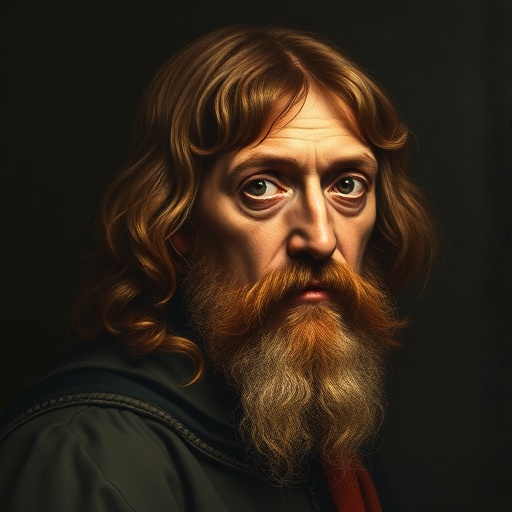
Nicolaus Copernicus — "For it is the duty of an astronomer to compose the history of the celestial moti…"
For it is the duty of an astronomer to compose the history of the celestial motions from a careful and skillful study of the observations.
For it is the duty of an astronomer to compose the history of the celestial motions from a careful and skillful study of the observations.
Click any product to generate a realistic preview. Up to 3 at a time.
* Initial load can take up to 90 seconds — revising the preview in another color is nearly instant.
"For, when a ship is floating calmly on a smooth sea, and the mariners are thinking of nothing but the voyage, if a sudden storm should strike it, and the ship should be driven by the wind, it is not t…"
"For it is clear that the earth performs a double motion: one about its axis, and another about the sun."
"The movements of the heavens are an ordered dance, and the Earth is a participant in this dance."
"There may be babblers, wholly ignorant of mathematics, who dare to condemn my hypothesis, upon the authority of some part of the Bible twisted to suit their purpose. I value them not, and scorn their …"
"Perhaps there will be babblers who, although completely ignorant of mathematics, nevertheless dare to pass judgment on these things, and because of some passage in Holy Scripture, want to distort my b…"
Found in 1 providers: grok
1 source checked
An astronomer's core responsibility is building an accurate account of how celestial bodies move, grounded in meticulous, expert observation rather than speculation or inherited assumption. Truth about the heavens must be earned through disciplined, skilled study of what is actually seen and recorded, not simply accepted from authority or philosophical tradition.
Copernicus spent decades meticulously observing planetary positions before publishing his heliocentric theory in De Revolutionibus (1543). He rejected Ptolemaic inherited dogma not through philosophy alone but through careful data analysis, demonstrating precisely this principle. His Canon law career funded private astronomical work, making disciplined, evidence-based inquiry his personal standard against ecclesiastical and academic pressure.
In the early modern period, astronomical knowledge still rested heavily on Ptolemy's ancient geocentric model, transmitted through medieval scholasticism. The printing press enabled wider circulation of observational data, while Renaissance humanism encouraged returning to primary sources. Copernicus wrote amid tension between Church authority and emerging empirical methodology, making the call for observation-grounded history of celestial motion quietly revolutionary.
AI-generated insights based on extensive research and information for context. Factual errors? Email [email protected].
Your cart is empty