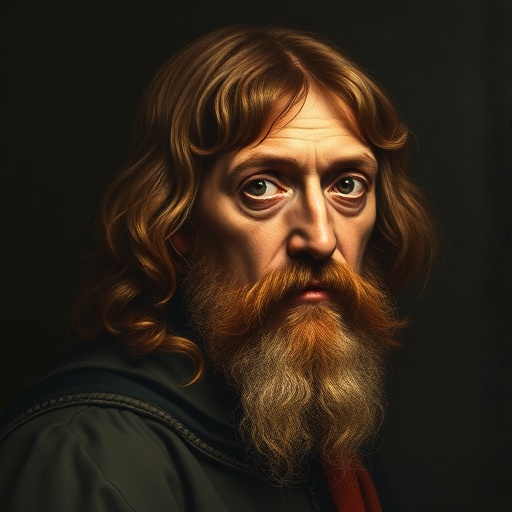
Nicolaus Copernicus — "The celestial sphere is finite and spherical."
The celestial sphere is finite and spherical.
The celestial sphere is finite and spherical.
Click any product to generate a realistic preview. Up to 3 at a time.
* Initial load can take up to 90 seconds — revising the preview in another color is nearly instant.
"The Sun is the center of the universe, and all the planets revolve around it."
"It is clear that the earth also moves in a similar manner, and describes an annual course."
"For it is the work of a good mathematician to compute the motions of the heavenly bodies, and to predict their positions at any given time."
"Indeed, I am aware that a philosopher's thoughts are far removed from the judgment of the multitude, for his aim is to seek the truth in all things, to the extent permitted to human reason by God."
"Therefore, we should not be surprised if the earth moves, for it is a planet, and all planets move."
Found in 1 providers: grok
1 source checked
The universe has a definite outer boundary and takes the shape of a sphere — the most geometrically perfect form. Nothing extends infinitely; the cosmos is bounded and orderly. This reflects the ancient belief that finite structure and spherical form signify perfection and divine design. The infinite was philosophically troubling, even impossible — the universe had a shell, an edge, a definable shape that reason and mathematics could describe.
Copernicus, a Polish canon and astronomer trained in the Aristotelian-Ptolemaic tradition, preserved the finite spherical cosmos even in his landmark *De Revolutionibus* (1543), where he displaced Earth from the universe's center. Revolutionary in repositioning the Sun, he remained faithful to classical geometry. His heliocentrism was radical — but sphere and boundary remained non-negotiable truths he never questioned, showing how partial a revolution his was.
During Copernicus's era, European cosmology followed Aristotle and Ptolemy: a finite universe of nested crystalline spheres with Earth at the center. The Catholic Church institutionalized this model as theologically sound. Humanist scholarship was reviving ancient Greek texts, intensifying debates about nature and creation. In this climate, asserting a finite spherical cosmos was entirely orthodox — what Copernicus dared change was only which body occupied its center.
AI-generated insights based on extensive research and information for context. Factual errors? Email [email protected].
Your cart is empty