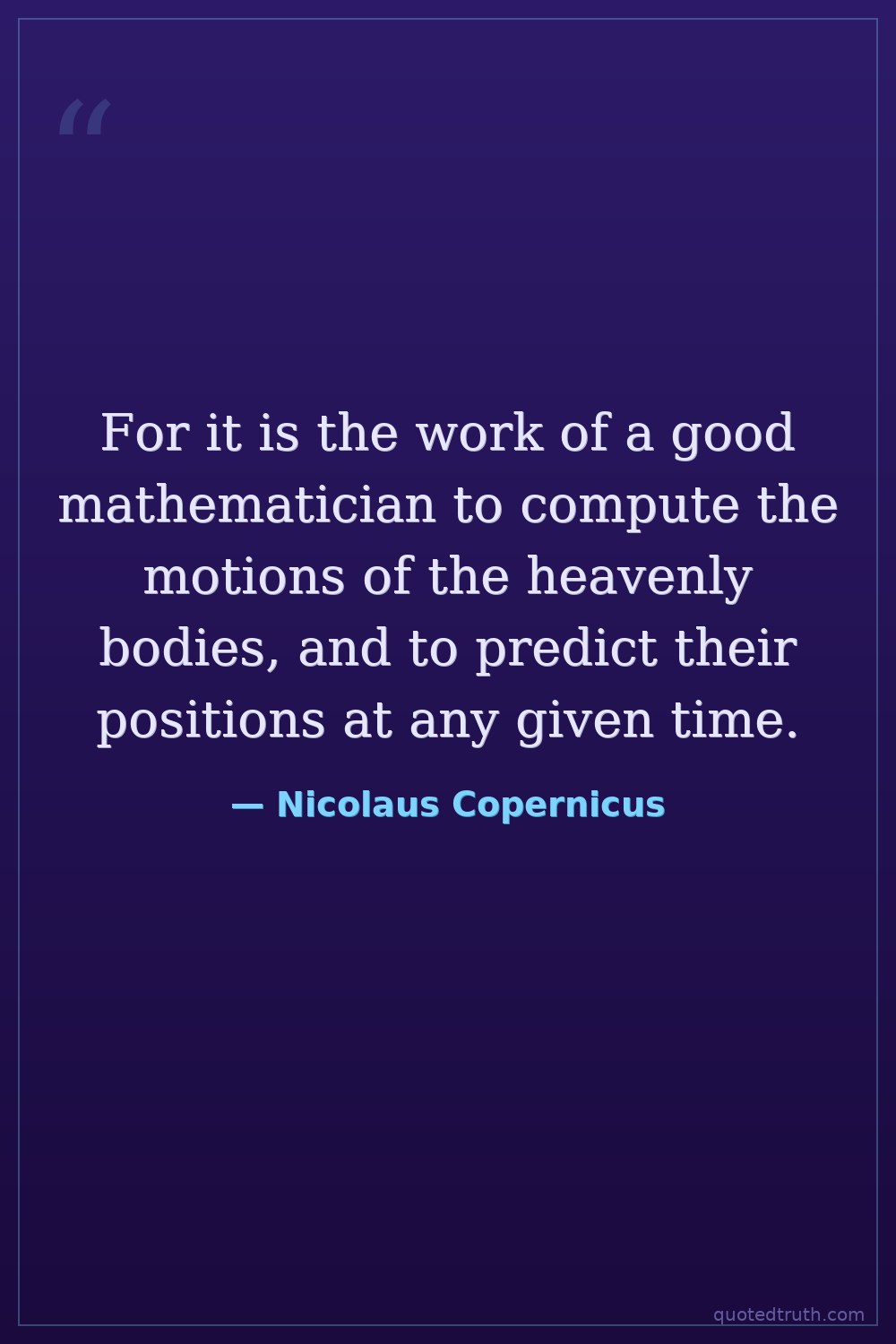
Nicolaus Copernicus — "For it is the work of a good mathematician to compute the motions of the heavenl…"
For it is the work of a good mathematician to compute the motions of the heavenly bodies, and to predict their positions at any given time.
For it is the work of a good mathematician to compute the motions of the heavenly bodies, and to predict their positions at any given time.
Click any product to generate a realistic preview. Up to 3 at a time.
* Initial load can take up to 90 seconds — revising the preview in another color is nearly instant.
"The earth has a spherical shape, for it is bounded on all sides by the circumference of a circle."
"The difficulty of the task, and the novelty of the opinion, almost deterred me from publishing the work."
"So, since there are many places in the Sacred Scriptures where the sun is mentioned as moving, and the earth as standing still, these people will hold that I have contradicted the Holy Scriptures."
"The world is spherical; whether it is finite or infinite is an open question."
"For it is manifest that the movements of the planets are not uniform, but sometimes faster, sometimes slower, sometimes direct, sometimes retrograde."
Found in 1 providers: grok
1 source checked
A skilled mathematician's true purpose is to calculate how celestial bodies move and accurately forecast where they will appear at any future moment. This defines mathematical astronomy not as passive observation but as active, predictive computation — turning raw data into reliable foresight about the cosmos.
Copernicus spent decades painstakingly computing planetary positions using trigonometry and geometric models. His masterwork, De revolutionibus, was fundamentally a mathematical treatise filled with tables predicting planetary motion. He saw himself primarily as a mathematician rescuing astronomy from accumulated errors, not merely a philosopher speculating about the universe's structure.
In the early 16th century, European astronomy still relied on Ptolemy's ancient geocentric tables, which had grown increasingly inaccurate over 1,400 years. Church calendars, navigation, and astrology all depended on planetary predictions. Copernicus wrote amid urgent demand for calendar reform — the Julian calendar's errors were visibly mounting — making precise celestial computation a pressing practical and religious necessity.
AI-generated insights based on extensive research and information for context. Factual errors? Email [email protected].
Your cart is empty