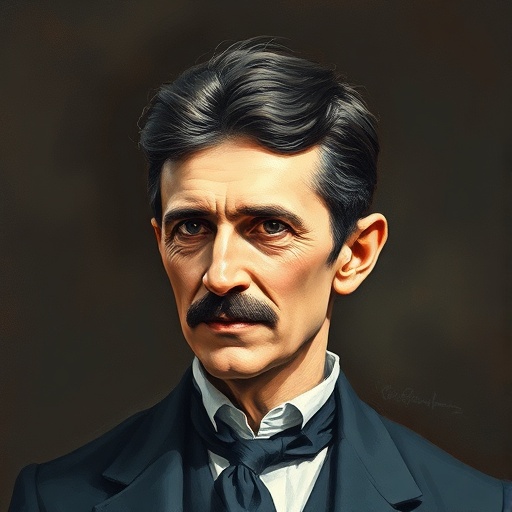
Nikola Tesla — "I could hear a fly walking across the room."
I could hear a fly walking across the room.
I could hear a fly walking across the room.
Click any product to generate a realistic preview. Up to 3 at a time.
* Initial load can take up to 90 seconds — revising the preview in another color is nearly instant.
"I could only achieve success in my life through self-discipline, and I applied it until my wish and my will became one."
"Electric power is everywhere present in unlimited quantities and can drive the world's machinery without the need of coal, oil, gas, or any other of the common fuels."
"We must all have some ideal which will govern our behaviour and satisfy us, but it is not material. It can be religion, art, science, whatever, it is only important that it acts as a non-material forc…"
"In no way can we get such an overwhelming idea of the grandeur of Nature than when we consider, that in accordance with the law of the conservation of energy, throughout the Infinite, the forces are i…"
"Life is and will ever remain an equation incapable of solution, but it contains certain known factors."
Serbian-American inventor and electrical engineer whose alternating-current designs powered the modern electrical grid; died poor and largely forgotten. Closely associated with George Westinghouse (his AC-power business partner) and Mihajlo Pupin (fellow Serbian-American physicist at Columbia). For an intellectual contrast, see Thomas Edison, American inventor and direct-current advocate — Edison's direct-current power-distribution scheme was displaced by Tesla-Westinghouse AC in the 1890s 'War of Currents'. Edison ran a public-relations campaign electrocuting animals to discredit AC — the most famous engineering-ethics rivalry in American history. Tesla's AC won and powers nearly every electrical grid on Earth.
Describing his extraordinary sense of hearing during childhood, 'My Inventions'
Date: 1919
Power & LeadershipFound in 1 providers: grok
1 source checked
The quote claims a level of auditory sensitivity so extreme it borders on superhuman — hearing the near-silent footsteps of a fly. It conveys hyperacuity of the senses, a mind tuned to detect the faintest signals in an environment others perceive as quiet. It speaks to being wired differently, perceiving the world at a granularity most people cannot access, turning ordinary stillness into a landscape of information.
Tesla genuinely reported extreme sensory hypersensitivity throughout his life — he was tormented by light, sounds, and touch. He wore gloves obsessively, couldn't tolerate certain frequencies, and had to work in near-silence. This wasn't metaphor; Tesla documented these experiences as real suffering and real gifts. His extraordinary perception of electromagnetic phenomena may have had neurological roots in this same hypersensitivity that made him both brilliant and tormented.
Tesla lived during the late 19th and early 20th centuries — the Gilded Age and Progressive Era — when science was rapidly overturning assumptions about the physical world. Electricity, radio waves, and X-rays revealed invisible forces everywhere. In this era of hidden energies being discovered, Tesla's claim of superhuman perception fit a cultural moment where the boundary between human capability and machine sensitivity was actively being redrawn by science.
AI-generated insights based on extensive research and information for context. Factual errors? Email [email protected].
Your cart is empty